
Catalogue Search | MBRL


Are you sure you want to remove the book from the shelf?

{{itemTitle}}
269
result(s) for
"Computer scientists Biography."
Sort by:

Computer science
Provides information on African-American computer scientists that have added to the worlds knowledge in writing software, doing pioneering work in artificial intelligence, developing powerful new silicon chips, and guiding new tech companies.
Book
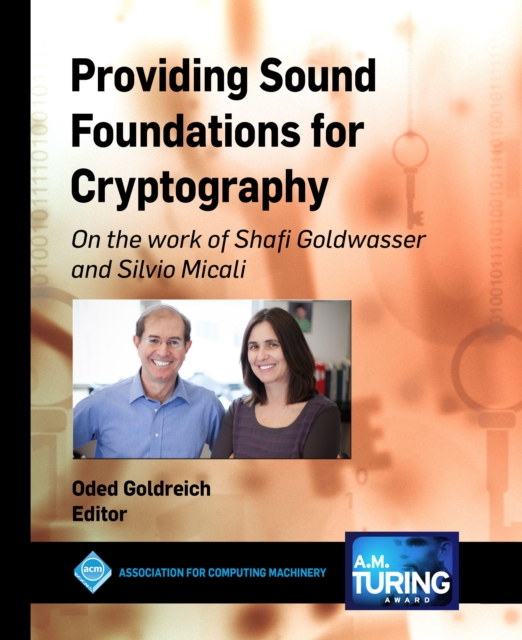
Providing Sound Foundations for Cryptography
Cryptography is concerned with the construction of schemes that withstand any abuse. A cryptographic scheme is constructed so as to maintain a desired functionality, even under malicious attempts aimed at making it deviate from its prescribed behavior. The design of cryptographic systems must be based on firm foundations, whereas ad hoc approaches and heuristics are a very dangerous way to go. These foundations were developed mostly in the 1980s, in works that are all co-authored by Shafi Goldwasser and/or Silvio Micali. These works have transformed cryptography from an engineering discipline, lacking sound theoretical foundations, into a scientific field possessing a well-founded theory, which influences practice as well as contributes to other areas of theoretical computer science. This book celebrates these works, which were the basis for bestowing the 2012 A.M. Turing Award upon Shafi Goldwasser and Silvio Micali. A significant portion of this book reproduces some of these works, and another portion consists of scientific perspectives by some of their former students. The highlight of the book is provided by a few chapters that allow the readers to meet Shafi and Silvio in person. These include interviews with them, their biographies and their Turing Award lectures.
eBook


Edmund Berkeley and the Social Responsibility of Computer Professionals
This book is the first full-length biography of Edmund Berkeley, a computer pioneer and social activist who has been called \"the conscience of the computer industry.\" Through his work with other early computer developers, he became aware of the potential dangers of these machines to society at large. He believed that computer developers had an obligation to address the complex social problems facing a Cold War world; the threat of suicidal nuclear war and the ethics of computer professionals using their expertise to build self-guided weapons systems. This is an historical narrative of a man ultimately in favor of engineering peace, instead of war, and how his career was ultimately damaged by politicians determined to portray him as a Communist sympathizer. Berkeley's life work provides a lens to understand social and political issues surrounding the early development of electronic computers which ties directly to current debates about the use of autonomous intelligent systems. This entertaining biography offers a humanistic approach to understanding technology and society via the successes and trials of Edmund Berkeley, a founding member of the Association of Computing Machinery (ACM). Telling Berkeley's story provides a more nuanced and dimensional picture of how the computers we use today came into being and why we ask the questions we do about our relationships with them. It explores ways in which Berkeley's life illuminates issues we still deal with regarding the social responsibilities of computer developers and human-computer relationships.
eBook

The innovators : how a group of hackers, geniuses, and geeks created the digital revolution
\"Following his blockbuster biography of Steve Jobs, The Innovators is Walter Isaacson's revealing story of the people who created the computer and the Internet. It is destined to be the standard history of the digital revolution and an indispensable guide to how innovation really happens. What were the talents that allowed certain inventors and entrepreneurs to turn their visionary ideas into disruptive realities? What led to their creative leaps? Why did some succeed and others fail? In his masterly saga, Isaacson begins with Ada Lovelace, Lord Byron's daughter, who pioneered computer programming in the 1840s. He explores the fascinating personalities that created our current digital revolution, such as Vannevar Bush, Alan Turing, John von Neumann, J.C.R. Licklider, Doug Engelbart, Robert Noyce, Bill Gates, Steve Wozniak, Steve Jobs, Tim Berners-Lee, and Larry Page. This is the story of how their minds worked and what made them so inventive. It's also a narrative of how their ability to collaborate and master the art of teamwork made them even more creative. For an era that seeks to foster innovation, creativity, and teamwork, The Innovators shows how they happen\"-- Provided by publisher.
Book

Concurrency
This book is a celebration of Leslie Lamport's work on concurrency, interwoven in four-and-a-half decades of an evolving industry: from the introduction of the first personal computer to an era when parallel and distributed multiprocessors are abundant. His works lay formal foundations for concurrent computations executed by interconnected computers. Some of the algorithms have become standard engineering practice for fault tolerant distributed computing - distributed systems that continue to function correctly despite failures of individual components. He also developed a substantial body of work on the formal specification and verification of concurrent systems, and has contributed to the development of automated tools applying these methods. Part I consists of technical chapters of the book and a biography. The technical chapters of this book present a retrospective on Lamport's original ideas from experts in the field. Through this lens, it portrays their long-lasting impact. The chapters cover timeless notions Lamport introduced: the Bakery algorithm, atomic shared registers and sequential consistency; causality and logical time; Byzantine Agreement; state machine replication and Paxos; temporal logic of actions (TLA). The professional biography tells of Lamport's career, providing the context in which his work arose and broke new grounds, and discusses LaTeX - perhaps Lamport's most influential contribution outside the field of concurrency. This chapter gives a voice to the people behind the achievements, notably Lamport himself, and additionally the colleagues around him, who inspired, collaborated, and helped him drive worldwide impact. Part II consists of a selection of Leslie Lamport's most influential papers. This book touches on a lifetime of contributions by Leslie Lamport to the field of concurrency and on the extensive influence he
had on people working in the field. It will be of value to historians of science, and to researchers and students who work in the area of concurrency and who are interested to read about the work of one of the most influential researchers in this field.
eBook

The Innovators : How a Group of Inventors, Hackers, Geniuses and Geeks Created the Digital Revolution
Following his blockbuster biography of Steve Jobs, The Innovators is Walter Isaacson's story of the people who created the computer and the Internet. It is destined to be the standard history of the digital revolution and a guide to how innovation really works. What talents allowed certain inventors and entrepreneurs to turn their disruptive ideas into realities? What led to their creative leaps? Why did some succeed and others fail? In his exciting saga, Isaacson begins with Ada Lovelace, Lord Byron's daughter, who pioneered computer programming in the 1840s. He then explores the fascinating personalities that created our current digital revolution, such as Vannevar Bush, Alan Turing, John von Neumann, J.C.R. Licklider, Doug Engelbart, Robert Noyce, Bill Gates, Steve Wozniak, Steve Jobs, Tim Berners-Lee and Larry Page. This is the story of how their minds worked and what made them so creative. It's also a narrative of how their ability to collaborate and master the art of teamwork made them even more creative. For an era that seeks to foster innovation, creativity and teamwork, this book shows how they actually happen.

Quantifying and contextualizing the impact of bioRxiv preprints through automated social media audience segmentation
Engagement with scientific manuscripts is frequently facilitated by Twitter and other social media platforms. As such, the demographics of a paper's social media audience provide a wealth of information about how scholarly research is transmitted, consumed, and interpreted by online communities. By paying attention to public perceptions of their publications, scientists can learn whether their research is stimulating positive scholarly and public thought. They can also become aware of potentially negative patterns of interest from groups that misinterpret their work in harmful ways, either willfully or unintentionally, and devise strategies for altering their messaging to mitigate these impacts. In this study, we collected 331,696 Twitter posts referencing 1,800 highly tweeted bioRxiv preprints and leveraged topic modeling to infer the characteristics of various communities engaging with each preprint on Twitter. We agnostically learned the characteristics of these audience sectors from keywords each user's followers provide in their Twitter biographies. We estimate that 96% of the preprints analyzed are dominated by academic audiences on Twitter, suggesting that social media attention does not always correspond to greater public exposure. We further demonstrate how our audience segmentation method can quantify the level of interest from nonspecialist audience sectors such as mental health advocates, dog lovers, video game developers, vegans, bitcoin investors, conspiracy theorists, journalists, religious groups, and political constituencies. Surprisingly, we also found that 10% of the preprints analyzed have sizable (>5%) audience sectors that are associated with right-wing white nationalist communities. Although none of these preprints appear to intentionally espouse any right-wing extremist messages, cases exist in which extremist appropriation comprises more than 50% of the tweets referencing a given preprint. These results present unique opportunities for improving and contextualizing the public discourse surrounding scientific research.
Journal Article

The innovators : how a group of hackers, geniuses, and geeks created the digital revolution
\"Following his blockbuster biography of Steve Jobs, The Innovators is Walter Isaacson's revealing story of the people who created the computer and the Internet. It is destined to be the standard history of the digital revolution and an indispensable guide to how innovation really happens. What were the talents that allowed certain inventors and entrepreneurs to turn their visionary ideas into disruptive realities? What led to their creative leaps? Why did some succeed and others fail? In his masterly saga, Isaacson begins with Ada Lovelace, Lord Byron's daughter, who pioneered computer programming in the 1840s. He explores the fascinating personalities that created our current digital revolution, such as Vannevar Bush, Alan Turing, John von Neumann, J.C.R. Licklider, Doug Engelbart, Robert Noyce, Bill Gates, Steve Wozniak, Steve Jobs, Tim Berners-Lee, and Larry Page. This is the story of how their minds worked and what made them so inventive. It's also a narrative of how their ability to collaborate and master the art of teamwork made them even more creative. For an era that seeks to foster innovation, creativity, and teamwork, The Innovators shows how they happen\"-- Provided by publisher.
Book
