
Catalogue Search | MBRL


Are you sure you want to remove the book from the shelf?

{{itemTitle}}
83
result(s) for
"Computer software developers United States."
Sort by:

Space engineer and scientist Margaret Hamilton
\"Margaret Hamilton wrote the computer software that helped humans land on the moon. Learn about Hamilton's fascinating career, including her role in the moon landing.\"-- Provided by publisher.
Book

No Vision All Drive
Intro -- No Vision All Drive -- Contents -- Foreword, Third Edition -- Foreword, First and Second Editions -- Introduction -- Prelude -- The Birth of a Company -- Chapter 1 Learning to Be an Entrepreneur -- The Quebec Department of Transportation -- TransControl -- DWC/ADS -- Gainesville -- Miami -- STS -- The Orlando Center -- The Syracuse Center -- The Miami Center -- David Cohen -- Eran -- Bob Durkin -- Managing the Miami Center -- Hurricane Andrew -- Living in Miami -- Selling EMTrack -- SkyWire and Vendview -- Chapter 2 The Idea for Pinpoint -- December 7, 1993 -- The Early RightWith Years -- Moving Away -- TransCare -- Chapter 3 The Early Years -- Funding -- RightWith's First Office -- Preparing for Beta -- Choosing Where to Live -- The 0th User Conference -- Chapter 4 Becoming a Real Company -- From RightWith to Pinpoint Technologies -- Moving to Boulder -- Beta -- Pinpoint's Second Office -- David and Eran Arrive from Phoenix -- Indy 500, Reliable, and David's Wedding -- Bob Durkin Becomes a Partner -- Getting AID Right -- Our First Sale -- Our First Trade Show -- Zebeth Parks, the Voice of RightCAD -- John Stapleton Arrives -- Pinpoint's Culture -- Our Second Sale -- Clemente, RAM, and Jennifer Jones -- Our Second Boulder Office -- User Conferences -- Core Beliefs -- Chapter 5 Growing Up -- Pinpoint on a Roll -- Sweet Computer Services -- TransCare -- Going International -- Working with a Distributor -- Chapter 6 A Personal Milestone -- Chapter 7 Growing the Company -- Buying a Building -- Integrated Management Solutions -- Exit Strategies -- Chapter 8 The Sale to ZOLL -- Chapter 9 The ZOLL Years -- ResponseOne -- Pinpoint Takes a Dive -- Chapter 10 Why End It? -- The New Guy -- Looking Back -- What I Learned about Vision, Strategy, and Execution -- What's Next? -- Chapter 11 After Pinpoint -- iContact -- Angel Investing.
Book

Margaret and the moon : how Margret Hamilton saved the first lunar landing
\"Margaret Hamilton loved numbers as a young girl. She knew how many miles it was to the moon (and how many back). She loved studying algebra and geometry and calculus and using math to solve problems in the outside world. Soon math led her to MIT and then to helping NASA put a man on the moon. She hand-wrote code that would allow the spacecraft's computer to solve any problems it might encounter. Apollo 8. Apollo 9. Apollo 10. Apollo 11. Without her code, none of those missions could have been completed\"--Provided by publisher.
Book

Gurus, Hired Guns, and Warm Bodies
Over the last several decades, employers have increasingly replaced permanent employees with temporary workers and independent contractors to cut labor costs and enhance flexibility. Although commentators have focused largely on low-wage temporary work, the use of skilled contractors has also grown exponentially, especially in high-technology areas. Yet almost nothing is known about contracting or about the people who do it. This book seeks to break the silence. Gurus, Hired Guns, and Warm Bodies tells the story of how the market for temporary professionals operates from the perspective of the contractors who do the work, the managers who employ them, the permanent employees who work beside them, and the staffing agencies who broker deals. Based on a year of field work in three staffing agencies, life histories with over seventy contractors and studies of workers in some of America's best known firms, the book dismantles the myths of temporary employment and offers instead a grounded description of how contracting works. Engagingly written, it goes beyond rhetoric to examine why contractors leave permanent employment, why managers hire them, and how staffing agencies operate. Barley and Kunda paint a richly layered portrait of contract professionals. Readers learn how contractors find jobs, how agents negotiate, and what it is like to shoulder the risks of managing one's own \"employability.\" The authors illustrate how the reality of flexibility often differs substantially from its promise. Viewing the knowledge economy in terms of organizations and markets is not enough, Barley and Kunda conclude. Rather, occupational communities and networks of skilled experts are what grease the skids of the high-tech, \"matrix economy\" where firms become way stations in the flow of expertise.
eBook


No Vision All Drive
Memoirs of an entrepreneur Ever wonder how a startup comes together—the people, places, skills, failures, and hustle that make it a real business? This is the story of David and David, two entrepreneurs with lots of energy and less of a roadmap than you might think. In 1993, David Cohen and David Brown founded their first company, Pinpoint Technologies, which grew from a basement startup to a successful multinational company with {dollar}50 million in annual sales and over 250 employees. Chronicling the story of that company from its beginnings up to 1999, when it was sold to ZOLL, and beyond, No Vision All Drive is the story of that company and the people who transformed a flat-broke, shot-in-the-dark concept into a market-leading small business. * This book is not about business; it's about people * David and David recount their experiences together * Insight on how to build a successful startup * Turn a seed idea into reality Startup founders and startup employees, venture capitalists, serial entrepreneurs, and anyone with an interest in stories of determination and hard work will love No Vision All Drive.
eBook

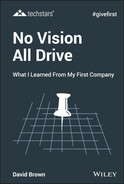
No Vision All Drive, 3rd Edition
Memoirs of an entrepreneur Ever wonder how a startup comes together—the people, places, skills, failures, and hustle that make it a real business? This is the story of David and David, two entrepreneurs with lots of energy and less of a roadmap than you might think. In 1993, David Cohen and David Brown founded their first company, Pinpoint Technologies, which grew from a basement startup to a successful multinational company with $50 million in annual sales and over 250 employees. Chronicling the story of that company from its beginnings up to 1999, when it was sold to ZOLL, and beyond, No Vision All Drive is the story of that company and the people who transformed a flat-broke, shot-in-the-dark concept into a market-leading small business. This book is not about business; it’s about people David and David recount their experiences together Insight on how to build a successful startup Turn a seed idea into reality Startup founders and startup employees, venture capitalists, serial entrepreneurs, and anyone with an interest in stories of determination and hard work will love No Vision All Drive.
eBook
Software developer, NASA
Hannah is a software developer for NASA. Based out of Huntsville, AL, she works on NASA's Artemis project, a simulation system that simulates space launch systems all throughout flight. Hannah's role is to write code that both ensures the accuracy of Artemis as well as importing the actual flight software for upcoming launches.
Streaming Video
Science, technology, and innovation in Uganda : recommendations for policy and action
Between 2006 and 2010 the World Bank sought to unmask the role of science, technology, and innovation in Ugandan industry. This report presents insights from this research based on case studies of six sectors: agriculture, health, energy, information and communication technology (ICT), transport, and logistics. Based on more than 80 interviews cutting across Uganda's small and medium-sized enterprises, universities, and government entities, the report's findings are intended to offer the government and its partners in industry increased clarity about how better to harness science, technology, and innovation to propel the economy. Enabling implementation of the recent Uganda national science, technology, and innovation policy is a parallel goal of the report. The policy articulates the government's intent to foster research and development that builds the human capital that Uganda requires for a knowledge-based economy. The case studies from which this report's recommendations are drawn depict a diverse range of experiences across industrial sectors in terms of generating, applying, and adapting science and technology to contribute to Uganda's development. Despite the relatively small size of the country's investments in science and technology, the past 20 years have seen considerable advances in building capacity in science and technology, developing related institutions and human resources, advancing collaboration and communication, and expanding the base of available knowledge. But given Uganda's limited investments in science and technology, policies should prioritize near-term investments that benefit key sectors. This report identifies those near-term investments as well as longer-term ones (three to five years in the future).
eBook