
Catalogue Search | MBRL


Are you sure you want to remove the book from the shelf?

{{itemTitle}}
24
result(s) for
"Computer-aided design Congresses."
Sort by:

Design and decision support systems in architecture
This volume contains a referred selection of contributions presented at the conference on 'Design and Decision Support Systems in Architecture and Urban Planning' held in Mierlo, The Netherlands, in July 1992.
Book


Being material
\"In 1995, MIT's Nicholas Negroponte predicted that \"being digital\" would have us entering a realm increasingly unconstrained by the materiality of the world. Two decades later, our everyday lives are indeed ever more suffused by computation and calculation. But unwieldy materiality persists and even reasserts itself. At the intersection of art, science and technology, \"Being Material\" revisits Negroponte's prediction by exploring new and unexpected convergences between the digital and the material in the practices of artists, designers, engineers and scientists who work with programmable matter, self-assembling structures, 3D/4D printing, wearable technologies and bio-inspired design. This book will radically intervene into the understanding of how material dynamics limit, expand, transform, and/or vivify our biological, social and political lives. \"Being Material\" will revisit the history of material science (particularly at MIT), contribute to \"new materialism\" in critical theory, and place both projects in dialogue with kindred and contrasting philosophy, art practice and critique. The editors and contributors refine and expand on such cross-field investigations by developing a contrast among five different material genealogical lineages: programmable, wearable, livable, invisible, and audible\"-- Provided by publisher.
Book

Computer-Aided Design, Manufacturing, Modeling and Simulation IV
Selected, peer reviewed papers from the 4th International Conference on Computer-Aided Design, Manufacturing, Modeling and Simulation (CDMMS 2014), September 13-15, 2014, Chongqing, China.
eBook
IBM Rational Team Concert 2 Essentials
IN DETAIL Software development is a collaborative effort needing active and timely input and response from all its members. Every day, project managers face ever-increasing pressures to produce high-quality software with increasing constraints. With IBM's Rational Team Concert collaborative software delivery environment, you can tremendously improve the productivity of your entire team through a web-based user-interface, continuous builds, a customizable process with work support, team support, integration and many more features. Written by Suresh Krishna and TC Fenstermaker, experts on Rational Team Concert, this book will help you leverage the full potential of the IBM Rational Team Concert platform to improve your individual and team performance. It follows a realistic case-study example enabling you to learn about Rational Team Concert fundamentals and best practices along the way to efficiently manage your software projects and tackle various software development challenges. Beginning with an in-depth analysis of software development challenges, the book goes on to introduce the Jazz Platform followed by a complete overview of the architecture of Rational Team Concert. After you install Rational Team Concert on WebSphere and learn to configure the server and clients, you will see all the features in relation to Web and Eclipse clients. From Chapter 3 onwards a realistic sample application is constructed to give you a strong grasp of your concepts. As you proceed, you learn source control, the mechanism to create, control, and manage documents, artifacts in a software development lifecycle, followed by different tools that Rational Team Concert offers for effective team and work management. You tackle the various challenges of Team Collaboration by integrated e-mail, instant messaging, events, feeds, and work items, the basic units of the task. You also learn the various aspects of the software development process and release planning along with process templates, which provide the initial process and iteration of your project. Finally, you extend the Rational Team Concert and make use of the Jazz Platform APIs to customize your process to fit your organizational needs. A comprehensive and practical guide to get acquainted with Rational Team Concert and Jazz Platform, boosting your individual and team productivity APPROACH With their straightforward style, Suresh Krishna and TC Fenstermaker have put their years of experience and motivation into this practical guide that assists in finding an integrated approach to increased team productivity. The numerous tips, notes, and suggestions strengthen your grasp of fundamentals and the foundation upon which you are ready to build your customized Rational Team Concert application. Ample screenshots make sure that you get the configurations correct the first time. A real-world Book Manager Application walks you through all the core features of the Rational Team Concert during different phases of development and release. WHO THIS BOOK IS FOR If you are a Project Manager or a Team Member, who would like to find an integrated approach to deal with modern software development challenges, you should read this book. Or if you are someone who likes to stay one step ahead in team management, you have got the right choice here.
eBook
Computer aided optimum design in engineering XII
Presenting the latest research discussed at the Twelfth International Conference on Computer Aided Optimum Design in Engineering, this book contains papers describing case studies in engineering; considering static, dynamic analysis and damage tolerance. Manufacturing and structural protection issues are discussed as well as emergent applications in fields such as biomechanics. Contributions also include numerical methods and different optimization techniques. Nowadays, it is widely accepted that optimization techniques have much to offer to those involved in the design of new industrial products. The formulation of optimum design has evolved from the time it was purely an academic topic, unable now to satisfy the requirements of real life prototypes. The development of new algorithms, the improvement of others, the appearance of powerful commercial computer codes with easy to use graphical interfaces and the revolution in the speed of computers has created a fertile field for the incorporation of optimization in the design process in different engineering disciplines Topics covered include: Structural Optimization; Shape and Topology Optimization; Optimization in Civil Engineering; Aerospace Structures; Evolutionary Methods in Design Optimization.
eBook

Coulson on Construction Adjudication
The first edition of Construction Adjudication was the first book to deal comprehensively with the law and practice of adjudication in construction and engineering disputes. Written by a High Court judge sitting in the Technology and Construction Court, this new edition of Coulson on Construction Adjudication provides a definitive up-to-date text, invaluable to all involved in the adjudication process.The Housing Grants, Construction and Regeneration Act 1996 introduced adjudication as a new and compulsory form of dispute resolution mechanism in construction contracts, pursuant to which all disputes are decided in 28 days by an adjudicator, whose decision then remains binding and enforceable, unless and until it is challenged in court or arbitration. Since the first edition of this book, there has been an explosion in the number of these adjudication cases before the courts in whichsignificant principles have been refined. The Local Democracy, Economic Development, and Construction Act 2009 has also introduced important amendments to the Act and to adjudication, including abolition of the requirement for construction contracts to be in writing; new powers for the adjudicator to makecorrections; changes to liability for the adjudicator's costs; and changes to the payment regime. The new edition of this established and popular text has been painstakingly revised to provide comprehensive coverage of these new legislative changes, as well as to analyze the wealth of decisions under clear headings, explaining the scope and limits of an adjudicator's decision.Containing new material on the principles of fairness and natural justice which have been key to many adjudication enforcement decisions, this new edition also contains an expanded section offering practical advice to parties and to adjudicators as to how they can ensure a successful adjudication,
and includes new material on the decision.
eBook
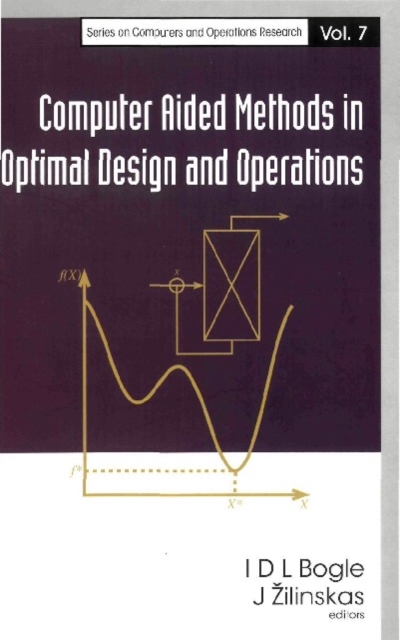
Computer aided methods in optimal design and operations
This book covers different topics on optimal design and operations with particular emphasis on chemical engineering applications. A wide range of optimization methods — deterministic, stochastic, global and hybrid — are considered.
eBook

CAD and rapid prototyping for product design
Computer-aided design (CAD) and rapid prototyping (RP) are now a fundamental part of the professional practice of product design and are therefore essential skills for product design undergraduate students. This book provides students with all the tools needed to get to grips with the range of both CAD software and RP processes used in the industry. Presented in a visually engaging format, this book is packed with case study examples from contemporary product designers, as well as screen shots, CAD models, and images of rapid prototypes highlighting the design process. This book shows how CAD and RP software is used in product design and explains, in clear language, the similarities and differences between the different software packages and processes.
eBook