
Catalogue Search | MBRL


Are you sure you want to remove the book from the shelf?

{{itemTitle}}
86
result(s) for
"Conception de produit."
Sort by:

The innovation mindset : eight essential steps to transform any industry
\"Innovation requires more than a eureka moment. The vast majority of new product ideas never make it to market. Typically, this is because of the failure to address a real problem that a customer has experienced and is willing to pay to have solved. What do people and businesses need to know about the realities of innovating in order to develop products successfully? Lorraine Marchand-a seasoned practitioner who has guided Fortune 500 companies and start-ups on developing and launching new ideas-lays out a step-by-step framework for spurring success. She shares her eight laws of innovation, a formula for driving significant and lasting transformation in any organization. Marchand emphasizes the frame of mind needed to spark the innovation process, underscoring the importance of creating a problem-solving culture and supporting personal curiosity, passion, and talent. She pinpoints the strengths shared by the big ideas that break through and debunks the myths that hold back aspiring creators. Drawing on her experience as a woman in a male-dominated field, Marchand discusses how to support entrepreneurship by women and highlights the contributions of underrepresented innovators. Marchand's how-to program for innovation is clear and easy to follow, featuring a toolkit of strategic templates and planning frameworks that are illustrated by helpful case studies. Written in authoritative but conversational language, The Innovation Mindset offers a practical plan for both the veteran with another great idea and the first-timer with a big dream\"-- Provided by publisher.
Book

Product Design, Technology, and Social Change
This cultural history critically examines product design and its development from pre-industrial times to the present day, considering major milestones in the mass production of goods and services, aiming to incorporate a more inclusive worldview than traditional surveys of the topic. The breadth and versatility of product design through history has been profound. Products have long supported the integration and interpretation of emerging technologies into our lives. These objects include everything from tools, accessories, furniture, and clothing, to types of transportation, websites, and mobile apps. Products provide singular or multiple functions, are tangible and intangible, and in many instances have impacted the quality of our lives by saving time or money or by increasing feelings of personal satisfaction. At the same time, many products have negatively impacted people and the environment. For nearly every product that makes it into the hands of a consumer, there is also a designer who created it and someone who laboured to make it. Examines the relationship between products, consumption, sustainability, politics, and social movements. This \"pocket history\" surveys product design from the agricultural revolution and the birth of cities, through industrialisation, and a digital design revolution.
eBook
Building For Everyone
Diversity and Inclusion to build better products from the front lines at Google Establishing diverse and inclusive organizations is an economic imperative for every industry. Any business that isn’t reaching a diverse market is missing out on enormous revenue potential and the opportunity to build products that suit their users' core needs. The economic “why” has been firmly established, but what about the “how?” How can business leaders adapt to our ever-more-diverse world by capturing market share AND building more inclusive products for people of color, women and other underrepresented groups? The Product Inclusion Team at Google has developed strategies to do just that and Building For Everyone is the practical guide to following in their footsteps. This book makes publicly available for the first time the same inclusive design process used at Google to create user-centric award-winning and profitable products. Author and Head of Product Inclusion Annie Jean-Baptiste outlines what those practices look like in industries beyond tech with fascinating case studies. Readers will learn the key strategies and step-by-step processes for inclusive product design that limits risk and increases profitability. Discover the questions you should be asking about diversity and inclusion in your products for marketers, user researchers, product managers and more. Understand the research the Product Inclusion team drove to back up their practices Learn the “ABCs of Product Inclusion” to build inclusion into your organization’s culture Leverage the product inclusion suite of tools to get your organization building more inclusively and identifying new opportunities. Read case studies to see how product inclusion works across industries and learn what doesn't work. Building For Everyone will show you how to infuse your business processes with inclusive design. You’ll learn best practices for inclusion in product design, marketing, management, leadership and beyond, straight from the innovative Google Product Inclusion team.
eBook
Designing for Service
Service design is the activity of planning and organizing people, infrastructure, communication and material components of a service in order to improve its quality and the interaction between service provider and customers. It is now a growing field of both practice and academic research. Designing for Service brings together a wide range of international contributors to map the field of service design and identify key issues for practitioners and researchers such as identity, ethics and accountability. Designing for Service aims to problematize the field in order to inform a more critical debate within service design, thereby supporting its development beyond the pure methodological discussions that currently dominate the field. The contributors to this innovative volume consider the practice of service design, ethical challenges designers may encounter, and the new spaces opened up by the advent of modern digital technologies.
eBook

Interdisciplinary Approaches to Product Design, Innovation, & Branding in International Marketing
Interdisciplinary approaches are critical to solve the interesting problems of the day. Branding, product design, and innovation are topics that have not been covered in the series so far but have been gaining attention. In all three cases, there is significant research and practitioner interest. This volume seeks to capture and synthesize the cutting-edge knowledge in the area of branding, product design, innovation, and strategic thought in international marketing. This volume was conceived from a conference held at The College of William & Mary where speakers from many fields - including business, arts, architecture, industrial design, and engineering - were invited to share their methods, findings and insights. The interdisciplinary nature of the conference and this subsequent volume serve to help us gain an appreciation for alternative perspectives while also facilitating cross-disciplinary research in these important areas.
eBook
Prototyping across the Disciplines
If people from different fields are going to work together on projects, then they need to begin to understand each other. They can be separated by the words they use, the ways they work and how they think. However, in many fields there is common ground, in the attempts to create what is sometimes called inventive knowledge. These fields progress not only by understanding increasingly more about what already exists, but by making guesses about possible better futures. The guesses consist of small forays into that future, using strategies that are variously called learning through making, research through design or, more simply, prototyping. While traditionally associated primarily with industrial design, and more recently with software development, prototyping is now used as an important tool in areas ranging from materials engineering to landscape architecture to the digital humanities. This book collects current theories and methods of prototyping in a dozen disciplines, illustrating them through case studies of actual projects, whether in industry or the classroom. This edited collection aims to provide a context, a theoretical framework and a set of methodologies for interdisciplinary collaboration in design. Each chapter offers a different disciplinary perspective on prototyping, providing a case study as a point of comparison for identifying commonalities and divergences in current practices. Contributions are from a group of scholars with worldwide experience of working and presenting in design, and who are currently based in Canada, the United States, Chile and Brazil. This book isn't just about design across the disciplines, it is about how prototyping works in different disciplines. Prototyping is a crucial part of the design process, and a practice used by creators from all design disciplines, from architects and engineers, to industrial and service designers, to test a concept or process and evaluate an idea. Much research has been published on prototyping in design; what makes this new book unique is the cross disciplinary nature, showing designers how they can learn from various approaches to improve their skills. Disciplines discussed include post-human design, theatre, tabletop game design, landscape architecture and arts entrepreneurship. Primarily of interest to design scholars and practitioners with an interest in integrative design. Undergraduates and graduate students in design, HCI (human-computer interaction) and the digital humanities. Textbook potential.
eBook
Building For Everyone
Diversity and Inclusion to build better products from the front lines at Google Establishing diverse and inclusive organizations is an economic imperative for every industry. Any business that isn't reaching a diverse market is missing out on enormous revenue potential and the opportunity to build products that suit their users' core needs. The economic \"why\" has been firmly established, but what about the \"how?\" How can business leaders adapt to our ever-more-diverse world by capturing market share AND building more inclusive products for people of color, women and other underrepresented groups? The Product Inclusion Team at Google has developed strategies to do just that and Building For Everyone is the practical guide to following in their footsteps. This book makes publicly available for the first time the same inclusive design process used at Google to create user-centric award-winning and profitable products. Author and Head of Product Inclusion Annie Jean-Baptiste outlines what those practices look like in industries beyond tech with fascinating case studies. Readers will learn the key strategies and step-by-step processes for inclusive product design that limits risk and increases profitability. * Discover the questions you should be asking about diversity and inclusion in your products for marketers, user researchers, product managers and more. * Understand the research the Product Inclusion team drove to back up their practices * Learn the \"ABCs of Product Inclusion\" to build inclusion into your organization's culture * Leverage the product inclusion suite of tools to get your organization building more inclusively and identifying new opportunities. * Read case studies to see how product inclusion works across industries and learn what doesn't work. Building For Everyone will show you how to infuse your business processes with inclusive design. You'll learn best practices for inclusion in product design, marketing, management, leadership and beyond, straight from the innovative Google Product Inclusion team.
eBook
The Product-Led Organization
A playbook on product-led strategy for software product teams There's a common strategy used by the fastest growing and most successful businesses of our time. These companies are building their entire customer experience around their digital products, delivering software that is simple, intuitive and delightful, and that anticipates and exceeds the evolving needs of users. Product-led organizations make their products the vehicle for acquiring and retaining customers, driving growth, and influencing organizational priorities. They represent the future of business in a digital-first world. This book is meant to help you transform your company into a product-led organization, helping to drive growth for your business and advance your own career. It provides: * A holistic view of the quantitative and qualitative insights teams need to make better decisions and shape better product experiences. * A guide to setting goals for product success and measuring progress toward meeting them. * A playbook for incorporating sales and marketing activities, service and support, as well as onboarding and education into the product * Strategies for soliciting, organizing and prioritizing feedback from customers and other stakeholders; and how to use those inputs to create an effective product roadmap The Product-Led Organization: Drive Growth By Putting Product at the Center of Your Customer Experience was written by the co-founder and CEO of Pendo—a SaaS company and innovator in building software for digital product teams. The book reflects the author's passion and dedication for sharing what it takes to build great products.
eBook
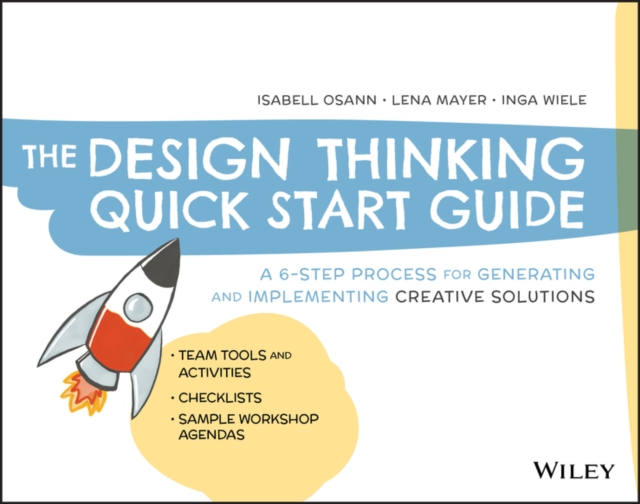
The design thinking quick start guide
A brief, beautiful introduction to Design Thinking that inspires business creativity and innovative solutions The Design Thinking Quick Start Guide: A 6-Step Process for Generating and Implementing Creative Solutions shows you how you and your team can become more creative. This book presents methods you can use to innovate playfully and enjoyably. The Design Thinking Quick Start Guide is full of practical tools and activities, like the 6-3-5 method of brainstorming, to help you and your team get creative. For each of the six steps in the design thinking process, the authors offer two warm-ups that get teams ready to contribute and arrive at innovative solutions. * Spur innovation with checklists for brainstorming and implementation * Learn how to generate new ideas * Lead your team in a proven process for doing creative work Whether you're new to design thinking or experienced, the clearly outlined steps in this guide will inspire you to create and implement great ideas.
eBook

Designing for Older Adults
There are many products, tools, and technologies available that could provide support for older adults. However, their success requires that they are designed with older adults in mind by being aware of, and adhering to, design principles that recognize the needs, abilities, and preferences of diverse groups of older adults. Achieving good design is a process facilitated by seeing principles and guidelines in action. Design success requires understanding how to use the methods and tools available to evaluate initial ideas and prototypes. The goal of this book is to provide illustrative \"case studies\" of designing for older adults based on real design challenges faced by the researchers of the Center for Research and Education on Aging and Technology Enhancement (CREATE) over the past two decades. These case studies exemplify the use of human factors tools and user-centered design principles to understand the needs of older adults, identify where existing designs failed older users, and examine the effectiveness of design changes to better accommodate the abilities and preferences of the large and growing aging population.
Features
Reviews important design considerations for older adults and presents a framework for design
Provides a series of real-world case studies to ground design principles and guidelines
Offers a unique set and broad array of design challenges, from the design of healthcare devices, to computer systems and apps, to transportation systems and robots
Gives an overview of emerging technologies, their potential benefits to older adults, anticipated design considerations, and new and emerging approaches to evaluating design
Covers these topics with designers in mind, providing the most up-to-date recommendations based on the scientific literature but in an accessible, easy-to-understand, non-technical manner
eBook