
Catalogue Search | MBRL


Are you sure you want to remove the book from the shelf?

{{itemTitle}}
45
result(s) for
"Confessor, Saint"
Sort by:


The Whole Mystery of Christ
A thoroughgoing examination of Maximus Confessor's
singular theological vision through the prism of Christ's cosmic
and historical Incarnation.
Jordan Daniel Wood changes the trajectory of patristic
scholarship with this comprehensive historical and systematic study
of one of the most creative and profound thinkers of the patristic
era: Maximus Confessor (560-662 CE). Wood's panoramic vantage on
Maximus's thought emulates the theological depth of Hans Urs von
Balthasar's Cosmic Liturgy while also serving as a
corrective to that classic text.
Maximus's theological vision may be summed up in his enigmatic
assertion that \"the Word of God, very God, wills always and in all
things to actualize the mystery of his Incarnation.\" The Whole
Mystery of Christ sets out to explicate this claim. Attentive
to the various contexts in which Maximus thought and
wrote-including the wisdom of earlier church fathers, conciliar
developments in Christological and Trinitarian doctrine, monastic
and ascetic ways of life, and prominent contemporary philosophical
traditions-the book explores the relations between God's act of
creation and the Word's historical Incarnation, between the analogy
of being and Christology, and between history and the Fall, in
addition to treating such topics as grace, deification, theological
predication, and the ontology of nature versus personhood. Perhaps
uniquely among Christian thinkers, Wood argues, Maximus envisions
creatio ex nihilo as creatio ex Deo in the event
of the Word's kenosis: the mystery of Christ is the revealed
identity of the Word's historical and cosmic Incarnation. This book
will be of interest to scholars and students of patristics,
historical theology, systematic theology, and Byzantine
studies.
eBook
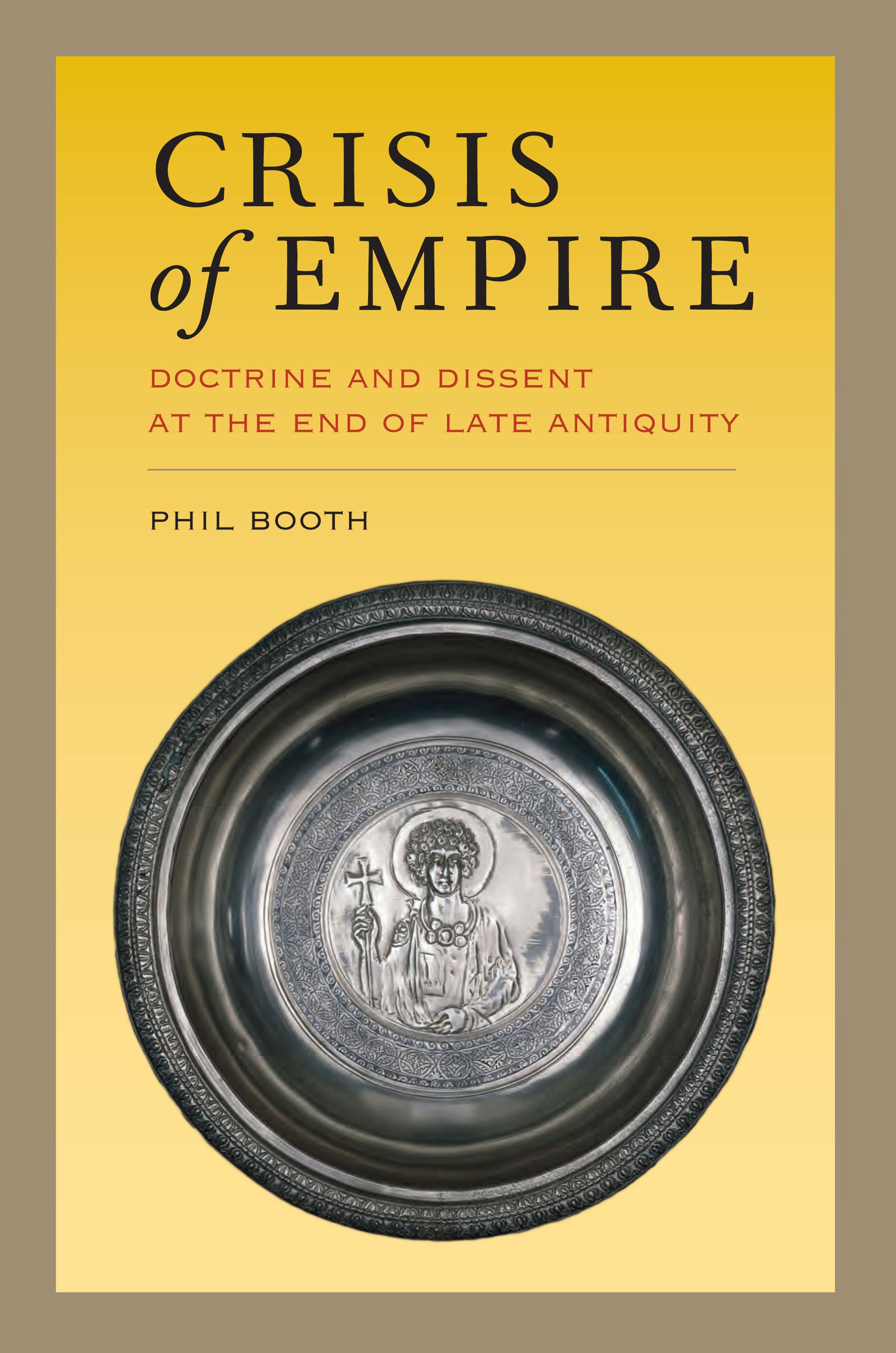
Crisis of empire
This book focuses on the attempts of three ascetics—John Moschus, Sophronius of Jerusalem, and Maximus Confessor—to determine the Church’s power and place during a period of profound crisis, as the eastern Roman empire suffered serious reversals in the face of Persian and then Islamic expansion. By asserting visions which reconciled long-standing intellectual tensions between asceticism and Church, these authors established the framework for their subsequent emergence as Constantinople's most vociferous religious critics, their alliance with the Roman popes, and their radical rejection of imperial interference in matters of the faith. Situated within the broader religious currents of the fourth to seventh centuries, this book throws new light on the nature not only of the holy man in late antiquity, but also of the Byzantine Orthodoxy that would emerge in the Middle Ages, and which is still central to the churches of Greece and Eastern Europe.
eBook

A Patristic Synthesis of the Word Enfleshed: The Christology of Maximus the Confessor
St. Maximus the Confessor (580–662) stands out among the Church Fathers as one of the last Christological martyrs. Maximus possessed one of the greatest minds of the Church’s first millennium. The greatest strength of Maximus’s Christology is that he presents a synthesis of all Christological contributions known to him while developing his own Christology of union in distinction. In order to flesh out his system of Christology, this essay works primarily with select works of Maximus’s, namely, the Small Theological and Polemical Works (Opuscula), the Ambigua, the Questions to Thalassius, and the Mystagogy. It will demonstrate that Maximus’s Christology bears the following four predominant signatures: it is patristic, Incarnational, composite, and cosmic. All four features are interrelated, particularly in Maximus’s theory of the λόγοι (logology), and all four hold significant sway over the whole of his doctrine. The essay concludes with a brief consideration of how the Ressourcement movement has benefitted Maximian studies.
Journal Article

Typologie Spatio-Temporelle de l'Ecclesia Byzantine
This study addresses the philosophical context of the Mystagogy of Maximus the Confessor. It examines how the Byzantine monk integrates Neoplatonist topics when exposing one of the most important feature of his religious conception of the physical world or cosmology. It provides many important new perspectives for reading the works of Maximus the Confessor, especially the Mystagogy, not only for theologians, but also for scholars interested in late Antique and Byzantine philosophy.
eBook

The mutual corruption of volition and nature? A closer reading of Ad Thalassium 42
This article closely examines the content of an important passage in Maximos the Confessor’s Ad Thalassium 42, in which we can identify a ternary soteriological structure (Adam-Christ-us) recurring in the work of the Byzantine theologian. The main focus of the article is to highlight and analyse the relationship that he evokes, but does not detail, between human nature and the exercise of will – in the case of Adam, as the protological and lapsarian exemplar of humanity; in the case of Christ, as its teleological and soteriological exemplar; and in the case of us, as natural descendants of the former and possible spiritual followers of the latter.Contribution: This article highlights a general soteriological structure and the circular dynamics between nature and will as the central anthropological mechanism of this structure, both of which are relevant to Maximos the Confessor’s entire work in general and to his moral psychology, including his concept of the passions, in particular.
Journal Article
The genetic mechanism of fallness: St. Maximos the Confessor revisited
Through a close reading of the two definitions of evil in the Introduction to Responses to Thalassios, this article points out a circular, cognitive-affective-somatic, genetic mechanism that St. Maximos the Confessor considers responsible for the initiation and transmission of the fallness as a human condition and the specific manifestation of it in the form of passions. It elucidates the first definition as mainly phenomenological, by identifying the circular mechanism and its behavioural expressions, and the second definition as more aetiological, by explaining why this mechanism emerges and reemerges with the fallen humanity despite its catastrophic results.ContributionThis article highlights a double genetic mechanism (survival cum passions) that St. Maximos the Confessor grasped within the fallen human condition as a curse solvable only in Christ, a notion largely carved out by previous Maximian scholarship, but fully explained and valuated here.
Journal Article
Divine Scripture and Human Emotion in Maximus the Confessor
In Exegesis of the Human Heart Andrew J. Summerson explores how Maximus the Confessor uses biblical interpretation to develop an account of human passibility, from fallen human passions to perfected human emotions among the divinized. This book features Maximus's role as a creative interpreter of tradition. Maximus inherits Christian thinking on emotion, which revises Stoic and Platonic thought according to biblical categories. Through a close reading of Quaestiones ad Thalassium and a wide selection of Maximus's works, Andrew J. Summerson shows that Maximus understands human emotion in an exegetical milieu and that Maximus places human emotion at the heart of his soteriology. Christ redeems passibility so the divinized can enjoy perfected emotional activity in the ever-moving repose of eternal life.
eBook
Cosmic liturgy : the universe according to Maximus the Confessor
This book presents a powerful, attractive, religiously compelling portrait of the thought of a major Christian theologian who might, for this book, have remained only an obscure name in the handbooks of patrology. It is based on an intelligent and careful reading of Maximus's own writings. Here the history of theology has become itself a way of theological reflection.
eBook