
Catalogue Search | MBRL


Are you sure you want to remove the book from the shelf?

{{itemTitle}}
334
result(s) for
"Conflit israélo-arabe."
Sort by:


Encountering Palestine
Encountering Palestine: Un/making Spaces of Colonial
Violence , edited by Mark Griffiths and Mikko Joronen, sits at
the intersection of cultural and political geographies and offers
innovative reflections on power, colonialism, and anti-colonialism
in contemporary Palestine and Israel. Organized around the theme of
encountering and focusing on the ways violence and struggle are
un/made in the encounter between the colonizer and colonized, the
essays focus on power relations as they manifest in cultural
practices and everyday lives in anti/colonial Palestine. Covering
numerous sites in Gaza, the West Bank, East Jerusalem, and Israel,
Encountering Palestine addresses a range of empirical
topics-from marriage and queer aesthetics to policing, demolition,
armament failure, and violence. The contributors utilize diverse
theoretical frameworks, such as hyperreality, settler capitalism,
intimate biopolitics, and politics of vulnerability, to help us
better understand the cultural making and unmaking of colonial and
anti-colonial space in Palestine. Encountering Palestine
asks us to rethink how colonialism and power operate in Palestine,
the ways Palestinians struggle, and the lifeways that constantly
encounter, un/make, and counter the spaces of colonial violence.
eBook

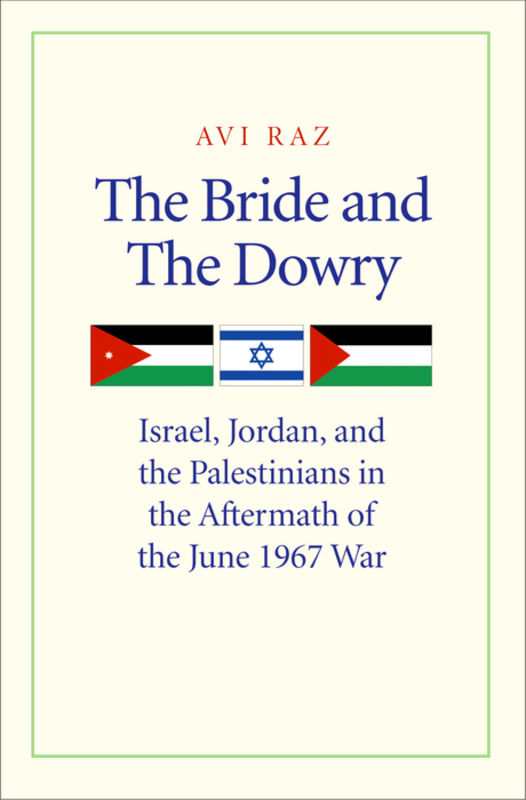
The Bride and the Dowry
Israel's victory in the June 1967 Six Day War provided a unique opportunity for resolving the decades-old Arab-Zionist conflict. Having seized the West Bank, the Gaza Strip, the Sinai Peninsula, and the Golan Heights, Israel for the first time in its history had something concrete to offer its Arab neighbors: it could trade land for peace. Yet the political deadlock persisted after the guns fell silent. This book sets out to find out why.
Avi Raz places Israel's conduct under an uncompromising lens. He meticulously examines the critical two years following the June war and substantially revises our understanding of how and why Israeli-Arab secret contacts came to naught. Mining newly declassified records in Israeli, American, British, and UN archives, as well as private papers of individual participants, Raz dispels the myth of overall Arab intransigence and arrives at new and unexpected conclusions. In short, he concludes that Israel's postwar diplomacy was deliberately ineffective because its leaders preferred land over peace with its neighbors. The book throws a great deal of light not only on the post-1967 period but also on the problems and pitfalls of peacemaking in the Middle East today.
eBook

One State, Two States
\"What is so striking about Morris's work as a historian is that it does not flatter anyone's prejudices, least of all his own,\" David Remnick remarked in aNew Yorkerarticle that coincided with the publication of Benny Morris's1948: A History of the First Arab-Israeli War.With the same commitment to objectivity that has consistently characterized his approach, Morris now turns his attention to the present-day legacy of the events of 1948 and the concrete options for the future of Palestine and Israel.
The book scrutinizes the history of the goals of the Palestinian national movement and the Zionist movement, then considers the various one- and two-state proposals made by different streams within the two movements. It also looks at the willingness or unwillingness of each movement to find an accommodation based on compromise. Morris assesses the viability and practicality of proposed solutions in the light of complicated and acrimonious realities. Throughout his groundbreaking career, Morris has reshaped understanding of the Israeli-Arab conflict. Here, once again, he arrives at a new way of thinking about the discord, injecting a ray of hope in a region where it is most sorely needed.
eBook

Imagining the Middle East
As its interests have become deeply tied to the Middle East, the
United States has long sought to develop a usable understanding of
the people, politics, and cultures of the region. In Imagining
the Middle East , Matthew Jacobs illuminates how Americans'
ideas and perspectives about the region have shaped, justified, and
sustained U.S. cultural, economic, military, and political
involvement there. Jacobs examines the ways in which an informal
network of academic, business, government, and media specialists
interpreted and shared their perceptions of the Middle East from
the end of World War I through the late 1960s. During that period,
Jacobs argues, members of this network imagined the Middle East as
a region defined by certain common characteristics--religion, mass
politics, underdevelopment, and an escalating
Arab-Israeli-Palestinian conflict--and as a place that might be
transformed through U.S. involvement. Thus, the ways in which
specialists and policymakers imagined the Middle East of the past
or present came to justify policies designed to create an imagined
Middle East of the future. Jacobs demonstrates that an analysis of
the intellectual roots of current politics and foreign policy is
critical to comprehending the styles of U.S. engagement with the
Middle East in a post-9/11 world.
eBook

The one-state solution
The One-State Solution demonstrates that Israeli settlements have already encroached on the occupied territory of the West Bank and Gaza Strip to the extent that any Palestinian state in those areas is unviable. It reveals the irreversible impact of Israel’s settlement grid by summarizing its physical, demographic, financial, and political dimensions. Virginia Tilley explains why we should assume that this grid will not be withdrawn—or its expansion reversed—by reviewing the role of the key political actors: the Israeli government, the United States, the Arab states, and the European Union. Finally, the book addresses the daunting obstacles to a one-state solution—including major revision of the Zionist dream but also Palestinian and other regional resistance—and offers some ideas about how those obstacles might be addressed.
eBook

Israeli and Palestinian narratives of conflict : history's double helix
Why does Hamas refuse to recognize the legitimacy of the state of Israel? Why do Israeli settlers in the West Bank insist that Israel has a legitimate right to that territory? What makes the Israeli-Palestinian conflict so intractable? Reflecting both Israeli and Palestinian points of view, this provocative volume addresses the two powerful, bitterly contested, competing historical narratives that underpin the Israeli-Palestinian conflict. Compelling contributions by Israeli and Palestinian authors show how the intertwined reckonings of the historical past \"history's double helix\" provide powerful ammunition for current battles. Just when a resolution of the conflict might seem to be on the horizon, the gulf of history resurges to separate the contenders. Palestinians and Israelis remain locked in struggle, tightly entangled and enveloped by a historical cocoon of growing complexity, fundamental disagreement, and overriding miscalculation. This book creates a dialogue among Palestinian and Israeli authors, who examine opposing versions of the historical narratives in the context of contemporary Israeli-Palestinian relations. In hard-hitting essays the contributors debate the two justifying and rationalizing constructions, laying bare the conflict's roots and the distorted prisms that fuel it. Israeli and Palestinian Narratives of Conflict is an invaluable resource for anyone seeking to make sense of today's headlines.
eBook

Cultural Contestation in Ethnic Conflict
Ethnic conflict often focuses on culturally charged symbols and rituals that evoke strong emotions from all sides. Marc Howard Ross examines battles over diverse cultural expressions, including Islamic headscarves in France, parades in Northern Ireland, holy sites in Jerusalem and Confederate flags in the American South to propose a psychocultural framework for understanding ethnic conflict, as well as barriers to, and opportunities for, its mitigation. His analysis explores how culture frames interests, structures demand-making and shapes how opponents can find common ground to produce constructive outcomes to long-term disputes. He focuses on participants' accounts of conflict to identify emotionally significant issues, and the power of cultural expressions to link individuals to larger identities and shape action. Ross shows that, contrary to popular belief, culture does not necessarily exacerbate conflict; rather, the constructed nature of psychocultural narratives can facilitate successful conflict mitigation through the development of more inclusive narratives and identities.
eBook

The Forgotten Palestinians
For more than 60 years, hundreds of thousands of Palestinians have lived as Israeli citizens within the borders of the nation formed at the end of the 1948 conflict. Occupying a precarious middle ground between the Jewish citizens of Israel and the dispossessed Palestinians of the West Bank and the Gaza Strip, the Israeli Palestinians have developed an exceedingly complex relationship with the land they call home; however, in the innumerable discussions of the Israel-Palestine problem, their experiences are often overlooked and forgotten.
In this book, historian Ilan Pappé examines how Israeli Palestinians have fared under Jewish rule and what their lives tell us about both Israel's attitude toward minorities and Palestinians' attitudes toward the Jewish state. Drawing upon significant archival and interview material, Pappé analyzes the Israeli state's policy towards its Palestinian citizens, finding discrimination in matters of housing, education, and civil rights. Rigorously researched yet highly readable,The Forgotten Palestiniansbrings a new and much-needed perspective to the Israel-Palestine debate.
eBook