
Catalogue Search | MBRL


Are you sure you want to remove the book from the shelf?

{{itemTitle}}
2,326
result(s) for
"Congo (Kinshasa)"
Sort by:


The Making of the Pentecostal Melodrama
How religion, gender, and urban sociality are expressed in and mediated via television drama in Kinshasa is the focus of this ethnographic study. Influenced by Nigerian films and intimately related to the emergence of a charismatic Christian scene, these teleserials integrate melodrama, conversion narratives, Christian songs, sermons, testimonies, and deliverance rituals to produce commentaries on what it means to be an inhabitant of Kinshasa.
eBook


Tropical Cowboys
During the 1950s and 60s in the Congo city of Kinshasa, there emerged young urban male gangs known as \"Bills\" or \"Yankees.\" Modeling themselves on the images of the iconic American cowboy from Hollywood film, the \"Bills\" sought to negotiate lives lived under oppressive economic, social, and political conditions. They developed their own style, subculture, and slang and as Ch. Didier Gondola shows, engaged in a quest for manhood through bodybuilding, marijuana, violent sexual behavior, and other transgressive acts. Gondola argues that this street culture became a backdrop for Congo-Zaire's emergence as an independent nation and continues to exert powerful influence on the country's urban youth culture today.
eBook

Congo's Dancers
Dance music plays a central role in the cultural, social,
religious, and family lives of the people of the Democratic
Republic of the Congo. Among the various genres popular in the
capital city of Kinshasa, Congolese rumba occupies a special place
and can be counted as one of the DRC's most well-known cultural
exports. The public image of rumba was historically dominated by
male bandleaders, singers, and musicians. However, with the
introduction of the danseuse (professional concert dancer)
in the late 1970s, the role of women as cultural, moral, and
economic actors came into public prominence and helped further
raise Congolese rumba's international profile. In Congo's
Dancers , Lesley Nicole Braun uses the prism of the Congolese
danseuse to examine the politics of control and the ways
in which notions of visibility, virtue, and socio-economic
opportunity are interlinked in this urban African context. The work
of the danseuse highlights the fact that public visibility
is necessary to build the social networks required for economic
independence, even as this visibility invites social opprobrium for
women. The concert dancer therefore exemplifies many of the
challenges that women face in Kinshasa as they navigate the public
sphere, and she illustrates the gendered differences of local
patronage politics that shape public morality. As an ethnographer,
Braun had unusual access to the world she documents, having been
invited to participate as a concert dancer herself.
eBook

The trouble with the Congo : local violence and the failure of international peacebuilding
The Trouble with the Congo suggests a new explanation for international peacebuilding failures in civil wars. Local rivalries motivated widespread violence during the Congolese transition from war to peace. However, a dominant peacebuilding culture shaped the intervention strategy in a way that precluded action on local conflicts.
eBook

Naming Colonialism
What’s in a name? As Osumaka Likaka argues in this illuminating study, the names that Congolese villagers gave to European colonizers reveal much about how Africans experienced and reacted to colonialism. The arrival of explorers, missionaries, administrators, and company agents allowed Africans to observe Westerners’ physical appearances, behavior, and cultural practices at close range—often resulting in subtle yet trenchant critiques. By naming Europeans, Africans turned a universal practice into a local mnemonic system, recording and preserving the village’s understanding of colonialism in the form of pithy verbal expressions that were easy to remember and transmit across localities, regions, and generations. Methodologically innovative,
Naming Colonialism advances a new approach that shows how a cultural process—the naming of Europeans—can provide a point of entry into economic and social histories. Drawing on archival documents and oral interviews, Likaka encounters and analyzes a welter of coded fragments. The vivid epithets Congolese gave to rubber company agents—“the home burner,” “Leopard,” “Beat, beat,” “The hippopotamus-hide whip”—clearly conveyed the violence that underpinned colonial extractive economies. Other names were subtler, hinting at derogatory meaning by way of riddles, metaphors, or symbols to which the Europeans were oblivious. Africans thus emerge from this study as autonomous actors whose capacity to observe, categorize, and evaluate reverses our usual optic, providing a critical window on Central African colonialism in its local and regional dimensions.
eBook
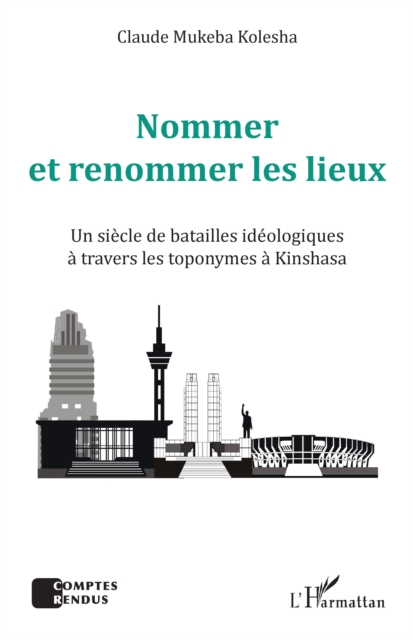
Nommer et renommer les lieux
Le pouvoir nomme les lieux à son image, en République démocratique du Congo comme ailleurs, hier comme aujourd'hui. Cet ouvrage scrute le phénomène à travers l'histoire de la RDC. Depuis l'EIC (1881-1908), en passant par l'administration belge (1908- 1960), l'autorité coloniale a procédé aux retoponymisations, puisées dans l'histoire et la culture occidentales. Après l'indépendance, certains toponymes ont été changés sur le fond d'une ferme volonté de Congolisation (1966). Un mouvement poursuivi et formalisé, à la faveur du Retour à l'Authenticité, trouvaille du Nouveau Régime (1971). En 1992, la Conférence Nationale Souveraine revisite la toponymie dans un esprit révisionniste. Se fondant sur un outil théorique et méthodologique, qu'il forge à partir de l'analyse sémique, l'auteur objective la chaîne des retoponymisations opérées à Kinshasa par les différents pouvoirs, avec pour ambition, chaque fois, de recréer un nouvel ordre de significations.
eBook

The diplomacy of decolonisation: America, Britain and the United Nations during the Congo crisis 1960-64
This volume reinterprets the role of the UN during the Congo crisis from 1960 to 1964, presenting a multidimensional view of the organisation. Through an examination of the Anglo-American relationship, it reveals how the UN helped position this event as a lightning rod in debates about how decolonisation interacted with the Cold War. By examining the ways in which the various dimensions of the UN came into play in Anglo-American considerations of how to handle the Congo crisis, Alanna O'Malley reveals how the Congo debate reverberated in wider ideological struggles about how decolonisation evolved and what the role of the UN would be in managing this process.
eBook