
Catalogue Search | MBRL


Are you sure you want to remove the book from the shelf?

{{itemTitle}}
685
result(s) for
"Connotation (Linguistics)"
Sort by:


Scalar Implicatures and Beyond
This book offers a comprehensive survey on the study of scalar implicatures, a central topic in modern pragmatics. This multidimensional and interdisciplinary topic is intensely studied in contemporary linguistics, psycholinguistics, and philosophy of language. Being one of the most prominent topics in pragmatics, they offer a window into the mind of communicative agents. On the one hand, scalar implicatures are closely related to the lexicon and grammar of natural languages. On the other hand, they shed light on how the linguistic meaning is enriched with context and speakers' intentions and knowledge. Starting from an overview of the classic Gricean theory and the theoretical development introduced by post-Gricean scholars, the book illustrates the modern accounts of scalar implicatures across the domains of theoretical linguistics, such as semantics, pragmatics, and psycholinguistics. The central part of the book is devoted to the review of the most influential studies on the acquisition, comprehension, and processing of these pragmatic inferences. The last part of the volume focuses on open issues concerning scalar implicatures by illustrating recent experimental studies and theoretical accounts advanced by the authors in collaboration with several scholars.
eBook


The Subtle Subtext
Subtexts are all around us. In conversation, business
transactions, politics, literature, philosophy, and even love, the
art of expressing more than what is explicitly said allows us to
live and move in the world. But rarely do we reflect on this
subterranean dimension of communication.
In this book, renowned classicist and scholar of rhetoric
Laurent Pernot explores the fascinating world of subtext. Of the
two meanings present in any instance of double meaning, Pernot
focuses on the meaning that is unstated-the meaning that counts. He
analyzes subtext in all its multifarious forms, including allusion,
allegory, insinuation, figured speech, irony, innuendo, esoteric
teaching, reading between the lines, ambiguity, and beyond. Drawing
on examples from figures as varied as Homer, Shakespeare, Molière,
Proust, Foucault, and others, as well as from popular culture,
Pernot shows how subtext can be identified and deciphered as well
as how prevalent and essential it is in human life.
With erudition and wit, Pernot explains and clarifies a device
of language that we use and understand every day without even
realizing it. The Subtle Subtext is a book for anyone who
is interested in language, literature, hidden meanings, and the
finer points of social relations.
eBook
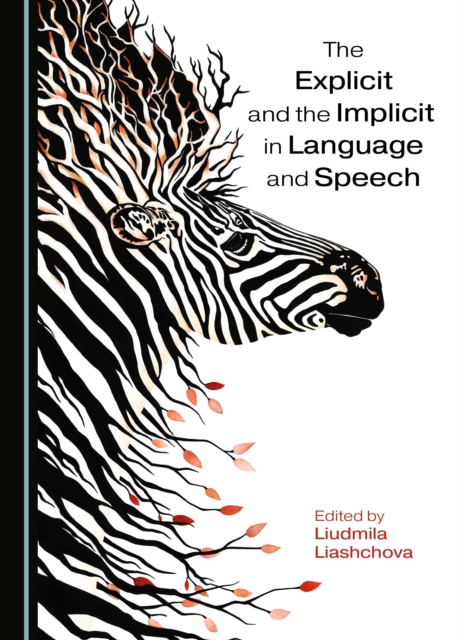
The Explicit and the Implicit in Language and Speech
Our ability to acquire a language - one of the most complex semiotic systems - is stunning. However, to describe and explain even a small fraction of this system and of this ability is a great challenge.This book brings together modified papers of seventeen university scholars from Belarus, Germany, Russia and Lithuania originally presented at an international conference held in Minsk, Belarus, in 2017, on different hidden and implicit aspects of language and the ways of disclosing and explicating them. Language is understood by them differently as a cognitive ability, a specific semiotic structure interwoven with culture, and a discourse. This book will be of great interest to a wide range of linguist-theoreticians, specialists in applied linguistics, and the general reader with an interest in understanding what exactly language is.
eBook
The manipulative disguise of truth : tricks and threats of implicit communication
Becoming effective hunters of manipulative communicative moves is far from an easy capacity to develop. This book aims at offering a guide to the most dangerous traps of deceptive language as triggered by implicit communication strategies such as presupposition, implicature, topicalization and vague expressions. A look at different contexts of language use highlights some of the most remarkable implications of using indirect speech and of how it affects the correct comprehension of a message. Within the remit of communication and pragmatics studies, this work marks an advancement in the direction of delving into the linguistic manifestations of manipulative discourse, its most common contexts of use and the educational paths that can be undertaken to master it in everyday interactions.
eBook

Computational Paralinguistics
This book presents the methods, tools and techniques that are currently being used to recognise (automatically) the affect, emotion, personality and everything else beyond linguistics ('paralinguistics') expressed by or embedded in human speech and language. It is the first book to provide such a systematic survey of paralinguistics in speech and language processing. The technology described has evolved mainly from automatic speech and speaker recognition and processing, but also takes into account recent developments within speech signal processing, machine intelligence and data mining. Moreover, the book offers a hands-on approach by integrating actual data sets, software, and open-source utilities which will make the book invaluable as a teaching tool and similarly useful for those professionals already in the field. Key features: * Provides an integrated presentation of basic research (in phonetics/linguistics and humanities) with state-of-the-art engineering approaches for speech signal processing and machine intelligence. * Explains the history and state of the art of all of the sub-fields which contribute to the topic of computational paralinguistics. * C overs the signal processing and machine learning aspects of the actual computational modelling of emotion and personality and explains the detection process from corpus collection to feature extraction and from model testing to system integration. * Details aspects of real-world system integration including distribution, weakly supervised learning and confidence measures. * Outlines machine learning approaches including static, dynamic and context?sensitive algorithms for classification and regression. * Includes a tutorial on freely available toolkits, such as the open-source 'openEAR' toolkit for emotion and affect recognition co-developed by one of the authors, and a listing of standard databases and feature sets used in the field to allow for immediate experimentation enabling the reader to build an emotion detection model on an existing corpus.
eBook

A Theory of Conventional Implicature and Pragmatic Markers in Chinese
Conventional implicature is itself a highly controversial term, understood very differently by various brands of contemporary pragmatic theory. This book sets out to advance a Gricean theoretical framework of conventional implicature. It also intends to offer an analysis of pragmatic markers in Chinese.
eBook
