
Catalogue Search | MBRL


Are you sure you want to remove the book from the shelf?

{{itemTitle}}
268
result(s) for
"Conodonts."
Sort by:

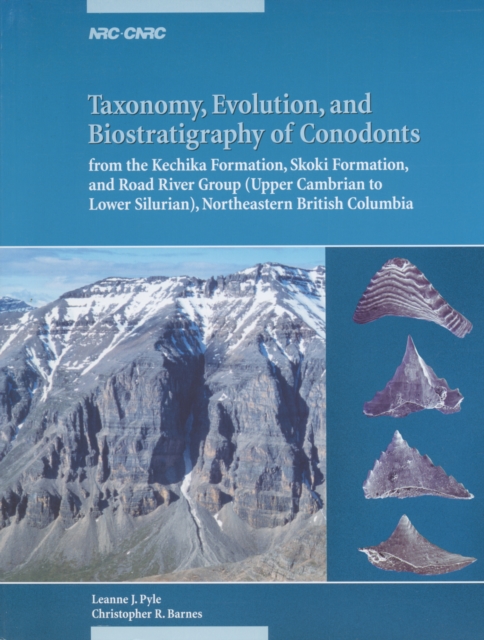
Taxonomy, evolution, and biostratigraphy of conodonts from the the Kechika Formation, Skoki Formation and Road River Group (Upper Cambrian to Lower Silurian), Northeastern British Columbia
Conodonts, the tiny, phosphatic, toothlike remains of an extinct group of early vertebrates, are the most important fossil group for biostratigraphy throughout their stratigraphic range from Late Cambrian to Late Triassic. The monograph presents the results of a significant project in remote regions of northeastern British Columbia. It extends the knowledge of the stratigraphic framework and conodont faunas into a region where information of this kind is largely unknown.
eBook

Detailed conodont data from the Olenekian–Anisian boundary interval of the GSSP candidate section at Deşli Caira, Romania
The Olenekian–Anisian boundary (OAB) interval is an important time in Earth's history, reflecting the last phase of marine ecosystem recovery in the aftermath of the end-Permian mass extinction. Despite this, the Global Boundary Stratotype Section and Point (GSSP) for the base of the Anisian remains undefined. The first appearance of the conodont Chiosella timorensis has been proposed as a potential index for the boundary; however, the discovery of this conodont with ammonoids traditionally considered to be Spathian (late Olenekian) has generated doubts about its suitability as a proxy. At the GSSP candidate section at Deşli Caira, Romania, the OAB was previously drawn at the base of bed GR7, which contained the first occurrence of Ch. timorensis; however, additional collecting has shown that Spathian ammonoids persist higher in the section, and recent studies have instead placed the OAB at the base of bed 822A, approximately 3 m above the previous placement. The conodont faunas from this higher interval are less well studied than those from the lower level; furthermore, the beds in this part of the section have now been subdivided in more detail than they were previously, with bed 822 alone now being split into six sub-beds. Existing conodont faunas are only recorded as coming from bed 822, so their position relative to the new subdivision is not certain. In order to improve the precision of conodont correlation around the potential higher position for the OAB, 10 new samples were collected from bed 821 to bed 824. In addition to characterizing the fauna throughout the OAB interval, these new collections also enable the evolution of late Spathian and early Anisian conodont species to be understood in more detail.
Journal Article

Conodonts across the Devonian/Carboniferous boundary: a review and implication for the redefinition of the boundary and a proposal for an updated conodont zonation
This paper is a contribution to the redefinition of the base of Carboniferous system. At present the criterion for the definition of the Devonian–Carboniferous boundary is the first occurrence of a conodont species. In order to evaluate the stratigraphic potential for new criteria for the definition of the Devonian–Carboniferous boundary, the distribution of conodont species of Bispathodus, Branmehla, Palmatolepis, Polygnathus, Protognathodus, Pseudopolygnathus and Siphonodella across the boundary is presented and discussed. An updated biozonation scheme across the boundary based on the First Appearance of Bispathodus ac. aculeatus, Bispathodus costatus, Bispathodus ultimus, Protognathodus kockeli, Siphonodella bransoni and Siphonodella duplicata is proposed, and it is suggested that the new criterion for the definition of the base of the Carboniferous system be the First Appearance Datum of Pr. kockeli or Si. bransoni.
Journal Article

The Middle to Late Triassic of Central Saudi Arabia with emphasis on the Jilh Formation. Part I: lithostratigraphy, facies and paleoenvironments, palaeontology and biostratigraphic age calibration from outcrop studies
The Middle to Late Triassic (Anisian–Carnian) Jilh Formation crops out along an approximately 880 km belt in Central Saudi Arabia to the east of the Proterozoic Arabian Shield. This outcrop belt has been mapped, described and analysed in detail, first by geologists of the BRGM (1990–1991) and more recently by the present authors. The current synthesis, which includes the results of previous comprehensive analyses of the overlying Norian to Early Jurassic Minjur Sandstone/Formation in outcrop and subsurface locations, is being published in two parts. The first part (Part I) consolidates previous sedimentological and biostratigraphic analyses, and introduces new stratigraphic results provided by conodonts and ammonoid studies. Part II “Sequence stratigraphy, depositional and structural evolution, and regional correlations” exploits the results of Part I, providing a dynamic reconstruction and a renewed vision of the Middle to Late Triassic at the regional scale. The Jilh Formation at outcrop consists of a multilayer system of thinly bedded, mixed siliciclastics with subordinate carbonates and evaporites, representing non-marine to offshore settings. Individual beds are difficult to correlate at regional scale. A pre-existing outcrop-based, three-fold, sub-division of the Jilh Formation into lithological units is shown to cross timelines and cannot be used as the basis for regional correlation. Instead, new identifications of Middle and Late Triassic conodonts in the formation and at the base of the overlying Minjur Sandstone/Formation, allied to re-interpretation of previously described ammonoids, provide new paleogeographic and chronostratigraphic data, which improve our understanding of transgressive–regressive (T–R) sequences at the outcrop and platform scales and demonstrate that the lithostratigraphic units of the Jilh Formation were inconsistently recognized at outcrop north of 25°30 ′ N due to erosion by a fourth unit of early Alaunian (Middle Norian) age; this raises the issue of the Jilh–Minjur boundary addressed in Part II. Marine flooding events are indicated by tidal flat sediments during the Anisian, and thin carbonate beds during the Ladinian, late Julian (Early Carnian), associated with Fe-oolite beds, and Tuvalian (Late Carnian). We recognise a regional Carnian–Norian hiatus and an early Middle Norian transgression, as well as marine and continental erosional discontinuities affecting the stacking pattern of the T–R wedges. These observations and analyses provide a sound foundation for sequence stratigraphic analysis and regional correlation, which are the subjects of Part II.
Journal Article
Early Triassic conodonts from the Liangshan area, Hanzhong, Shaanxi, South China
The Liangshan area in Hanzhong city, Shaanxi Province, China, is in the northwestern part of the Yangtze Platform. Strata across the Permian–Triassic boundary (PTB) are continuous, well developed, and fossiliferous, providing an ideal place for biostratigraphic study. However, there is a dearth of reliable conodont biostratigraphic data from PTB sequences in the Liangshan area. In this study, conodonts are examined at the Zhangkouzi and Chencun sections in the Liangshan area. Three conodont species are documented from the Zhangkouzi section, Hindeodus parvus, H. sosioensis, and H. postparvus, and six conodont species are documented from the Chencun section, Pachycladina multidentata, Pa. costatus, Pa. magnus, Pa. bidentata, Foliella formosa, and Neospathodus concavus. Based on the stratigraphic distribution of conodonts, the Zhangkouzi section is Changhsingian–Griesbachian (early Induan) in age, and the Chencun section is Smithian (early Olenekian) in age. Our data suggest that the genus Foliella evolved from the genus Pachycladina, that F. gardenae evolved from F. formosa, and that the latter evolved from Pa. multidentata. The multi-element apparatus of Pachycladina is reconstructed with 15 elements.
Journal Article

From deep-marine stratigraphic condensation to mass-transport deposition: Illyrian stepwise extension recorded in a red nodular limestone drowning sequence (Bulog Formation) of the Ravni Carbonate Ramp (Seljani area, Montenegro)
New biostratigraphic data obtained by studying ammonoids, calcareous algae, conodonts, and foraminifera from the westernmost part of the East Bosnian – Durmitor mega-unit in northern Montenegro, result in a detailed reconstruction of the Middle – Late Anisian (Pelsonian-Illyrian) subsidence history related to tectonic motion. Two independent times of extension with formation of a horst-and-graben structure and neptunian dikes can be distinguished. During the first phase of extension, a rapid deepening of the footwall block during late Pelsonian times can be recognized. The initial late Pelsonian deepening is characterized by the formation of neptunian dikes in the older Pelsonian shallow-water limestones, which are filled with open-marine red micrite showing a microfacies typical for shallow deepswells. This initial phase is only preserved in the infilling of neptunian dikes and represents the onset of the drowning sequence. The final late Pelsonian depositional deep-swell environment is preserved in a level with stratigraphic condensation, but a deep-water microfacies. The second (late Illyrian) deepening also resulted in the formation of neptunian dikes, a horst-and-graben topography, and the mobilization of mass-transport deposits related to the onset of intense volcanism.
Journal Article

The origin of conodonts and of vertebrate mineralized skeletons
A study of tooth evolution comparing fossil euconodonts and paraconodonts using X-rays reveals that paraconodonts do not contain vertebrate hard tissues like enamel and dentine and therefore euconodont and vertebrate teeth arose independently and convergently.
The evolutionary roots of teeth
Sedimentary rocks often contain small tooth-like microfossils called conodont elements in such abundance that they are commonly used to date strata. They are components of the pharynx, in the throat of soft-bodied eel-like animals classified as Conodonta. Their histology strongly resembles that of vertebrate teeth, suggesting an 'inside out' evolutionary model in which teeth originated in the mouth. A new study using synchrotron radiation X-ray tomographic microscopy to compare the microstructure of morphologically similar euconodont and paraconodont elements raises doubts over this interpretation. The data suggest that the last common ancestor of Conodonta and jawed vertebrates lacked mineralized skeletal tissues. Teeth seem to have evolved through the extension of odontogenic competence from the external dermis to internal epithelium soon after the origin of jaws. On this model, similarities between conodont elements and teeth are a classic example of parallelism in evolution.
Conodonts are an extinct group of jawless vertebrates whose tooth-like elements are the earliest instance of a mineralized skeleton in the vertebrate lineage
1
,
2
, inspiring the ‘inside-out’ hypothesis that teeth evolved independently of the vertebrate dermal skeleton and before the origin of jaws
3
,
4
,
5
,
6
. However, these propositions have been based on evidence from derived euconodonts. Here we test hypotheses of a paraconodont ancestry of euconodonts
7
,
8
,
9
,
10
,
11
using synchrotron radiation X-ray tomographic microscopy to characterize and compare the microstructure of morphologically similar euconodont and paraconodont elements. Paraconodonts exhibit a range of grades of structural differentiation, including tissues and a pattern of growth common to euconodont basal bodies. The different grades of structural differentiation exhibited by paraconodonts demonstrate the stepwise acquisition of euconodont characters, resolving debate over the relationship between these two groups. By implication, the putative homology of euconodont crown tissue and vertebrate enamel must be rejected as these tissues have evolved independently and convergently. Thus, the precise ontogenetic, structural and topological similarities between conodont elements and vertebrate odontodes appear to be a remarkable instance of convergence. The last common ancestor of conodonts and jawed vertebrates probably lacked mineralized skeletal tissues. The hypothesis that teeth evolved before jaws and the inside-out hypothesis of dental evolution must be rejected; teeth seem to have evolved through the extension of odontogenic competence from the external dermis to internal epithelium soon after the origin of jaws.
Journal Article
Triassic limestone, turbidites and serpentinite–the Cimmeride orogeny in the Central Pontides
The basement of the Central Pontides, and by implication that of Crimea, consists of pre-Permian low-grade metaclastic rocks intruded by latest Permian – Early Carboniferous (305–290 Ma) granitoids. Further up in the stratigraphic sequence are Triassic limestones, which are now preserved as olistoliths in the deformed Upper Triassic turbidites. New conodont and foraminifera data indicate an Anisian to Carnian (Middle to Late Triassic) age for these hemi-pelagic Hallstatt-type limestones. The siliciclastic turbidites surrounding the Triassic limestone contain the Norian (Late Triassic) bivalve Monotis salinaria; the same species is also found in the Tauric series in Crimea. The Upper Triassic flysch in the Central Pontides is locally underlain by basaltic pillow lavas and includes kilometre-size tectonic slices of serpentinite. Both the flysch and the serpentinite are cut by an undeformed acidic intrusion with an Ar–Ar biotite age of 162 ± 4 Ma (Callovian–Oxfordian). This indicates that the serpentinite was emplaced into the turbidites before Middle Jurassic time, most probably during latest Triassic or Early Jurassic time, and that the deformation of the Triassic sequence pre-dates the Middle Jurassic. Regional geological data from the circum-Black Sea region, including widespread Upper Triassic flysch, Upper Triassic eclogites and blueschists of oceanic crustal affinity, and apparent absence of a ‘Cimmerian continent’ between the Cretaceous and Triassic accretionary complexes indicate that the latest Triassic Cimmeride orogeny was accretionary rather than collisional and is probably related to the collision and accretion of an oceanic plateau to the southern active margin of Laurasia.
Journal Article
Anagenetic evolution and peramorphosis of a latest Devonian conodont from Holy Cross Mountain (Poland)
I explored the fossil record of the Dasbergina marburgensis → Dasbergina trigonica lineage in Kowala, situated in the Holy Cross Mountains of central Poland. Through biometrical measurements of the platform P1 element, I traced the trajectory of anagenetic evolution. The collected data reveal a gradual shift in the morphology of elements, encompassing the development of branches, a change in the platform line, and transformations of the basal cavity. An interesting aspect lies in the ontogeny evolution, which I studied using rhythmic increments corresponding to potential days of the animals lifespan. Notably, the organogenesis of branches, calibrated based on ontogeny, indicates that these conodonts underwent a process of peramorphosis. Furthermore, this study introduces an alternative approach for age correlation during the latest Famennian period and perspectives on the evolutionary history of Dasbergina.
Journal Article