
Catalogue Search | MBRL


Are you sure you want to remove the book from the shelf?

{{itemTitle}}
16
result(s) for
"Conquerors America History."
Sort by:

The conquistadors : a very short introduction
With startling speed, Spanish conquistadors invaded hundreds of Native American kingdoms, took over the mighty empires of the Aztecs and Incas, and initiated an unprecedented redistribution of the world's resources and balance of power. They changed the course of history, but the myth they established was even stranger than their real achievements. This Very Short Introduction deploys the latest scholarship to shatter and replace the traditional narrative. Chapters explore New World civilizations prior to the invasions, the genesis of conquistador culture on both sides of the Atlantic, the roles black Africans and Native Americans played, and the consequences of the invasions.
Book

Go-betweens and the Colonization of Brazil
Doña Marina (La Malinche) ...Pocahontas ...Sacagawea-their names live on in historical memory because these women bridged the indigenous American and European worlds, opening the way for the cultural encounters, collisions, and fusions that shaped the social and even physical landscape of the modern Americas. But these famous individuals were only a few of the many thousands of people who, intentionally or otherwise, served as \"go-betweens\" as Europeans explored and colonized the New World.
In this innovative history, Alida Metcalf thoroughly investigates the many roles played by go-betweens in the colonization of sixteenth-century Brazil. She finds that many individuals created physical links among Europe, Africa, and Brazil-explorers, traders, settlers, and slaves circulated goods, plants, animals, and diseases. Intercultural liaisons produced mixed-race children. At the cultural level, Jesuit priests and African slaves infused native Brazilian traditions with their own religious practices, while translators became influential go-betweens, negotiating the terms of trade, interaction, and exchange. Most powerful of all, as Metcalf shows, were those go-betweens who interpreted or represented new lands and peoples through writings, maps, religion, and the oral tradition. Metcalf's convincing demonstration that colonization is always mediated by third parties has relevance far beyond the Brazilian case, even as it opens a revealing new window on the first century of Brazilian history.
eBook

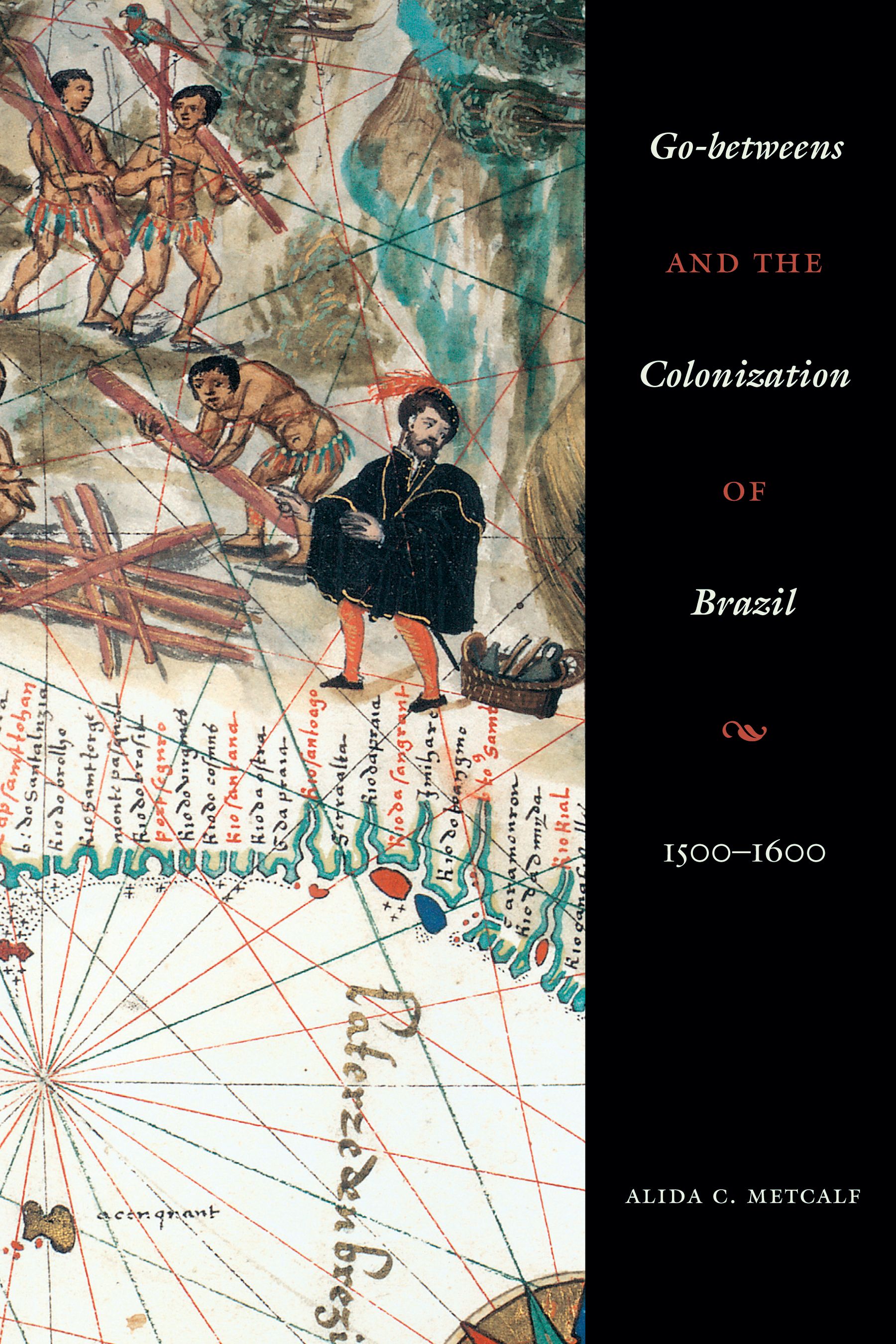
Go-betweens and the Colonization of Brazil
Doña Marina (La Malinche) ...Pocahontas ...Sacagawea—their names live on in historical memory because these women bridged the indigenous American and European worlds, opening the way for the cultural encounters, collisions, and fusions that shaped the social and even physical landscape of the modern Americas. But these famous individuals were only a few of the many thousands of people who, intentionally or otherwise, served as \"go-betweens\" as Europeans explored and colonized the New World. In this innovative history, Alida Metcalf thoroughly investigates the many roles played by go-betweens in the colonization of sixteenth-century Brazil. She finds that many individuals created physical links among Europe, Africa, and Brazil—explorers, traders, settlers, and slaves circulated goods, plants, animals, and diseases. Intercultural liaisons produced mixed-race children. At the cultural level, Jesuit priests and African slaves infused native Brazilian traditions with their own religious practices, while translators became influential go-betweens, negotiating the terms of trade, interaction, and exchange. Most powerful of all, as Metcalf shows, were those go-betweens who interpreted or represented new lands and peoples through writings, maps, religion, and the oral tradition. Metcalf's convincing demonstration that colonization is always mediated by third parties has relevance far beyond the Brazilian case, even as it opens a revealing new window on the first century of Brazilian history.
eBook


Death in the Snow
Pedro de Alvarado is best known as Cortés's right-hand man in the conquest of Mexico and the ruthless conqueror of Guatemala. Less known is his intent to intrude in the conquest of Peru and lay claim to the riches of the Inca Empire. Death in the Snow conveys the delusions of one headstrong conquistador and mourns the loss of countless Indigenous lives, casualties of Alvarado's lust for fame and fortune.
eBook

Miradas sobre Hernán Cortés
Reconocidos especialistas ofrecen al lector un conocimiento más justo y objetivo de un hombre [Texto de la editorial]
eBook


The Structure of Knowledge in Westernized Universities: epistemic racism/sexism and the four genocides/epistemicides of the long 16th century
This article is inspired by Enrique Dussel's historical and philosophical work on Cartesian philosophy and the conquest of the Americas. It discusses the epistemic racism/sexism that is foundational to the knowledge structures of the Westernized University. The article proposes that the epistemic privilege of Western Man in Westenized Universities' structures of knowledge, is the result of four genocides/epistemicides in the long 16th century (against Jewish and Muslim origin population in the conquest of Al-Andalus, against indigenous people in the conquest of the Americas, against Africans kidnapped and enslaved in the Americas and against women burned alive, accused of being witches in Europe). The article proposes that Dussel's argument in the sense that the condition of possibility for the mid-17th century Cartesian \"I think, therefore I am\" (ego cogito) is the 150 years of \"I conquer, therefor I am\" (ego conquiro) is historically mediated by the genocide/epistemicide of the \"I exterminate, therefore I am\" (ego extermino). The 'I exterminate' is the socio-historical structural mediation between the idolatric 'I think' and the 'I conquer.'
Journal Article

Seven myths of the Spanish conquest
Here is an intriguing exploration of the ways in which the history of the Spanish Conquest has been misread and passed down to become popular knowledge of these events. The book offers a fresh account of the activities of the best-known conquistadors and explorers, including Columbus, Cortés, and Pizarro. Using a wide array of sources, historian Matthew Restall highlights seven key myths, uncovering the source of the inaccuracies and exploding the fallacies and misconceptions behind each myth. This vividly written and authoritative book shows, for instance, that native Americans did not take the conquistadors for gods and that small numbers of vastly outnumbered Spaniards did not bring down great empires with stunning rapidity. We discover that Columbus was correctly seen in his lifetime--and for decades after--as a briefly fortunate but unexceptional participant in efforts involving many southern Europeans. It was only much later that Columbus was portrayed as a great man who fought against the ignorance of his age to discover the new world. Restall also shows that the Spanish Conquest relied heavily on black and native allies, who provided many thousands of fighters, vastly outnumbering the conquistadors. In fact, the native perception of the Conquest differed sharply from the Spanish version--they saw it as a native civil war in which the Spaniards played an important but secondary role. The Conquest, Restall shows, was more complex--and more fascinating--than conventional histories have portrayed it. Seven Myths of the Spanish Conquest offers a richer and more nuanced account of a key event in the history of the Americas.
eBook