
Catalogue Search | MBRL


Are you sure you want to remove the book from the shelf?

{{itemTitle}}
427
result(s) for
"Conservatism Case studies."
Sort by:


Bible-carrying Christians : conservative Protestants and social power
This book focuses on the relationship between conservative Protestants and social power in the U.S. The book, which is particularly concerned with which sorts of power relationships seem natural and which do not, is based on fieldwork (conducted in the early 1990s), in three Philadelphia churches: Oak Grove Church, Philadelphia Mennonite Fellowship, and the Philadelphia Church of Christ. The data drawn from that fieldwork suggests that in the early 1990s, Bible‐carrying Christian churches tended to naturalize (to various degrees) the authority of heterosexuals and men. The data also suggested that under certain (relatively rare) circumstances Bible‐carrying Christian churches denaturalized the authority of ministers, corporations, and nation‐states.
eBook

Memory Games: Dobbs's Originalism as Anti-Democratic Living Constitutionalism - and Some Pathways for Resistance
This Article examines originalism's role in overruling Roe v. Wade in Dobbs v. Jackson Women's Health Organization. Through this case study the Article explores competing understandings of originalism. It shows that originalism is not simply a value-neutral method of interpreting the Constitution. Originalism is also a political practice whose long-term goal has been the overturning of Roe. As the conservative legal movement has developed originalism, judicial appointments matter critically to originalism's authority, as do originalism's appeals to constitutional memory to legitimate the exercise of public power. Examining these different dimensions of originalism's authority, this Article shows that the conservative legal movement has practiced originalism as a form of living constitutionalism that makes our constitutional order less democratic in several important ways. To demonstrate how this is so, this Article returns to originalism's roots in the Reagan years and examines originalism's origins in a backlash to the decisions of the Warren and Burger Courts. In 1980, for the first time-and continuously ever since-the Republican Party's platform promised that \"[w]e will work for the appointment of judges at all levels of the judiciary who respect traditional family values and the sanctity of innocent human life.\" I examine the family-values politics from which the quest to overturn Roe emerged, the judicial screening practices developed to pursue it, and the talk of law and politics employed to justify it. This Article reads Dobbs through a double lens. I first consider how originalists have evaluated the originalism of the opinion (some term Dobbs \"living constitutionalist\") and then go on to show how Dobbs depends on the appointments politics and constitutional memory claims I have identified as part of the political practice of originalism. Dobbs's living constitutionalism serves contemporary movement goals: the history-and-traditions standard that Dobbs employs to overturn Roe threatens many of the same lines of cases targeted for reversal by the architects of originalism in the Reagan Administration. The deepest problem with Dobbs, however, is that its originalism is living constitutionalism that makes our constitutional order less democratic. Dobbs restricts and threatens rights that enable equal participation of members of historically marginalized groups; Dobbs locates constitutional authority in imagined communities of the past-entrenching norms, traditions, and modes of life associated with old status hierarchies; and Dobbs presents its contested value judgments as expert claims of law and historical fact to which the public owes deference. A concluding Part focuses on constitutional memory as a terrain of constitutional conflict and begins to ask questions about how claims on our constitutional past might be democratized, both inside and outside of originalism, in the aspiration to take back the Constitution from the Court.
Journal Article

The Americanization of Israeli Conservative Civil Society: A Critical Community and Transnational Transference Perspective
This article examines the Americanization of Israeli conservative civil society organizations (CSOs), by exploring how the transnational transfer of Jewish American philanthropy and the diffusion of conservative ideas influence the formation of right-wing Israeli CSOs, applying the theoretical framework of critical community. \"Critical Community\" is a concept describing the transference of ideas, ideologies, and cultural cues between protest groups in different countries. We explain the transnational diffusion of American conservative ideology using three case studies of Israeli CSOs that exhibit organizational trajectories affected by an American conservative model: The Tikvah Fund, Shalem Center, and the Kohelet Policy Forum. We trace the financial, ideational, and personal links between these CSOs and their American counterparts, shedding light on the significance of transnational relations between ideological groups across borders. Such a critical community enables philanthropic support for these organizations and the emergence of a conservative movement shaped by the flow of ideas from the United States to Israel.
Journal Article

Adaptive Observer Design with Fixed-Time Convergence, Online Disturbance Learning, and Low-Conservatism Linear Matrix Inequalities for Time-Varying Perturbed Systems
This paper proposes a finite-time adaptive observer with online disturbance learning for time-varying disturbed systems. By integrating parameter-dependent Lyapunov functions and slack matrix techniques, the method eliminates conservative static disturbance bounds required in prior work while guaranteeing fixed-time convergence. The proposed approach features a non-diagonal gain structure that provides superior noise rejection capabilities, demonstrating 41% better performance under measurement noise compared to conventional methods. A power systems case study demonstrates significantly improved performance, including 62% faster convergence and 63% lower steady-state error. These results are validated through LMI-based synthesis and adaptive disturbance estimation. Implementation analysis confirms the method’s feasibility for real-time systems with practical computational requirements.
Journal Article

Diversification is decoupled from biome fidelity
Aim To investigate species and clade biome occupancy patterns of Australian Acacia to test for within‐biome diversification, which indicate biome conservatism. Location Australia. Taxon Acacia (Fabaceae). Methods Species distributions were predicted for 481 Australian Acacia using the Thornley Transport Resistance Species Distribution Model and mapped across four biome typologies. Within Acacia 19 clades were identified. The number of biomes occupied and niche size was quantified for every species and clade using the range area projected by the distribution model. Relationships between clade species richness, niche size and biomes occupied were tested using phylogenetic least squares regression models. Results Only 9% of the Acacia 481 species and no clades were biome specialists. There were most specialist taxa in the Crisp Biome classification (8.7%), followed by WWF Biomes (6.2%), González–Orozco Biomes (5.0%) then Functional Biomes (1.2%). On average Acacia species occupied four WWF Biomes, seven Functional Biomes, three Crisp Biomes and three González–Orozco Biomes (out of 7, 13, 5 or 6 biomes respectively). Clades were also distributed across multiple biomes (2–13) with a significant positive relationship between clade species richness and the number of biomes occupied for all biome typologies. Species richness had positive linear relationships with biome area for all biome concepts except the González–Orozco Biomes. Larger clades had larger niche sizes. Main conclusions Acacia diversification occurred across biome boundaries and was not associated with biome specialization. Species and clades mainly occurred in multiple biomes, and there were typically few biome specialists. Diversification in Acacia appears to be decoupled from biome conservatism, associated with expanding niche size across biome boundaries. Major ecological–environmental units such as biomes may constrain adaptive radiation processes via biome conservatism in many groups, but this study leads us to hypothesize that for some lineages biome boundaries are permeable.
Journal Article
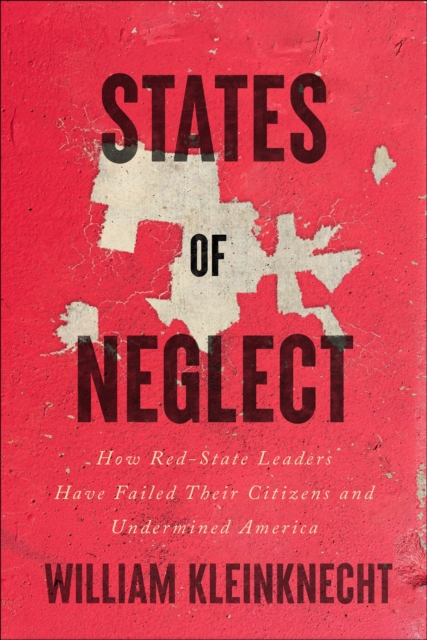
States of Neglect
As America continues down its path of polarization, a
celebrated journalist tells us the deep story of the
red-state/blue-state divide
In the wake of Trump’s presidency, Republican-led
states have joined in an alarming assault on our democratic
system. But the drift toward authoritarianism in red states has
far deeper roots. We now have a country where tens of millions
of people live under regimes that have spent years starving
education and health care, empowering polluters, engaging in
voter suppression, and neglecting their citizens’
well-being in the interest of cutting taxes for the
wealthy.
In
States of Neglect , journalist William Kleinknecht
surveys the landscape of neglect in states including Texas,
Florida, and Arizona through the experiences of a rich cast of
characters. He visits environmental dead zones in the Texas
Gulf region. He investigates Arizona’s abandonment of
public education and its corrupt charter school industry. He
shows how Mississippi’s denuded health care system has
made the Magnolia State the sickest in the nation. And he
explains how North Carolina allows its people to sink into
poverty while catering to the needs of corporations.
As a postscript, Kleinknecht proposes how progressive states
on either coast might join in a compact of “progressive
federalism” that uses their superior economic and
cultural resources to counter the influence of the far
right.
eBook

From green crap to net zero: Conservative climate policy 2015–2022
This article outlines the Conservative Party’s approach to climate change from 2015 to 2022; focusing on its governing policy record and the wider political considerations that shaped it. During this time, the Conservatives’ mixed performance reflected competing political incentives for its leaders and internal party division on the issue. A detailed exploration of Conservative climate policies allows for two broader contributions. European centre-right parties often face common strategic challenges, such as competition from the radical right, but the UK Conservative Party case study shows that responding to these challenges does not necessarily demand the abandonment of climate commitments. We also find evidence that in this period climate change embodied characteristics of both a positional and a valence issues.
Journal Article

Brexit and party change
This article analyses the extent of party change in response to the vote for Brexit in the Conservative Party and the Labour Party. It focuses particularly on how both parties struggled to manage internal divisions and ideological conflict, and how each sought to manage the issue in terms of party competition. It argues that the Conservative Party victory at the 2019 UK general election was the result of an ultimately more effective response to the electoral dynamics unleashed by Brexit, as the party adjusted its position to successfully mobilise the coalition of Leave voters into party competition, while Labour struggled to do the same with Remain voters. In short, it suggests that substantial party change, particularly by the Conservatives, effectively averted major party system change and the realignment of British politics many analysts predicted. This case study analysis consequently contributes to the wider theoretical literature on external system shocks and party change.
Journal Article

It Just Feels Right. Visuality and Emotion Norms in Right-Wing Populist Storytelling
Abstract
This paper contributes to debates on the growing appeal of right-wing populism by combining a focus on visuality, narratives, and emotions. We argue that right-wing populists’ claims extend to establishing alternative emotion norms that collectivize feelings and their expression, and are conveyed in visual narratives. The emotional range covered by these norms transcends emotions usually associated with right-wing populism such as fear or humiliation. By employing seemingly inoffensive modes of presentation, emotional responses including indignation, compassion, and schadenfreude can be used as narrative bait for hitherto uninterested audiences. Following from that, emotion norms, such as exclusive forms of sympathy and humor, can be established. We illustrate our argument in three short case studies from Austria, France, and Italy. The conceptual and methodological insights are particularly relevant for those interested in the power of emotions, different modes of visual storytelling in world politics, and the performative effects of right-wing populist practices and narratives in politics.
Journal Article