
Catalogue Search | MBRL


Are you sure you want to remove the book from the shelf?

{{itemTitle}}
114
result(s) for
"Conservatism Soviet Union."
Sort by:

Russian Conservatism
\"Examines the history of Russian conservative thought from the beginning of the nineteenth century to the present\"-- Provided by publisher.
Book


Russian Conservatism
Paul Robinson's Russian Conservatism examines the history of Russian conservative thought from the beginning of the nineteenth century to the present. As he shows, conservatism has made an underappreciated contribution to Russian national identity, to the ideology of Russian statehood, and to Russia's social-economic development. Robinson charts the contributions made by philosophers, politicians, and others during the Imperial, Soviet, and post-Soviet periods. Looking at cultural, political, and social-economic conservatism in Russia, he discusses ideas and issues of more than historical interest. Indeed, whatRussian Conservatism demonstrates is that such ideas are helpful in interpreting Russia's present as well as its past and will be influential in shaping Russia's future, for better or for worse, in the years to come.
For the past two centuries Russian conservatives have sought to adapt to the pressures of modernization and westernization and, more recently, globalization, while preserving national identity and political and social stability. Through Robinson's research we can now understand how Russian conservatives have continually proposed forms of cultural, political, and economic development seen as building on existing traditions, identity, forms of government, and economic and social life, rather than being imposed on the basis of abstract theory and foreign models.
eBook
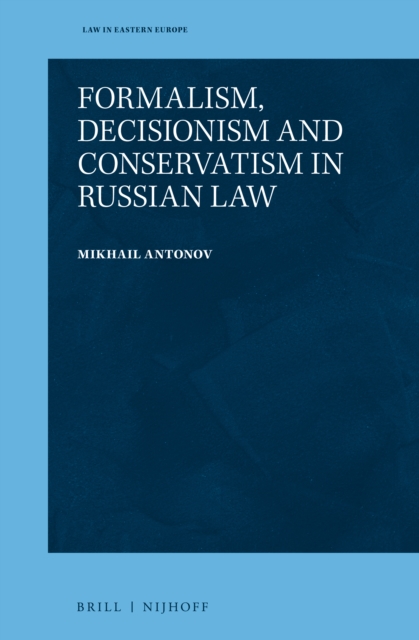
Formalism, decisionism and conservatism in Russian law
This volume examines the elements of formalism and decisionism in Russian legal thinking and, also, the impact of conservatism on the interplay of these elements. This combination leads to internal contradictions in theorizing about law and rights in Russian legal culture.
eBook

Paradoxical Russian nationalism in the Soviet context: a contentious literary debate in 1969–1970
A literary debate occurred during 1969 and 1970 as Soviet society stepped into the holistic transition to conservatism. In the debate process, liberals in the journal Novyi Mir interpreted Soviet patriotism based on cultural pluralism and censured Russian nationalists of the journal Molodaia Gvardiia for deviating from Lenin’s ideas on the nationality question and obscuring the demarcation between patriotism and Russian chauvinism. Conversely, nationalists in Molodaia Gvardiia emphasized their validity in reviving the Russian tradition to defend the national culture from Western cultural penetration and responded that Western cosmopolitanism was the innate character behind the words of Novyi Mir. The contention gradually stirred up so much public attention that Soviet authorities decided to quiet down the contestation. Eventually, the editorial boards of Novyi Mir and Molodaia Gvardiia were reshuffled, although the Soviet authorities sheltered Molodaia Gvardiia to some degree. The result of the debate was affected by a combination of synthesized factors: the background of rising Russian nationalism, the ideological rhetoric of the debate, and the influences of the opinions of international media and officials toward either side. Whatever individual preferences the authorities had, the principles of the Era of Stagnation (Zastoi) were the guidelines in dealing with the debate.
Journal Article

Challenges and promises of comparative research into post-Soviet fascism: Methodological and conceptual issues in the study of the contemporary East European extreme right
The international study of fascism has, over the last 25 years, experienced considerable consolidation. Inspired by influential theoretical publications of Roger D. Griffin and others, a new sub-discipline, “comparative fascist studies,” has emerged that proceeds from a largely common conceptualization of fascism. It explicitly includes and particularly promotes the cross-cultural, as well as inter-epochal investigation into ultra-nationalisms outside Central and Western Europe after the year 1945. The concepts, approaches and hypotheses of this new sub-discipline are well-suited to be applied to the study of inter-war and post-Soviet right-wing radicalism in Eastern Europe. However, before comprehensive classification and informative comparison becomes possible, the putative fascist phenomena of Eastern Europe need more thorough descriptive analysis, field research, and empirical investigation by researchers, in the region.
Journal Article

Medicine, Law, and the State in Imperial Russia
Examines the theoretical and practical outlook of forensic physicians in Imperial Russia, from the 18th to the early 20th centuries, arguing that the interaction between state and these professionals shaped processes of reform in contemporary Russia. It demonstrates the ways in which the professional evolution of forensic psychiatry in Russia took a different turn from Western models, and how the process of professionalization in late imperial Russia became associated with liberal legal reform and led to the transformation of the autocratic state system.
eBook
Subjects of the Empress. Wider Context of Regional History Education on East Prussia and Identity Processes in Contemporary Kaliningrad Oblast
Political, economic and social changes brought about by the dissolution of the Soviet Union have had a significant impact on Kaliningrad Oblast, the empire’s westernmost territory of geostrategic importance. Formerly belonging to the German province of East Prussia, the region was meant to become Sovietised completely. The end of the Cold War led to a complete bankruptcy of such policies. At the turn of the 80s and 90s the emergence of a grass-roots interest in the officially forbidden parts of the Oblast’s history made the question of the relation between its pre-war and postwar past up-to-date. Its topicality was strengthened after the 2005-06 commemorations of founding the city of Königsberg and Kaliningrad Oblast, in which both central and regional authorities were heavily involved. This paper aims at identifying how elements of the history of East Prussia have been selected, interpreted and incorporated into the regional history education course books in contemporary Kaliningrad Oblast. It argues that the growing criticism of the course books’ contents has been related to Russia’s domestic situation since the 2012 presidential election and the tensions with the West after 2014. Both events have hastened the process of forming and cementing the so-called new Russian conservatism which has had a growing influence on the Baltic semiexclave.
Journal Article

Constructing Japan's 'Northern Territories'
This article seeks to contribute both to the scholarly debate on Japan's territorial dispute with USSR/Russia and to the broader body of academic literature devoted to the ideational factor in foreign policy. By focusing on the formative years of the dispute and examining the variety of symbolic meanings attached to the Soviet-occupied islands by the domestic actors, this article examines the process of the emergence of the idea of the 'Northern Territories' as a national mission. It argues that the formation and institutionalization of the idea of the 'Northern Territories' in its present form can be traced to a complex web of power relations among the domestic actors, none of which perceived the return of the territory as its ultimate goal.
Journal Article

Idea and Institution: Russkii Mir between Cultural Mission and Geopolitics
Founded in 2007, the foundation Russkii mir is officially in charge of promoting Russian culture abroad. As the name \"Russian world\" suggests, it is only partly comparable with the cultural institutes of other countries: the concept russkii mir goes back to the Slavophiles of the 19th century and the Eurasians. After the demise of the Soviet Union, their ideas combined with other anti-Western currents to form an ideological conglomerate that now apparently represents the basis of Russia's international cultural policy. It is basically conservative and neo-imperial. In the post-Soviet space, the foundation openly pursues political aims. Adapted from the source document.
Journal Article