
Catalogue Search | MBRL


Are you sure you want to remove the book from the shelf?

{{itemTitle}}
3,763
result(s) for
"Constable, John"
Sort by:

The Use of Scanning XRF to Map the Reduction in Foxing Stains on Paper with Chelating Agents
To reduce staining, paper conservators have increasingly treated artworks on paper with enhanced washing using chelating agents, which form complexes with metallic ions, thus facilitating the removal of stains. However, questions remain regarding the efficacy of the method and its impact on the long-term preservation of paper. A treatment of enhanced washing was undertaken on a nineteenth-century mezzotint printed using the chine collé technique, by David Lucas after a painting by John Constable, which was disfigured by significant foxing stains. This intervention provided the opportunity to investigate the mechanism and efficacy of the treatment and whether an alkali reserve could successfully be reintroduced. The print was analysed before, during, and after treatment with a Bruker M6 Jetstream scanning X-ray fluorescence (XRF) spectrometer. The results provided spatially resolved information on the effects of the treatment and gave new insights into the heavily debated causes of foxing on paper, challenging the link with iron contamination. Instead, the distribution of foxing stains showed a correlation with the presence of potassium and calcium, and their reduction during washing corresponded with an improvement in appearance. Calcium replenishment proved only partially successful. Finally, scanning XRF has rarely been used for the analysis of artworks on paper; this study proves its value for research.
Journal Article


John Constable (1776–1837), Archdeacon Fisher, and the ‘Garter Painting’
On Aug 9, 1829, a crate arrived at Leydenhall, the home of the Archdeacon of Salisbury, John Fisher. The crate contained a painting by John Constable. Fisher and Constable had been close friends for years. Obviously the painting Constable sent to the Fishers was an important work. As we see, Fisher described the picture, in the phrase beginning 'Your case containing the', not in words but with a rebus, which was evidently designed to serve as his personal comment on the work, and thus should have served as a means of identifying the picture. Fisher clearly associated the picture with Constable's new position, but why would he have drawn this rebus in reference to the painting in question? To answer this we have to examine the year 1829 from the perspective of John Constable's career.
Journal Article

Gericault, Delacroix and Constable's The Hay Wain
All art treasures are prone to fabled accounts, none more pertinent to Anglo-French artistic relations of the 1820s than Constable's The Hay Wain. It is a familiar axiom, repeated incessantly, that after its prominent exhibition in Paris in the Salon of 1824, the so-called 'Salon anglais', the work became entrenched in art-historical lore as a singular icon that transformed French artistic sensibilities in landscape depiction, much to the regret of Ruskin. The influence that Constable's works in the exhibition had on French painters was noted for decades and was most emphatically expressed by the anglophile critic Ernest Chesneau, who paid homage specifically to The Hay Wain when he affirmed that the painting 'firent en France un effet extraordinaire' and that 'notre grande ecole de paysage modern se rattache directement a lui [Constable]'.
Journal Article
John Constable et la mélancolie du paysage
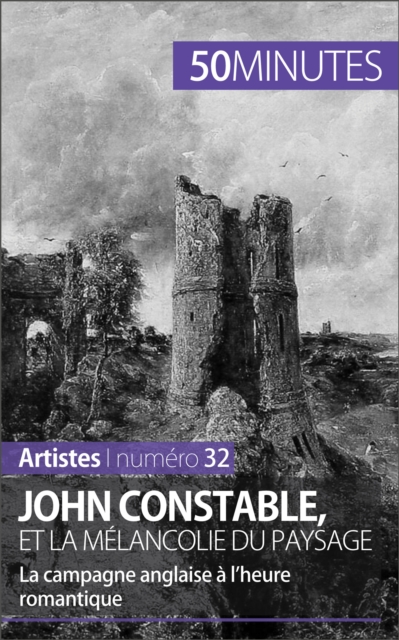
Décryptez l'art de John Constable en moins d'une heure!
Considéré comme l'un des plus grands peintres paysagistes anglais aux côtés de son éternel rival, William Turner, John Constable puise son inspiration dans l'univers qui lui est familier: la campagne anglaise de l'East Anglia. Avec le ciel pour cadre principal de ses toiles, il cherche inlassablement à faire ressortir la beauté et la vitalité de la nature, peignant les reflets de l'eau, les jeux de lumière dans les feuilles des arbres ou encore les mouvements des nuages. Ce livre vous permettra d'en savoir plus sur: •Le contexte socio-politique dans lequel John Constable s'inscrit
•La vie de l'artiste et son parcours
•Les caractéristiques et spécificités de son art
•Une sélection d'œuvres-clés de Constable
•Son impact dans l'histoire de l'art Le mot de l'éditeur:
« Dans ce numéro de la série \"50MINUTES | Artistes\", Thomas Jacquemin part sur les traces de John Constable. Évoquant sa vie et son art, l'auteur met surtout l'accent sur la sensibilité du peintre et son œuvre incroyablement romantique. Parmi les toiles les plus célèbres de Constable, Thomas Jacquemin aborde notamment La Vallée de Dedham et La Cathédrale de Salisbury vue du jardin de l'évêché. Mais nous avons également tenu à insister sur la postérité de Constable: la peinture du célèbre Eugène Delacroix, entre autres, n'aurait certainement pas été ce qu'elle est sans l'artiste britannique! »
Stéphanie Felten À PROPOS DE LA SÉRIE 50MINUTES | Artistes
La série « Artistes » de la collection « 50MINUTES » aborde plus de cinquante artistes qui ont profondément marqué l'histoire de l'art, du Moyen Âge à nos jours. Chaque livre a été conçu à la fois pour les passionnés d'art et pour les amateurs curieux d'en savoir davantage en peu de temps. Nos auteurs analysent avec précision les œuvres des plus grands artistes tout en laissant place à toutes les interprétations.
eBook

Clouds Are Soul: Goethe Versus P. H. Valenciennes on Caspar David Friedrich’s Sublime Representation of Sky
The representation of atmospheric phenomena and, in particular, clouds was a prominent theme for painters during the transition from the eighteenth to the nineteenth centuries. During this period, under the influence of rationalism and encyclopedism, Luke Howard’s cloud classification (1803) was proposed, gaining followers among scientists and artists of the time. Among the latter, Goethe was instrumental, as he intensely promoted this cloud classification, even dedicating his own poems and drawings to it. From then on, some painters depicted cloud studies following the academic principles recommended by Goethe. Caspar David Friedrich did not adopt these principles and depicted clouds as bodies endowed with freedom and feeling, as fragments of soul. The work of P. H. de Valenciennes played a prominent role in this approach; it was translated into German and became a reference manual for Romantic landscape painting. This paper addresses the scientific and cultural context of that historical moment, studies the importance of the landscape, and its aerial aspect, in the painting of the time and details the role of Friedrich as a singular author of German Romanticism, who did not want to participate in the academic ideas of representing clouds, since the sky was, for this painter, a symbol of the transcendent.
Journal Article

John Constable, Luke Howard, and the Aesthetics of Climate
In early nineteenth-century Britain, the painter John Constable and meteorologist Luke Howard experimented with new aesthetic forms in response to the challenges climate posed to representation. In landscape paintings, sketches, tables, and graphs, the artist and scientist grappled with climate's temporal scale, which extended beyond the domain of immediate \"feeling\" associated with landscape representation. Their efforts to construct a stable representation of England's climate took shape against the polluted atmosphere of industrial, imperial London, and in tandem with the modern state's disciplinary visuality. In their work, an aesthetics of climate emerged that was responsive to an environment increasingly known through numeric data and abstraction.
Journal Article

Life slips: work, love, and gender in John Constable's Correspondence
[...] many of the recurrent tropes, themes, and character traits Julie Codell has discovered in late-Victorian serialized biographies of artists (\"Serialized\")-simplicity and modesty, childlike attitudes, affability, independence, respectability, domesticity, and a life uneventful but for its incessant labor-are heralded by Leslie's discerning selection from the correspondence. [...] Anthony Bailey's 2006 biography John Constable: A Kingdom of his Own rebalances Leslie's selection from the correspondence to draw attention to the \"darkness visible in Constable's life and works,\" and to argue that the artist was \"torn between his two ambitions ... to perfect his life and perfect his work\" (xvii).
Journal Article