
Catalogue Search | MBRL


Are you sure you want to remove the book from the shelf?

{{itemTitle}}
370,069
result(s) for
"Constitutional "
Sort by:

Comparative constitutional reasoning
To what extent is the language of judicial opinions responsive to the political and social context in which constitutional courts operate? Courts are reason-giving institutions, with argumentation playing a central role in constitutional adjudication. However, a cursory look at just a handful of constitutional systems suggests important differences in the practices of constitutional judges, whether in matters of form, style, or language. Focusing on independently-verified leading cases globally, a combination of qualitative and quantitative analysis offers the most comprehensive and systematic account of constitutional reasoning to date. This analysis is supported by the examination of eighteen legal systems around the world including the European Court of Human Rights and the European Court of Justice. Universally common aspects of constitutional reasoning are identified in this book, and contributors also examine whether common law countries differ to civil law countries in this respect.-- Provided by Publisher.
Book

Constitutional Faith
This book examines the \"constitutional faith\" that has, since 1788, been a central component of American \"civil religion.\" By taking seriously the parallel between wholehearted acceptance of the Constitution and religious faith, Sanford Levinson opens up a host of intriguing questions about what it means to be American. While some view the Constitution as the central component of an American religion that serves to unite the social order, Levinson maintains that its sacred role can result in conflict, fragmentation, and even war. To Levinson, the Constitution's value lies in the realm of the discourse it sustains: a uniquely American form of political rhetoric that allows citizens to grapple with every important public issue imaginable.
In a new afterword, Levinson looks at the deepening of constitutional worship and attributes the current widespread frustrations with the government to the static nature of the Constitution.
eBook

Assessing constitutional performance
\"From London to Libya, from Istanbul to Iceland, there is great interest among comparative constitutional scholars and practitioners about when a proposed constitution is likely to succeed. But what does it mean for a constitution to succeed? Are there universal criteria of success, which apply across the board? Or is the choice of criteria entirely idiosyncratic? This edited volume takes on the idea of constitutional success and shows the manifold ways in which it can be understood. It collects essays from philosophers, political scientists, political scientists, empiricists, and legal scholars, that approach the definition of constitutional success from many different angles. It also brings together case studies from Africa, Europe, Latin America, the Middle East, and Asia. By exploring a varied array of constitutional histories, this book shows how complex ideas of 'constitutional success' play out differently in different contexts and provides examples of how \"success\" can be differently defined under different circumstances\"-- Provided by publisher.
Book

Constitution for a Disunited Nation
This collection is the most comprehensive account of the Fundamental Law and its underlying principles. The objective is to analyze this constitutional transition from the perspectives of comparative constitutional law, legal theory and political philosophy. The authors outline and analyze how the current constitutional changes are altering the basic structure of the Hungarian State. The key concepts of the theoretical inquiry are sociological and normative legitimacy, majoritarian and partnership approach to democracy, procedural and substantive elements of constitutionalism. Changes are also examined in the field of human rights, focusing on the principles of equality, dignity, and civil liberties.
eBook


Law and New Governance in the EU and the US
New approaches to governance have attracted significant scholarly attention in recent years. Commentators on both sides of the Atlantic have identified, charted and evaluated the rise and spread of forms of governance, forms which seem to differ from previous regulatory and legal paradigms. In Europe, the emergence of the Open Method of Coordination has provided a focal point for new governance studies.
eBook


Restoring the Lost Constitution
The U.S. Constitution found in school textbooks and under glass in Washington is not the one enforced today by the Supreme Court. InRestoring the Lost Constitution, Randy Barnett argues that since the nation's founding, but especially since the 1930s, the courts have been cutting holes in the original Constitution and its amendments to eliminate the parts that protect liberty from the power of government. From the Commerce Clause, to the Necessary and Proper Clause, to the Ninth and Tenth Amendments, to the Privileges or Immunities Clause of the Fourteenth Amendment, the Supreme Court has rendered each of these provisions toothless. In the process, the written Constitution has been lost.
Barnett establishes the original meaning of these lost clauses and offers a practical way to restore them to their central role in constraining government: adopting a \"presumption of liberty\" to give the benefit of the doubt to citizens when laws restrict their rightful exercises of liberty. He also provides a new, realistic and philosophically rigorous theory of constitutional legitimacy that justifies both interpreting the Constitution according to its original meaning and, where that meaning is vague or open-ended, construing it so as to better protect the rights retained by the people.
As clearly argued as it is insightful and provocative,Restoring the Lost Constitutionforcefully disputes the conventional wisdom, posing a powerful challenge to which others must now respond.
This updated edition features an afterword with further reflections on individual popular sovereignty, originalist interpretation, judicial engagement, and the gravitational force that original meaning has exerted on the Supreme Court in several recent cases.
eBook

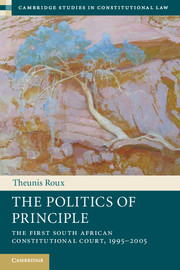
The Politics of Principle
Under its first chief justice, Arthur Chaskalson, the South African Constitutional Court built an unrivalled reputation in the comparative constitutional law community for technically accomplished and morally enlightened decision-making. At the same time, the Court proved remarkably effective in asserting its institutional role in post-apartheid politics. While each of these accomplishments is noteworthy in its own right, the Court's simultaneous success in legal and political terms demands separate investigation. Drawing on and synthesising various insights from judicial politics and legal theory, this study offers an interdisciplinary explanation for the Chaskalson Court's achievement. Rather than a purely political strategy of the kind modelled by rational choice theorists, the study argues that the Court's achievement is attributable to a series of adjudicative strategies in different areas of law. In combination, these strategies allowed the Court to satisfy institutional norms of public reason-giving while at the same time avoiding political attack.
eBook