
Catalogue Search | MBRL


Are you sure you want to remove the book from the shelf?

{{itemTitle}}
808
result(s) for
"Constitutional law Asia."
Sort by:

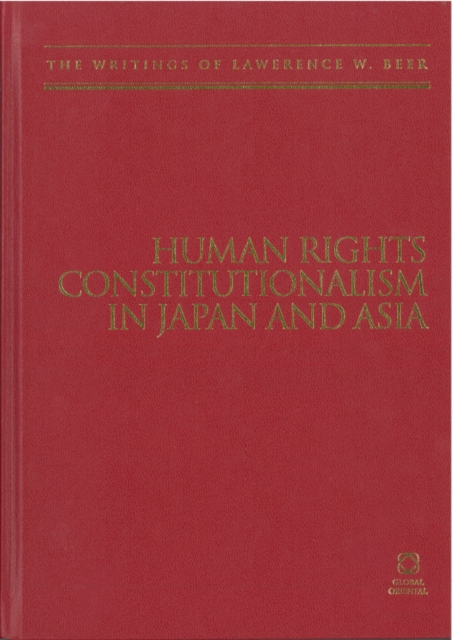
Human Rights Constitutionalism in Japan and Asia
The collection opens with a review of constitutionalism in Asia and the United States and concludes with a recent examination of Japan's rejection of war: 'Japan's Constitutional Discourse and Performance'. By way of Afterword, the author offers an in-depth review of 'Globalization of Human Rights in the 21st Century'.
eBook


Central-local Relations in Asian Constitutional Systems
This book examines territorial governance in Asia in the context of central-local relations. In an era of attempts to deal with issues such as decentralisation, conflict involving ethnic and religious enclaves, and demands for regional autonomy, it is timely to examine central-local relations from a pan-Asian perspective, assessing the attempts in a range of different systems, federal and unitary, to re-order constitutional structures for territorial governance, including local government. The book looks at the constitutional systems for organising central-local relations of this kind, and attempts to draw conclusions from contemporary experiences.
eBook

Courts and democracies in Asia
\"What is the relationship between the strength of a country's democracy and the ability of its courts to address deficiencies in the electoral process? Drawing a distinction between democracies that can be characterised as 'dominant-party' (for example Singapore, Malaysia, and Hong Kong), 'dynamic' (for example India, South Korea, and Taiwan), and 'fragile' (for example Thailand, Pakistan ,and Bangladesh), this book explores how democracy sustains and is sustained by the exercise of judicial power. In dominant-party systems, courts can only pursue 'dialogic' pathways to constrain the government's authoritarian tendencies. On the other hand, in dynamic democracies, courts can more successfully innovate and make systemic changes to the electoral system. Finally, in fragile democracies, where a country regularly oscillates between martial law and civilian rule, their courts tend to consistently overreach, and this often facilitates or precipitates a hostile take-over by the armed forces, and lead to the demise of the rule of law\"-- Provided by publisher.
Book

The constitutional systems of East Asia
This volume, which is part of the Comparative Public Law Treaties directed by prof.Giuseppe Franco Ferrari, offers the result of a reflection on the characteristics of the constitutional laws of East Asia.
eBook


South Asian Constitutional Systems
This book examines the South Asian constitutional systems (India 1950, Bangladesh 1972, Pakistan 1973, Sri Lanka 1978, Bhutan 2008, Nepal 2015), adopting a comparative law and 'contextual' approach.Social diversity is the main feature of this geographical region, vast in dimension, also according to its demographic profile.
eBook

Social difference and constitutionalism in Pan-Asia
\"One of the most vexing problems in the theory and practice of politics is the issue of difference. How do we build a just and stable polity in the face of identity differences that have historically been the basis for inequality, injustice, and violence? Such differences can take a variety of forms, including religious difference, race and ethnicity, language difference, urban/rural tensions, and gender. In many countries, divisions such as these are the fault lines that threaten the stability of the social and legal order. This book addresses the role of constitutions and constitutionalism in dealing with the challenge of difference. In the spring of 2011, a conference held at Indiana University brought together a distinguished group of lawyers, political scientists, historians, religious studies scholars, and area studies experts to consider how constitutions and constitutionalism address issues of difference across a wide swath of the world we called \"Pan-Asia.\" Pan-Asia runs from the Middle East, through Central Asia, South Asia, Southeast Asia, East Asia, and into Oceania. This is a meta-region across which ideas and influences have traveled for centuries. It is also an area of the world that includes every type of difference in abundant supply. Pan-Asia, therefore, provides a wonderful laboratory for examining the role of constitutions in addressing difference. The existing literatures, while rich in other ways, do not speak directly to this issue of constitutions as a mechanism for addressing difference. There is a vast political theory literature on the relationship between democracy and difference\"-- Provided by publisher.
Book
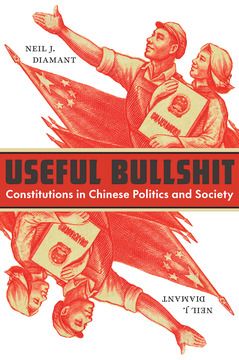
Useful Bullshit
In Useful Bullshit
Neil J. Diamant pulls back the curtain on early
constitutional conversations between citizens and officials in the
PRC. Scholars have argued that China, like the former
USSR, promulgated constitutions to enhance its domestic and
international legitimacy by opening up the constitution-making
process to ordinary people, and by granting its citizens political
and socioeconomic rights. But what did ordinary officials and
people say about their constitutions and rights? Did constitutions
contribute to state legitimacy?
Over the course of four decades, the PRC government encouraged
millions of citizens to pose questions about, and suggest revisions
to, the draft of a new constitution. Seizing this opportunity,
people asked both straightforward questions like \"what is a
state?\", but also others that, through implication, harshly
criticized the document and the government that sponsored it. They
pressed officials to clarify the meaning of words, phrases, and
ideas in the constitution, proposing numerous revisions. Despite
many considering the document \"bullshit,\" successive PRC
governments have promulgated it, amending the constitution,
debating it at length, and even inaugurating a \"Constitution
Day.\"
Drawing upon a wealth of archival sources from the Maoist and
reform eras, Diamant deals with all facets of this constitutional
discussion, as well as its afterlives in the late '50s, the
Cultural Revolution, and the post-Mao era. Useful Bullshit
illuminates how the Chinese government understands and makes use of
the constitution as a political document, and how a vast array of
citizens-police, workers, university students, women, and members
of different ethnic and religious groups-have responded.
eBook