
Catalogue Search | MBRL


Are you sure you want to remove the book from the shelf?

{{itemTitle}}
5,093
result(s) for
"Construction industry Environmental aspects."
Sort by:

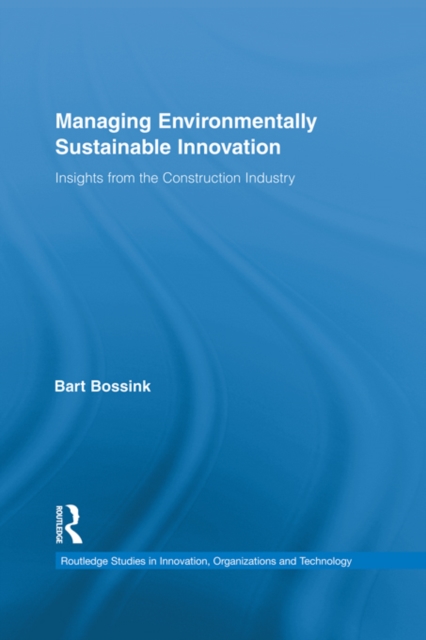
Managing Environmentally Sustainable Innovation
A paradigm shift is happening at this moment. Firms and consumers are aware of the fact that they cause environmental pollution, depletion of resources and are responsible for the dangers involved. At the same time awareness is growing that they need to and will develop the appropriate solutions in the time to come. The idea that sustainable, cyclic businesses are more logical than consumption-oriented and waste-dumping ones seems fascinating to a growing number of people. For this change to happen new thinking and behavior is needed.
Firms and consumers play a central role in a sustainable business. Companies deliver what consumers buy and vice versa. In a sustainable paradigm, companies are able to develop and produce sustainably. Therefore, companies need new management concepts for sustainable investment, manufacturing, logistics and marketing and for sustainable management.
In Managing Environmentally Sustainable Innovation, Bossink evaluates the innovation chain in a process of five consecutive stages, articulates five levels at which people collectively manage the chain, and analyzes the interplay between the two. Acquainting the reader with the complexities of innovation, as well as which complexities are active in the management of environmental sustainability, this book offers guiding principles and a toolbox for the management of environmentally sustainable innovation in construction.
eBook

Portugal SB07. Sustainable Construction, Materials and Practices
The construction industry is a vibrant and active industry. The building sector is responsible for creating, modifying and improving the living environment of humanity. On the other hand, construction and buildings have considerable environmental impacts, consuming a significant proportion of limited resources of the planet including energy, raw material, water and land. Therefore, the sustainability of the built environment, the construction industry and the related activities is a pressing issue facing all stakeholders in order to promote Sustainable Development. The new millennium is challenging practitioners and researchers with the sustainability of the built environment and the construction industry. Hence, the main purpose of this publication is to discuss these challenges and present solutions that actively facilitate and promote the adoption of policies, methods and tools to accelerate the movement towards a global sustainable built environment. The issues presented include: Building sustainability assessment tools; Indoor environment quality and benchmarks; Sustainable resources and materials use; Use of non-conventional materials; Use of industrial waste; Eco-materials and technologies; Sustainable management of existing building stock; Innovative sustainable construction systems; and Design.
eBook
Nanotechnology in Eco-Efficient Construction
As the environmental impact of existing construction and building materials comes under increasing scrutiny, the search for more eco-efficient solutions has intensified. Nanotechnology offers great potential in this area and is already being widely used to great success. Nanotechnology in eco-efficient construction is an authoritative guide to the role of nanotechnology in the development of eco-efficient construction materials and sustainable construction.Following an introduction to the use of nanotechnology in eco-efficient construction materials, part one considers such infrastructural applications as nanoengineered cement-based materials, nanoparticles for high-performance and self-sensing concrete, and the use of nanotechnology to improve the bulk and surface properties of steel for structural applications. Nanoclay-modified asphalt mixtures and safety issues relating to nanomaterials for construction applications are also reviewed before part two goes on to discuss applications for building energy efficiency. Topics explored include thin films and nanostructured coatings, switchable glazing technology and third generation photovoltaic (PV) cells, high-performance thermal insulation materials, and silica nanogel for energy-efficient windows. Finally, photocatalytic applications are the focus of part three, which investigates nanoparticles for pollution control, self-cleaning and photosterilisation, and the role of nanotechnology in manufacturing paints and purifying water for eco-efficient buildings.Nanotechnology in eco-efficient construction is a technical guide for all those involved in the design, production and application of eco-efficient construction materials, including civil engineers, materials scientists, researchers and architects within any field of nanotechnology, eco-efficient materials or the construction industry.Provides an authoritative guide to the role of nanotechnology in the development of eco-efficient construction materials and sustainable constructionExamines the use of nanotechnology in eco-efficient construction materialsConsiders a range of important infrastructural applications, before discussing applications for building energy efficiency
eBook


Design Economics for the Built Environment
The drive towards environmentally friendly buildings and infrastructure has led to a growing interest in providing design solutions underpinned by the core principles of sustainability to balance economic, social and environmental factors. Design Economics for the Built Environment: Impact of sustainability on project evaluation presents new directions, reflecting the need to recognise the impact of climate change and the importance of sustainability in project evaluation. The aim is to provide a new approach to understanding design economics in the context of the changing policy environment, legislative and regulatory framework, and increasing economic, environmental and social pressure as result of the sustainability agenda. The book follows a structured approach from theories and principles in the earlier chapters, to the practical applications and emerging techniques focusing on value and social, economic and environmental considerations in making design decisions. It starts with the policy context, building on various theories and principles such as, capital cost, value of design and resource-based theories, the new rules of measurement (NRM) to explore cost planning, the relationship between height and costs, key socio-economic and environmental variables for design appraisal, eco-cost/value ratio (EVR), whole life theory and the treatment of carbon emission as external costs, productivity and efficiency, fiscal drivers and legal framework for carbon reduction, procurement and allocation of risks in contracts. Case studies, practical examples and frameworks throughout reinforce theories and principles and relate them to current practice. The book is essential reading for postgraduate students in architecture, building and quantity surveying and is also a valuable resource for academics, consultants and policy-makers in the built environment.
eBook

Nanotechnology in Eco-Efficient Construction
As the environmental impact of existing construction and building materials comes under increasing scrutiny, the search for more eco-efficient solutions has intensified.Nanotechnology offers great potential in this area and is already being widely used to great success.
eBook

Environmental concerns in Malaysian construction industry
As the construction industry continues to develop within the natural environment, the industry has to take strong measures to ensure that its activities are in harmony with the environment. The challenge for the construction sector is not just to respond to the need for adequate housing and rapid urbanisation, but to do it in a way that is socially and ecologically responsible. This book begins with the current progress of the construction industry in Malaysia before shifting to the fragile relationship between construction and environment. Knowing the rapid development in Malaysia and how construction can affect the environment, this book delves into some evidence of environmental degradation in Malaysia. In the mist of degradation, there is some light shone by the government agencies, state government and some construction players who have initiated several actions to improve present situation. Construction players must be ready to address these concerns, aware of the requirements and comply with it, while the government must be ready to implement and enforce the requirement. An effective planning, implementation and monitoring is vital if the environment is to be part of the culture of the construction industry everywhere.
eBook

Construction for a Sustainable Environment
With a focus on engineered waste disposal by landfill, contaminated land, exploitation of mineral resources and the consequences, and waste disposal, this book provides a forum for new developments relating to the interaction between construction and the environment.
eBook
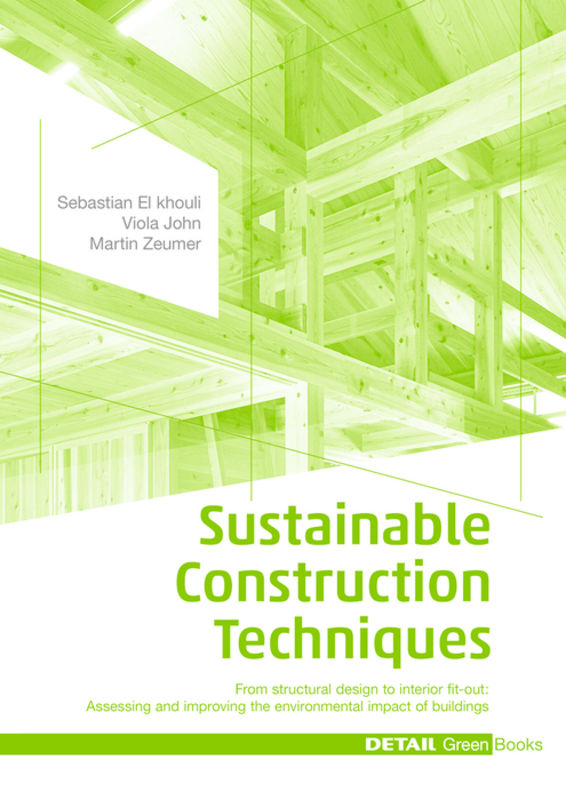
Sustainable Construction Techniques
What makes building materials sustainable?How can we reduce how much \"grey energy\" is produced in the building process?And how does a Life Cycle Analysis work?These are questions which are becoming increasingly more common in the context of sustainable construction.
eBook