
Catalogue Search | MBRL


Are you sure you want to remove the book from the shelf?

{{itemTitle}}
28,569
result(s) for
"Consumer satisfaction"
Sort by:


Happy pills in America : from Miltown to Prozac
Valium. Paxil. Prozac. Prescribed by the millions each year, these medications have been hailed as wonder drugs and vilified as numbing and addictive crutches. Where did this \"blockbuster drug\" phenomenon come from? What factors led to the mass acceptance of tranquilizers and antidepressants? And how has their widespread use affected American culture?
David Herzberg addresses these questions by tracing the rise of psychiatric medicines, from Miltown in the 1950s to Valium in the 1970s to Prozac in the 1990s. The result is more than a story of doctors and patients. From bare-knuckled marketing campaigns to political activism by feminists and antidrug warriors, the fate of psychopharmacology has been intimately wrapped up in the broader currents of modern American history. Beginning with the emergence of a medical marketplace for psychoactive drugs in the postwar consumer culture, Herzberg traces how \"happy pills\" became embroiled in Cold War gender battles and the explosive politics of the \"war against drugs\"—and how feminists brought the two issues together in a dramatic campaign against Valium addiction in the 1970s. A final look at antidepressants shows that even the Prozac phenomenon owed as much to commerce and culture as to scientific wizardry.
With a barrage of \"ask your doctor about\" advertisements competing for attention with shocking news of drug company malfeasance, Happy Pills is an invaluable look at how the commercialization of medicine has transformed American culture since the end of World War II.
eBook


Modern analysis of customer surveys : with applications using R
Modern Analysis of Customer Surveys: with applications using R Customer survey studies deal with customer, consumer and user satisfaction from a product or service.In practice, many of the customer surveys conducted by business and industry are analyzed in a very simple way, without using models or statistical methods.
eBook


I CAN’T GET NO SATISFACTION: EXPLORING INDONESIAN GUESTS’ SATISFACTION AND SERVICE QUALITY IN SOUTH AFRICAN HOTELS
This study aims to determine whether the dimensions of service quality affect the satisfaction of Indonesian tourists who visit South Africa and use hotel services, as well as to analyse the most dominant factors in influencing Indonesian tourists' satisfaction toward hotels’ service in South Africa. The population in this study were Indonesian tourists who had just returned from South Africa and used hotel accommodations. Samples were obtained randomly at the Soekarno Hatta International Arrival Terminal, Tangerang, Indonesia in 2019 before the Covid-19 pandemic. The sample was taken around 100 respondents by using non-probability sampling approach with the accidental sampling method. It is discovered that Indonesian guests are pleased with the service quality of the hotels during their stay in South Africa and that the Indonesia guest’s revisit intention quite high. Also, it is suggested that the hotel managements in South Africa need to maintain the elements that have been rated satisfactory by Indonesian guests and need to improve the things that are still lacking. This study contributes an empirical basis in strategic aspect for managing foreign tourists/hotel guests’ satisfaction from abroad perspective.
Journal Article

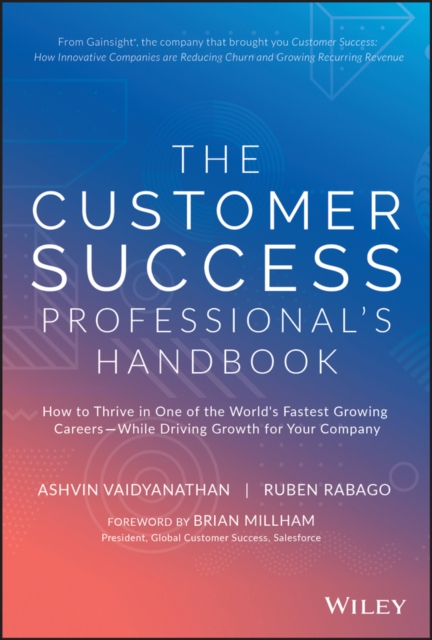
The Customer Success Professional's Handbook
The definitive \"Customer Success Manager How-To-Guide\" for the CSM profession from Gainsight, who brought you the market-leading Customer Success
The Customer Success Manager has become a critical asset to organizations across the business landscape. As the subscription model has spread from the cloud and SaaS to more sectors of the economy, that pivotal role will only grow in importance. That's because if you want to compete and thrive in this new environment, you need to put the customer at the center of your strategy. You need to recognize you're no longer selling just a product. You're selling an outcome. Customer Success Managers (CSM) are committed to capturing and delivering those outcomes by listening to their customers, understanding their needs, and adapting products and services to drive success. Although several existing resources address the customer success imperative, there is no authoritative instruction manual for the CSM profession— until now.
The Customer Success Professional's Handbook is the definitive reference book for CSMs and similar roles in the field. This practical, first-of-its-kind manual fills a significant gap in professional customer success literature, providing the knowledge every CSM needs to succeed—from the practitioner level all the way to senior leadership. The authors—acknowledged experts in building, training, and managing Customer Success teams—offer real-world guidance and practical advice for aspiring and experienced CSMs alike. The handbook is written by practioners for practioners. An indispensable resource for front-line Customer Success Managers, this much-needed book:
* Demonstrates how to build, implement, and manage a Customer Success team
* Helps new CSMs develop their skills and proficiency to be more employable and grow in their careers
* Provides clear guidance for managers on how to hire a stellar CSM
* Presents practical tactics needed to drive revenue growth during renewal, expansion, and customer advocacy opportunities
* Explains proven methods and strategies for mentoring CSMs throughout their careers
* Offers valuable insights from Gainsight, the Customer Success Company, and the broader customer success community with more than a dozen of the industry's most respected leaders contributing their perspectives
Currently, with over 70, 000 open positions, Customer Success Manager in one of the fastest-growing jobs in the world. The Customer Success Professional's Handbook: How to Thrive in One of the World's Fastest Growing Careers — While Driving Growth For Your Company will prove to be your go-to manual throughout every stage of your CSM career.
eBook


Prosperity for all
The history of consumerism is about much more than just shopping. Ever since the eighteenth century, citizen-consumers have protested against the abuses of the market by boycotting products and promoting fair instead of free trade. In recent decades, consumer activism has responded to the challenges of affluence by helping to guide consumers through an increasingly complex and alien marketplace. In doing so, it has challenged the very meaning of consumer society and tackled some of the key economic, social, and political issues associated with the era of globalization.
InProsperity for All, the first international history of consumer activism, Matthew Hilton shows that modern consumer advocacy reached the peak of its influence in the decades after World War II. Growing out of the product-testing activities ofConsumer Reportsand its international counterparts (includingWhich?in the United Kingdom,Que Choisirin France, andTestin Germany), consumerism evolved into a truly global social movement. Consumer unions, NGOs, and individual activists like Ralph Nader emerged in countries around the world-including developing countries in Southeast Asia and Latin America-concerned with creating a more equitable marketplace and articulating a politics of consumption that addressed the needs of both individuals and society as a whole.
Consumer activists achieved many victories, from making cars safer to highlighting the dangers of using baby formula instead of breast milk in countries with no access to clean water. The 1980s saw a reversal in the consumer movement's fortunes, thanks in large part to the rise of an antiregulatory agenda both in the United States and internationally. In the process, the definition of consumerism changed, focusing more on choice than on access. As Hilton shows, this change reflects more broadly on the dilemmas we all face as consumers: Do we want more stuff and more prosperity for ourselves, or do we want others less fortunate to be able to enjoy the same opportunities and standard of living that we do?
Prosperity for Allmakes clear that by abandoning a more idealistic vision for consumer society we reduce consumers to little more than shoppers, and we deny the vast majority of the world's population the fruits of affluence.
eBook