
Catalogue Search | MBRL


Are you sure you want to remove the book from the shelf?

{{itemTitle}}
1,908
result(s) for
"Content Area Reading"
Sort by:


Exploring sources of reading comprehension difficulties among adolescents in Taiwan: a latent profile analysis with a focus on content-area reading
With a focus on content-area reading, this study aimed to (a) understand the sources and prevalence of concurrent and specific difficulties in word-level skills, vocabulary, and knowledge among adolescent struggling readers (ASRs) and (b) explore the relations among reading skills, profiles, and reading comprehension. A dual-measure screening approach was used to classify a sample of 492 seventh- and eighth-graders. Among the subgroup of 225 ASRs, five distinct profiles were identified by latent profile analysis. The results confirmed the following: (a) the heterogeneity of reading difficulties in adolescents; (b) the universal prevalence of vocabulary difficulties across various language systems; and (c) the finding that fluency, rather than word accuracy, presents a more significant challenge at the word level in ASRs. Additionally, academic vocabulary knowledge and content-area knowledge independently predict content-area reading comprehension, even after accounting for general reading comprehension. This implies that preventive and remedial efforts for adolescent reading difficulties should prioritize and tailor crucial components of content-area reading.
Journal Article

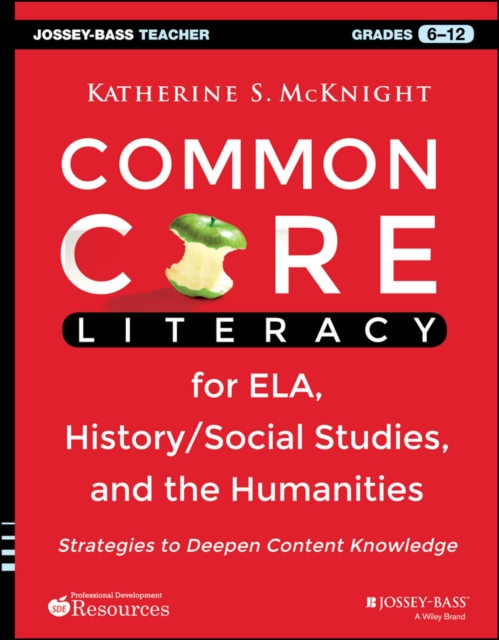
Common Core Literacy for ELA, History/Social Studies, and the Humanities
\"According to the Common Core State Standards, which have now been adopted by 46 states, students must develop literacy skills across all content areas. This means that educators must teach literacy--reading, writing, speaking, listening, and language--in subjects like Social Studies, Math, Science, and other technical areas. This book help teachers understand what literacy looks like in English/Language Arts (ELA), Social Studies and other humanities-related subjects (such as: philosophy, psychology, history, classics, drama, foreign language, and art), and shows them how to develop these literacy skills in their students. Author Katie McKnight is a popular education consultant who trains teachers nationwide on Common Core literacy. Features include: Alignment of activities to the Common Core State Standards in Interdisciplinary Literacy A Difficulty Dial: a quick reference to determine the complexity of each literacy activity Tips for Classroom Implementation: an overview of each literacy activity and how the tool supports the development of literacy skills and builds content knowledge Student Samples: serve as useful references for teachers across a variety of grade levels.
eBook
Academic Language/Literacy Strategies for Adolescents
Fast-paced, practical, and innovative, this text for pre-service and in-service teachers features clear, easily accessible lessons and professional development activities to improve the delivery of academic language/literacy education across the content areas in junior/middle school and high school classrooms. Numerous hands-on tools and techniques demonstrate the effectiveness of content-area instruction for students in a wide variety of school settings, particularly English language learners, struggling readers, and other special populations of students.
Based on a strong professional development model the authors have been instrumental in designing, Academic Language/Literacy Strategies for Adolescents addresses:
motivation
attributes of academic language
vocabulary: theory and practice
reading skills development
grammar and writing.
A wealth of charts, graphs, and lesson plans give clear examples of academic language/literacy strategies in action. The appendices - a key component of the practical applications developed in the text - include a glossary, exemplary lessons that address key content areas, and a Grammar Handbook.
In this era of increased accountability, coupled with rapid demographic change and challenges to traditional curricula and pedagogical methods, educators will find this book to be a great resource.
eBook

Empowering Struggling Readers
This book provides classroom-tested methods for engaging struggling middle grade readers--even those who appear to have given up--and fostering their success. The emphasis is on constructing respectful, encouraging learning environments that incorporate students' diverse literacies, cultural interests, and prior knowledge and skills into instruction. Chapters outline effective, innovative strategies for instruction and assessment in comprehension, vocabulary, text-based discussion, critical reading, and other core areas. Realistic classroom examples are included throughout, including applications of nontraditional texts. Other useful features include reflection questions at the end of each chapter. Winner--Literacy Research Association's Edward B. Fry Book Award.
eBook

Content-area reading comprehension and teachers’ use of instructional time: effects on middle school students’ social studies knowledge
We examined the influence of teachers’ use of instructional time on students’ learning within the context of a randomized controlled trial investigating the effects of a content-area reading comprehension intervention. Participants were 8th grade social studies teachers who had their classes randomly assigned to either Promoting Acceleration of Comprehension and Content through Text (PACT) or business-as-usual (BAU). In both conditions, the same social studies content was the focus of instruction. Thirty-five 8th grade teachers (18 female, 17 male) audio-record instruction in both PACT and BAU classes for the duration of the 6–8 week intervention. Instruction was coded on five dimensions: interactive instruction, teacher silence, noninstructional activities, video usage, and neutral class time. Social studies knowledge acquisition was measured amongst 2786 8th grade students. Findings indicated that teachers spent more time engaged in interactive instruction when delivering content-area instruction in PACT classrooms as compared to BAU classrooms. Further, instructional behaviors were significantly related to changes in content knowledge acquisition in the BAU classes. In the treatment condition, teachers’ instructional behaviors were not significantly related to changes in content acquisition, except for noninstructional activities and non-content related video, which both had negative effects. Our findings suggest that while interactive instructional time remains important, the instructional methods utilized during this time are equally (if not more) impactful on student achievement.
Journal Article