
Catalogue Search | MBRL


Are you sure you want to remove the book from the shelf?

{{itemTitle}}
447
result(s) for
"Contingency (philosophy)"
Sort by:

Other pasts, different presents, alternative futures
\"What if there had been no World War I or no Russian Revolution? What if Napoleon had won at Waterloo in 1815, or if Martin Luther had not nailed his complaints to the church door at Wittenberg in 1517, or if the South had won the American Civil War? The questioning of apparent certainties or 'known knowns' can be fascinating and, indeed, 'What if?' books are very popular. However, this speculative approach, known as counterfactualism, has had limited impact in academic histories, historiography, and the teaching of historical methods. In this book, Jeremy Black offers a short guide to the subject, one that is designed to argue its value as a tool for public and academe alike. Black focuses on the role of counterfactualism in demonstrating the part of contingency, and thus human agency, in history, and the salutary critique the approach offers to determinist accounts of past, present, and future\"--Provided by publisher.
Book
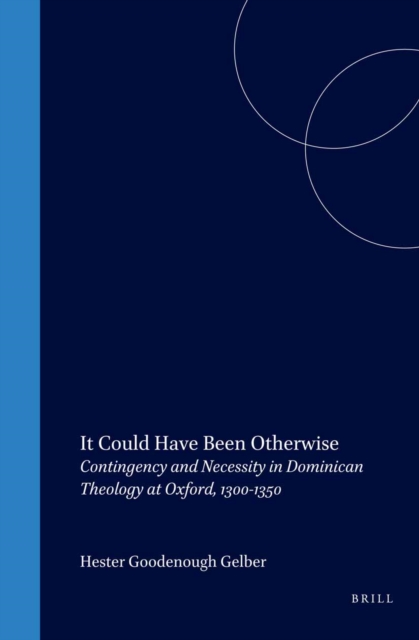
It could have been otherwise : contingency and necessity in Dominican theology at Oxford, 1300-1350
This description of Dominicans at Oxford from 1300-1350 and the theology of Hugh of Lawton, Arnold of Strelley, William Crathorn and Robert Holcot reclaims the Dominicans as highly original contributors to theology and philosophy at a time of great innovation.
eBook


Truth and truthfulness
What does it mean to be truthful? What role does truth play in our lives? What do we lose if we reject truthfulness? No philosopher is better suited to answer these questions than Bernard Williams. Writing with his characteristic combination of passion and elegant simplicity, he explores the value of truth and finds it to be both less and more than we might imagine.
eBook

A THEORY OF CONSTITUTIONAL NORMS
The political convulsions of the past decade have fueled acute interest in constitutional norms or \"conventions.\" Despite intense scholarly attention, existing accounts are incomplete and do not answer at least one or more of three major questions: (1) What must all constitutional norms do? (2) What makes them conventional? (3) And why are they constitutional? This Article advances an original theory of constitutional norms that answers these questions. First, it defines them and explains their general character: they are normative, contingent, and arbitrary practices that implement constitutional text and principle. Most scholars have foregone examining how norms are conventional or have relegated them to coordinating behavior, like rules requiring drivers to stick to one side of the road. By contrast, this Article argues that constitutional norms are constitutive conventions, which concretize values into practices; they are akin to conventions of etiquette that concretize concepts like \"politeness.\" Constitutional norms implement abstract principles, like the separation of powers, or indeterminate text, such as \"advice and consent,\" into specific behavior and action. By understanding constitutional norms as constitutive conventions, this Article explains norms' salient features, basic functions, and relationship to the Constitution. Norms are normative because they command respect and allegiance; they are contingent because they depend on political, social, and intellectual conditions to emerge and endure; they are arbitrary because they represent one of many possible ways of realizing constitutional text and principle; and they are constitutional because the values they implement arise from the Constitution itself. This Article animates its theory through case studies of three constitutional norms: blue slips, the norm against court-packing, and executive noninterference in law enforcement. It concludes by questioning the use of historical practice in constitutional interpretation. It suggests that when scholars and judges draw on norms that are intrinsically contingent and arb trary, they embed unstated normative assumptions about the past and how it should constrain the future.
Journal Article

Protecting the cultural property of religious communities during war: The Church of Sweden and total defense planning
Even though places of worship are protected by the Hague Convention for the Protection of Cultural Property in the Event of Armed Conflict, they often become targets. To safeguard the cultural property of religious communities, it is necessary to plan for wartime protection under peaceful conditions, but studies of how this planning was conducted after 1945 are largely missing. This Article compares how the cultural property of the Church of Sweden (Lutheran) has been planned for protection up until 2023. Cultural property protection was first introduced in World War II, but the Church had to plan and carry out most protective measures without state support. During the Cold War, a system for protecting movable property was developed that lasted until it was replaced in the 1980s by cultural protection plans that employed a more holistic approach to risk mitigation in peace as well as in war. Finally, the recent development and future challenges are discussed in relation to the 1954 Hague Convention and the reconstruction of a Swedish total defense due to the Russo-Ukrainian War.
Journal Article

Bound by recognition
In an era of heightened concern about injustice in relations of identity and difference, political theorists often prescribe equal recognition as a remedy for the ills of subordination. Drawing on the philosophy of Hegel, they envision a system of reciprocal knowledge and esteem, in which the affirming glance of others lets everyone be who they really are. This book challenges the equation of recognition with justice. Patchen Markell mines neglected strands of the concept's genealogy and reconstructs an unorthodox interpretation of Hegel, who, in the unexpected company of Sophocles, Aristotle, Arendt, and others, reveals why recognition's promised satisfactions are bound to disappoint, and even to stifle.
Written with exceptional clarity, the book develops an alternative account of the nature and sources of identity-based injustice in which the pursuit of recognition is part of the problem rather than the solution. And it articulates an alternative conception of justice rooted not in the recognition of identity of the other but in the acknowledgment of our own finitude in the face of a future thick with surprise. Moving deftly among contemporary political philosophers (including Taylor and Kymlicka), the close interpretation of ancient and modern texts (Hegel'sPhenomenology, Aristotle'sPoetics, and more), and the exploration of rich case studies drawn from literature (Antigone), history (Jewish emancipation in nineteenth-century Prussia), and modern politics (official multiculturalism), Bound by Recognition is at once a sustained treatment of the problem of recognition and a sequence of virtuoso studies.
eBook

The priority of democracy
Pragmatism and its consequences are central issues in American politics today, yet scholars rarely examine in detail the relationship between pragmatism and politics. InThe Priority of Democracy, Jack Knight and James Johnson systematically explore the subject and make a strong case for adopting a pragmatist approach to democratic politics--and for giving priority to democracy in the process of selecting and reforming political institutions.
What is the primary value of democracy? When should we make decisions democratically and when should we rely on markets? And when should we accept the decisions of unelected officials, such as judges or bureaucrats? Knight and Johnson explore how a commitment to pragmatism should affect our answers to such important questions. They conclude that democracy is a good way of determining how these kinds of decisions should be made--even if what the democratic process determines is that not all decisions should be made democratically. So, for example, the democratically elected U.S. Congress may legitimately remove monetary policy from democratic decision-making by putting it under the control of the Federal Reserve.
Knight and Johnson argue that pragmatism offers an original and compelling justification of democracy in terms of the unique contributions democratic institutions can make to processes of institutional choice. This focus highlights the important role that democracy plays, not in achieving consensus or commonality, but rather in addressing conflicts. Indeed, Knight and Johnson suggest that democratic politics is perhaps best seen less as a way of reaching consensus or agreement than as a way of structuring the terms of persistent disagreement.
eBook

Philosophical Myths of the Fall
Did post-Enlightenment philosophers reject the idea of original sin and hence the view that life is a quest for redemption from it? In Philosophical Myths of the Fall, Stephen Mulhall identifies and evaluates a surprising ethical-religious dimension in the work of three highly influential philosophers - Nietzsche, Heidegger, and Wittgenstein. He asks: Is the Christian idea of humanity as structurally flawed something that these three thinkers aim simply to criticize? Or do they, rather, end up by reproducing secular variants of the same mythology? Mulhall argues that each, in different ways, develops a conception of human beings as in need of redemption: in their work, we appear to be not so much capable of or prone to error and fantasy, but instead structurally perverse, living in untruth. In this respect, their work is more closely aligned to the Christian perspective than to the mainstream of the Enlightenment. However, all three thinkers explicitly reject any religious understanding of human perversity; indeed, they regard the very understanding of human beings as originally sinful as central to that from which we must be redeemed.And yet each also reproduces central elements of that understanding in his own thinking; each recounts his own myth of our Fall, and holds out his own image of redemption. The book concludes by asking whether this indebtedness to religion brings these philosophers' thinking closer to, or instead forces it further away from, the truth of the human condition.
eBook

Beyond the Market
Beyond the Marketlaunches a sociological investigation into economic efficiency. Prevailing economic theory, which explains efficiency using formalized rational choice models, often simplifies human behavior to the point of distortion. Jens Beckert finds such theory to be particularly weak in explaining such crucial forms of economic behavior as cooperation, innovation, and action under conditions of uncertainty--phenomena he identifies as the proper starting point for a sociology of economic action.
Beckert levels an enlightened critique at neoclassical economics, arguing that understanding efficiency requires looking well beyond the market to the social, cultural, political, and cognitive factors that influence the coordination of economic action. Beckert searches social theory for the components of an alternative theory of action, one that accounts for the social embedding of economic behavior. In Durkheim and Parsons he finds especially useful approaches to cooperation; in Luhmann, a way to understand how people act under highly contingent conditions; and in Giddens, an understanding of creative action and innovation. Together, these provide building blocks for a research program that will yield a theoretically sophisticated understanding of how economic processes are coordinated and the ways that markets are embedded in social, cultural, and cognitive structures.
Containing one of the most fully informed critiques of the neoclassical analysis of economic efficiency--as well as one of the most thoughtful blueprints for economic sociology--this book reclaims for sociology the study of one of the most important arenas of human action.
eBook