
Catalogue Search | MBRL


Are you sure you want to remove the book from the shelf?

{{itemTitle}}
7,226
result(s) for
"Contracts Language."
Sort by:

Evaluation of a Legally Binding Smart-Contract Language for Blockchain Applications
Blockchain governs inter-organizational business processes and enables decentralized autonomous organizations (DAO) with governance capabilities via smart contracts (SC). Due to the programmer's lack of prior knowledge of the contract domain, SCs are ambiguous and error-prone. Several works, i.e., SPESC, Symboleo, and SmaCoNat, exist to support the legally-binding SCs. The aforementioned SCLs present intriguing approaches to building legally-binding SCs but either lack domain completeness, or are intended for non-collaborative business processes. In our previous work, we address the above-mentioned shortcomings of the XML-based smart-legal-contract markup language (SLCML), in which blockchain developers focus on the contractual workflow rather than the syntax specifics. However, SLCML, as a blockchain-independent formal specification language, is not evaluated to determine its applicability, usefulness, and usability for establishing legally-binding SCs for workflow enactment services (WES) to automate and streamline the business processes within connected organizations. In accordance with this, we formally implement the SLCML and propose evaluation approaches, such as running case and lab experiments, to demonstrate the SLCML's generality and applicability for developing legally-binding SCs. Overall, the results of this work ascertain the applicability, usefulness, and usability of the proposed SLCML for establishing legally-binding SCs for WES.
Journal Article


Automatically running experiments on checking multi-party contracts
Contracts play an important role in business management where relationships among different parties are dictated by legal rules. Electronic contracts have emerged mostly due to technological advances and electronic trading between companies and customers. New challenges have then arisen to guarantee reliability among the stakeholders in electronic negotiations. In this scenario, automatic verification of electronic contracts appeared as an imperative support, specially the conflict detection task of multi-party contracts. The problem of checking contracts has been largely addressed in the literature, but there are few, if any, methods and practical tools that can deal with multi-party contracts using a contract language with deontic and dynamic aspects as well as relativizations, over the same formalism. In this work we present an automatic checker for finding conflicts on multi-party contracts modeled by an extended contract language with deontic operators and relativizations. Moreover a well-known case study of sales contract is modeled and automatically verified by our tool. Further, we performed practical experiments in order to evaluate the efficiency of our method and the practical tool.
Journal Article
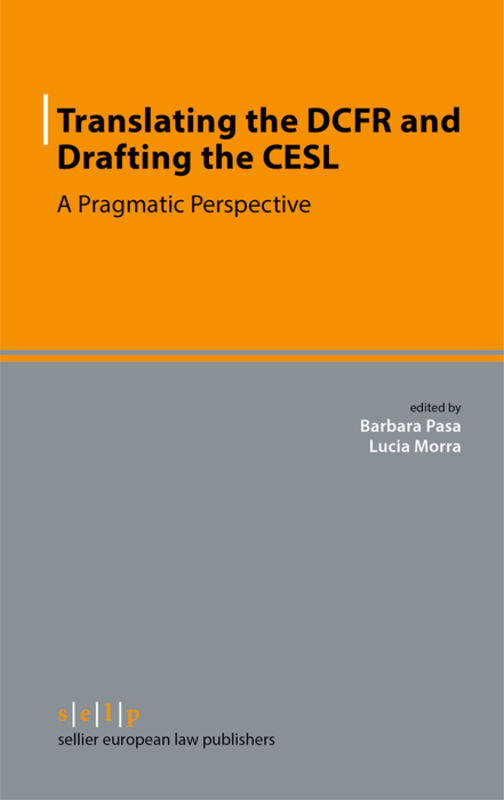
Translating the DCFR and Drafting the CESL
Translating the DCFR and writing the CESL have been extremely complex enterprises, and closely dependent one on the other. The volume takes a pragmatic approach in describing them. Structured in four parts, it sets out the historical and philosophical background of legal translation, and then focuses more narrowly on the legal translation processes adopted in the DCFR and the CESL.
eBook

Sumerian model contracts from the Old Babylonian period in the Hilprecht Collection Jena
During the Old Babylonian period (ca. 2002-1595 B.C.), the city of Nippur was a primary center for transmission of Sumerian culture, and its scribal schools (called edubba in Sumerian, lit. 'the house of the tablets') had a great reputation throughout ancient Mesopotamia. The function of the edubba was twofold: to train the scribes in the skills of their profession, equipping them to record day-to-day affairs, and to preserve and pass on their cultural heritage. In the last phase of early education, pupils were trained comprehensively in the formal rhetoric of administration and law by compilations of the so-called 'model contracts,' together with 'model court cases,' legal phrasebooks and collections of legal principles. While they were not functional documents, but simply didactic tools (being stripped of incidental details, such as list of witnesses and date), model contracts follow the common patterns of Sumerian contract types and represent a comprehensive assortment of all possible transactions that the ancient Mesopotamian administration might have been required to draw up in everyday economic life: barley and silver loans; deeds of real estate, field or slave sale; marriage contracts; adoptions, and so on. The book contains the publication of the Sumerian model contracts from Old Babylonian Nippur kept in the Hilprecht Collection, Jena. The edition provides transliterations, translations, commentaries of the entire corpus and of some duplicates kept in other cuneiform collections; the indexes comprise personal names, deities, toponyms and a glossary. Finally, the plates at the end of the volume offer handcopies and photographs of all the HS tablets.
Book

Transformation of Real-World Contracts to Smart Contracts for Blockchain Applications
The widespread adoption of smart contracts, self-executing agreements on the blockchain, is hindered by the complexity of translating real-world contracts, often written in multiple languages, into their digital counterparts. This paper addresses this challenge by introducing an innovative approach based on Contract Text Markup Language (CTML), an extensible markup language specifically designed to facilitate the automatic generation of smart contracts from multilingual contracts. CTML overcomes traditional method limitations by employing a two-stage transformation process: (1) Contract Abstraction and Markup: CTML redefines grammar rules and incorporates encoding extensions to transform multilingual contracts into structured, marked-up contracts. This process effectively abstracts the essential details of the original contract, enabling language-agnostic interpretation. (2) Domain-Specific Language (DSL) Translation and Smart Contract Code Generation: The marked-up contract is then seamlessly translated into a DSL program, capturing the legal concepts in a machine-readable format. Finally, the DSL program is automatically compiled into executable smart contract code, ready for deployment on the blockchain. The effectiveness of the proposed approach is demonstrated using a legal contract in both English and Chinese. Therefore, the CTML-based approach can automatically generate smart contracts from multilingual contracts, enabling a more inclusive and accessible smart contract ecosystem.
Journal Article

Contract Drafting
In thirteen chapters, Contract Drafting: Powerful Prose in Transactional Practice is a complete how-to guide for all lawyers who desire to hone their drafting skills.The book explains the contract drafting process in terms of content and style, demonstrating through clear, detailed examples how to revise template documents to produce effective.
eBook
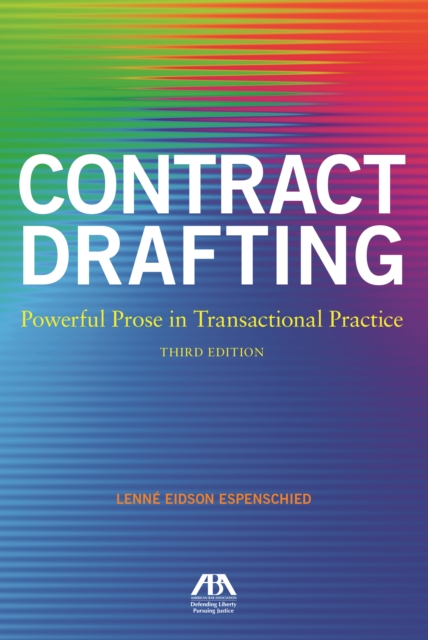
Contract drafting : powerful prose in transactional practice
Contract Drafting is today's seminal authority on negotiating and drafting indemnification provisions, even in low leverage situations. It carefully explains how to prevent ambiguity in contracts by using better words, developing a consistent strategy for expressing key concepts, crafting strong sentences, and organizing content properly.
eBook