
Catalogue Search | MBRL


Are you sure you want to remove the book from the shelf?

{{itemTitle}}
2,269
result(s) for
"Convention (Philosophy)"
Sort by:


Social conventions
Social conventions are those arbitrary rules and norms governing the countless behaviors all of us engage in every day without necessarily thinking about them, from shaking hands when greeting someone to driving on the right side of the road. In this book, Andrei Marmor offers a pathbreaking and comprehensive philosophical analysis of conventions and the roles they play in social life and practical reason, and in doing so challenges the dominant view of social conventions first laid out by David Lewis.
Marmor begins by giving a general account of the nature of conventions, explaining the differences between coordinative and constitutive conventions and between deep and surface conventions. He then applies this analysis to explain how conventions work in language, morality, and law. Marmor clearly demonstrates that many important semantic and pragmatic aspects of language assumed by many theorists to be conventional are in fact not, and that the role of conventions in the moral domain is surprisingly complex, playing mostly an auxiliary and supportive role. Importantly, he casts new light on the conventional foundations of law, arguing that the distinction between deep and surface conventions can be used to answer the prevalent objections to legal conventionalism.
Social Conventionsis a much-needed reappraisal of the nature of the rules that regulate virtually every aspect of human conduct.
eBook

Conventions and Constitutive Norms
The paper addresses a popular argument that accounts of assertion in terms of constitutive norms are incompatible with conventionalism about assertion. The argument appeals to an alleged modal asymmetry: constitutive rules are essential to the acts they characterize, and therefore the obligations they impose necessarily apply to every instance; conventions are arbitrary, and thus can only contingently regulate the practices they establish. The paper argues that this line of reasoning fails to establish any modal asymmetry, by invoking the distinction between the non-discriminating existence across possible worlds of types (“blueprints”, as Rawls called them) of practices and institutions defined by constitutive rules, and the discriminating existence of those among them that are actually in force , and hence truly normative. The necessity of practices defined by constitutive rules that the argument relies on concerns the former, while conventionalist claims are only about the latter. The paper should thus contribute to get a better understanding of what social constructs conceived as defined by constitutive norms are. It concludes by suggesting considerations that are relevant to deciding whether assertion is in fact conventional.
Journal Article

The Beauty of Convention
This volume addresses the beauty of convention not in an attempt to recapitulate established values (as, luckily, in literature and culture, there are not absolute beauties that serve everyone and always), but as an aesthetic appreciation of form as a keeper of meaning and as an ethical post-cynical metadiscourse on human dependence on symbolic interaction and generic conventions. Looking into the artificial, invented, side of this concept, the book addresses such questions as: What is beauty.
eBook
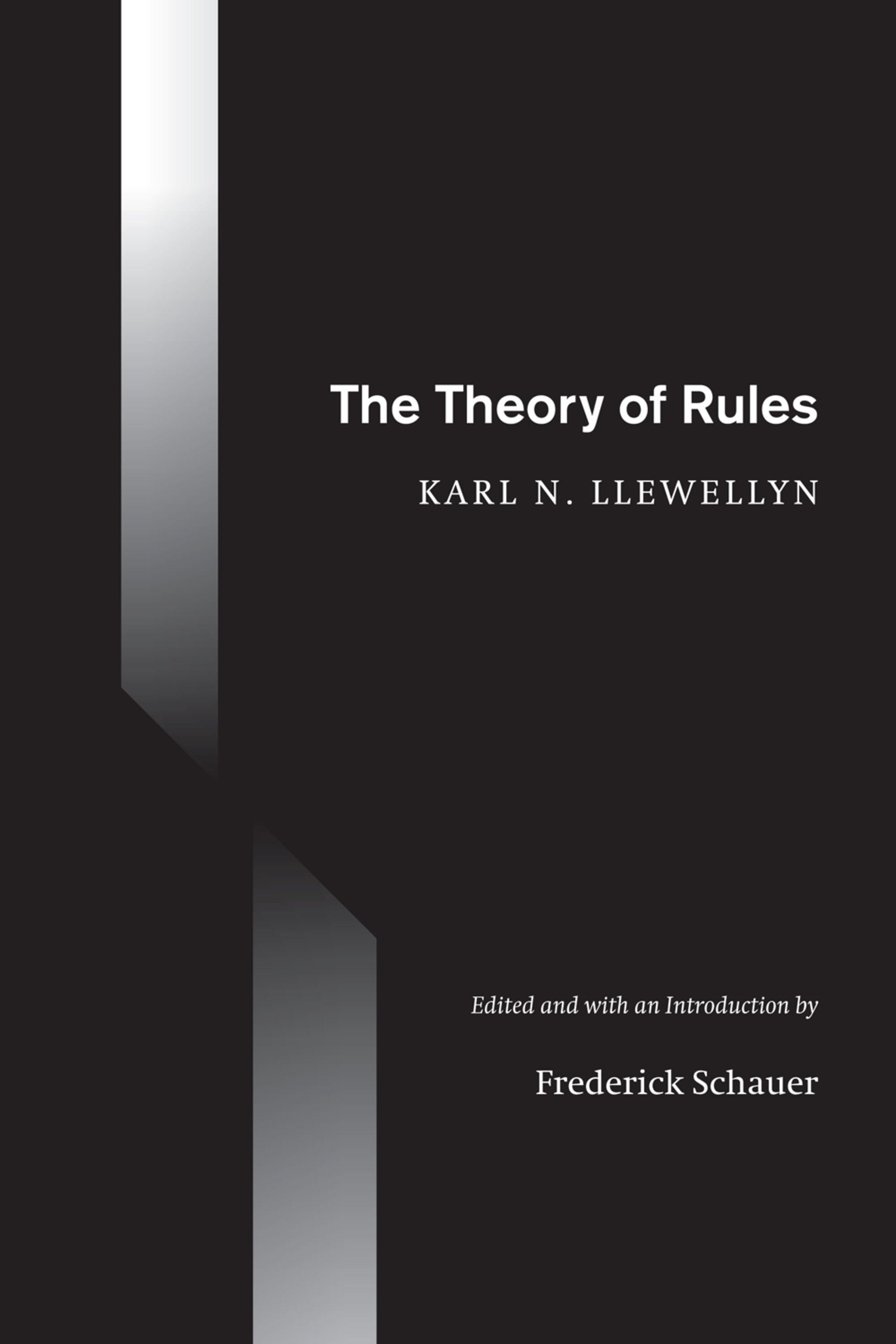
The theory of rules
Karl N. Llewellyn was one of the founders and major figures of legal realism, and his many keen insights have a central place in American law and legal understanding. Key to Llewellyn's thinking was his conception of rules, put forward in his numerous writings and most famously in his often mischaracterized declaration that they are \"pretty playthings.\" Previously unpublished, The Theory of Rules is the most cogent presentation of his profound and insightful thinking about the life of rules.
This book frames the development of Llewellyn's thinking and describes the difference between what rules literally prescribe and what is actually done, with the gap explained by a complex array of practices, conventions, professional skills, and idiosyncrasies, most of which are devoted to achieving a law's larger purpose rather than merely following the letter of a particular rule. Edited, annotated, and with an extensive analytic introduction by leading contemporary legal scholar Frederick Schauer, this rediscovered work contains material not found elsewhere in Llewellyn's writings and will prove a valuable contribution to the existing literature on legal realism.
eBook
For and against method
The work that helped to determine Paul Feyerabend's fame and notoriety, Against Method, stemmed from Imre Lakatos's challenge: \"In 1970 Imre cornered me at a party. 'Paul,' he said, 'you have such strange ideas. Why don't you write them down? I shall write a reply, we publish the whole thing and I promise you—we shall have a lot of fun.' \" Although Lakatos died before he could write his reply, For and Against Method reconstructs his original counter-arguments from lectures and correspondence previously unpublished in English, allowing us to enjoy the \"fun\" two of this century's most eminent philosophers had, matching their wits and ideas on the subject of the scientific method. For and Against Method opens with an imaginary dialogue between Lakatos and Feyerabend, which Matteo Motterlini has constructed, based on their published works, to synthesize their positions and arguments. Part one presents the transcripts of the last lectures on method that Lakatos delivered. Part two, Feyerabend's response, consists of a previously published essay on anarchism, which began the attack on Lakatos's position that Feyerabend later continued in Against Method. The third and longest section consists of the correspondence Lakatos and Feyerabend exchanged on method and many other issues and ideas, as well as the events of their daily lives, between 1968 and Lakatos's death in 1974. The delight Lakatos and Feyerabend took in philosophical debate, and the relish with which they sparred, come to life again in For and Against Method, making it essential and lively reading for anyone interested in these two fascinating and controversial thinkers and their immense contributions to philosophy of science.
eBook

How signaling conventions are established
We consider how human subjects establish signaling conventions in the context of Lewis-Skyrms signaling games. These experiments involve games where there are precisely the right number of signal types to represent the states of nature, games where there are more signal types than states, and games where there are fewer signal types than states. The aim is to determine the conditions under which subjects are able to establish signaling conventions in such games and to identify a learning dynamics that approximates how they succeed when they do. Our results suggest that human agents tend to use a win-stay/lose-shift with inertia dynamics to establish conventions in such games. We briefly consider the virtues and vices of this low-rationality dynamics.
Journal Article

Strategic justice, conventions, and game theory: introduction to a Synthese topical collection
Evolutionary, game-theoretic approaches to justice and the social contract have become increasingly popular in contemporary moral and political philosophy. (Vanderschraaf, Strategic justice: convention and problems of balancing divergent interests, Oxford University Press, 2019) theory of strategic justice represents the most recent contribution to this tradition and, in many ways, can be viewed as a culmination of it. This article discusses some of the central features of Vanderschraaf’s theory and relates them to the contributions in this collection. Some of the contributions directly address Vanderschraaf’s work, while others explore related topics in game theory, bargaining theory, formal philosophy, rationality, equality, justice, and the theory of conventions. This collection aims to bridge a gap between disjoint but closely related literature spanning a wide range of disciplines. The contributions allow readers to systematically engage with the topic of strategic justice, advance dialogue, and more easily follow this rich and expanding field of study.
Journal Article
Against Conventional Wisdom
Conventional wisdom has it that truth is always evaluated using our actual linguistic conventions, even when considering counterfactual scenarios in which different conventions are adopted. This principle has been invoked in a number of philosophical arguments, including Kripke’s defense of the necessity of identity and Lewy’s objection to modal conventionalism. But it is false. It fails in the presence of what Einheuser (2006) calls c-monsters, or convention-shifting expressions (on analogy with Kaplan’s monsters, or context-shifting expressions). We show that c-monsters naturally arise in contexts where speakers entertain alternative conventions, such as metalinguistic negotiations. We develop an expressivist theory — inspired by Barker (2002) and MacFarlane (2016) on vague predications and Einheuser (2006) on counterconventionals — to model these shifts in convention. Using this framework, we reassess the philosophical arguments that invoked the conventional wisdom.
Journal Article
Quasi-Conventions
I consider a generalizarion of Vanderschraaf's correlated conventions to Quasi-Conventions, using the concept of coarse correlated equilibria. I discuss the possibility of improved payoffs and the question of learnability by simple uncoupled learning dynamics. Laboratory experiments are surveyed. The generalization introduces strains of commitment, which can be see from different points of view. I conclude that the strains of commitment preclude using the generalization as a stand-alone definition of convention, but that in certain settings Quasi-Conventions can be important modules within larger true conventions.
Journal Article