
Catalogue Search | MBRL


Are you sure you want to remove the book from the shelf?

{{itemTitle}}
170
result(s) for
"Cooking Dictionaries"
Sort by:
A dictionary of Japanese food
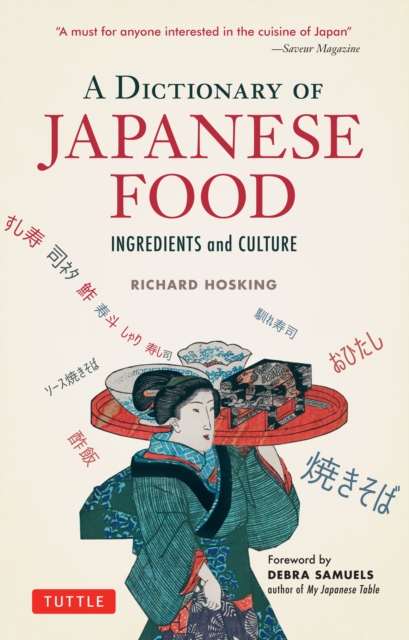
Nominated for the Glenfiddich Food Book of the Year Award, this timeless volume is the first and only book of its kind on the subject. A Dictionary of Japanese Food helps food lovers around the world decipher the intricacies and nuances of Japanese cooking and its ingredients. Definitions in ordinary cookbooks and standard dictionaries-such as akebia for akebi, sea cucumber for namako, plum for ume-can be inadequate, misleading, or just plain wrong. Richard Hoskings eliminates the mystery by ensuring that each entry in the Japanese-English section includes the Japanese term in Roman script; the term in kana or kanji or both; a Latin name where appropriate; an English definition; and, for most entries, a short annotation. The English-Japanese section defines important English food terms in Japanese and annotates those needing explanation. One hundred small line drawings make it easy for readers to identify everything from mitsuba to the okoze fish, and seventeen appendices address the most critical elements of Japanese cuisine, from the making of miso and the structure of the Japanese meal to the tea ceremony.
eBook

Italy food companion : phrasebook and miscellany
How to enjoy the best of Italian food - understand the menu and know how to order in a restaurant or street market. Complements the Blue Guides' classic guide-book range as preparation for and accompaniment to any visit to Italy. Comprehensive coverage from pizza and pasta to rare regional delicacies and fine wines. Separate sections on seasonal food, Mediterranean fish, wines and aperitifs, and star chefs. Extensive phrasebook-divided into 'what it means' (Italian into English including a glossary) and 'how to ask for' (English into Italian).
Book

Eating Your Words
Here is a feast of words that will whet the appetite of food and word lovers everywhere.William Grimes, former restaurant critic for The New York Times, covers everything from bird's nest soup to Trockenbeerenauslese in this wonderfully informative food lexicon.
eBook

Eating your words / William Grimes, editor
More than two thousand entries define a variety of words and terms related to eating and foods, describing exotic dishes, cooking techniques, ingredients, and foods.
eBook

Effect of consuming food cooked in iron pots and behavior change communication on iron status in non-pregnant, non-lactating women: protocol for randomized controlled trial
Background
Iron-deficiency anemia (IDA) remains a significant public health concern, particularly among women of reproductive age in developing countries. Despite ongoing supplementation and fortification programs, the prevalence of anemia remains high due to challenges such as poor compliance, logistical constraints, and limited access to iron and dietary sources. Cooking in iron cookware has been proposed as a low-cost, culturally acceptable strategy for improving dietary iron intake; however, evidence of its effectiveness remains mixed. This randomized controlled trial (RCT) aimed to evaluate the effectiveness of consuming food cooked in iron pots, coupled with a structured behaviour change programme, on improving hemoglobin and ferritin levels among non-pregnant, non-lactating women of reproductive age in rural India.
Methods
A community-based randomized controlled trial will be conducted in selected rural blocks of Akola and Wardha districts in Maharashtra, India. Eligible women (aged 18–45 years, non-pregnant, non-lactating) will be randomized into two groups: an intervention group receiving iron cookware along with structured behaviour change communication sessions, and a control group receiving non-iron cookware. Iron status indicators (hemoglobin, ferritin, serum iron, transferrin saturation, and total iron-binding capacity) will be assessed at baseline, 6 months, and 12 months after the intervention. Patient compliance with iron pot usage will be monitored through food diaries, spot checks, and interviews. Barriers and facilitators of adherence will be explored through qualitative assessments.
Discussion
It is anticipated that women using iron cookware with structured counselling support will demonstrate significant improvements in anemia and iron deficiency indicators compared to controls. This study will also identify the practical, cultural, and economic barriers affecting patient compliance with cooking in iron pots. The findings will contribute to the evidence base for promoting iron cookware as a sustainable intervention in rural population settings. The results will inform community health strategies and align with India’s Anemia Mukt Bharat initiative.
Trial registration
This randomized controlled trial was prospectively registered with the Clinical Trials Registry–India (CTRI) under the registration number CTRI/2025/04/085829, dated April 28, 2025.
Journal Article

The Potential of Aquafaba as a Structure-Shaping Additive in Plant-Derived Food Technology
Aquafaba is the water solution left over from cooking legumes, mainly chickpeas. The liquid can also be obtained from canned beans. Aquafaba is currently very popular as an egg replacement in vegan diets. The chemical composition of aquafaba depends on the type of legume, variety, genotype and parameters during production, such as cooking time or proportions of water to seeds. Aquafaba can be used for its nutritional properties. Aquafaba is starting to be used more widely in food technology as well, due to its innovative texture-shaping properties. The foaming, emulsifying, gelling and thickening properties of aquafaba can be used in plant-based food recipes, but also in animal-based food recipes and 3D printing. So far, aquafaba has been used to make meringues, cakes, cookies, bread, crackers and vegan dairy substitutes. This raw material is used for the production of low-calorie food and for people on an egg-free diet. Perhaps the potential of this product is greater. The use of waste from legumes will be the answer from food producers to the needs of consumers, for whom environmental protection or the clean label trend are particularly important. In order to effectively use aquafaba in food technology, it is necessary to standardize its production process and conduct further research on the potential of using other legumes.
Journal Article

A Cook's Dictionary: International Food and Cooking Terms from A to Z (2nd edition)
Harrison reviews A Cook's Dictionary: International Food and Cooking Terms from A to Z (2nd edition) by Charles Sinclair.
Book Review