
Catalogue Search | MBRL


Are you sure you want to remove the book from the shelf?

{{itemTitle}}
25
result(s) for
"Cooking Great Britain History."
Sort by:


In the Kitchen, 1550-1800
In the Kitchen insists that the preparation of food, whether imaginative, physical, or spatial, is central to a deeper understanding of early modern food cultures and practices.
eBook

The philosophy of curry
\"There are curries on almost every continent, with a stunning diversity of flavours and textures across India alone, and many more interpretations the world over, including in Indonesia, Malaysia, Japan, Trinidad and the curry capital of the UK, Bradford. But curry is difficult to define. The word has origins in ancient India, but its adoption by Portuguese and British colonisers saw curry reinterpreted in the west to encompass an entire cuisine, prompting many Indians to reject the term outright. Sejal Sukhadwala probes the complex intersection of tradition and colonialism through the fascinating history of curry, from its association with Ayurveda - one of the world's oldest holistic healing systems to its enduring popularity in contemporary British culture. Garnishing this history is a surfeit of helpful advice on which oils to use, how to temper spices and where to find those all-important mouth-watering recipes.\"-- Publisher's description.
Book

Invention of the Modern Cookbook
This eye-opening history will change the way you read a cookbook or regard a TV chef, making cooking ventures vastly more interesting—and a lot more fun. Every kitchen has at least one well-worn cookbook, but just how did they come to be? Invention of the Modern Cookbook is the first study to examine that question, discussing the roots of these collections in 17th-century England and illuminating the cookbook's role as it has evolved over time. Readers will discover that cookbooks were the product of careful invention by highly skilled chefs and profit-minded publishers who designed them for maximum audience appeal, responding to a changing readership and cultural conditions and utilizing innovative marketing and promotion techniques still practiced today. They will see how cookbooks helped women adjust to the changes of the Enlightenment and Industrial Revolution by educating them on a range of subjects from etiquette to dealing with household servants. And they will learn how the books themselves became \"modern, \" taking on the characteristics we now take for granted.
eBook


Political Gastronomy
\"The table constitutes a kind of tie between the bargainer and the bargained-with, and makes the diners more willing to receive certain impressions, to submit to certain influences: from this is born political gastronomy. Meals have become a means of governing, and the fate of whole peoples is decided at a banquet.\"-Jean Anthèlme Brillat-Savarin,The Physiology of Taste, or, Meditations on Transcendental GastronomyThe first Thanksgiving at Plymouth in 1621 was a powerfully symbolic event and not merely the pageant of abundance that we still reenact today. In these early encounters between Indians and English in North America, food was also symbolic of power: the venison brought to Plymouth by the Indians, for example, was resonant of both masculine skill with weapons and the status of the men who offered it. These meanings were clearly understood by Plymouth's leaders, however weak they appeared in comparison.Political Gastronomyexamines the meaning of food in its many facets: planting, gathering, hunting, cooking, shared meals, and the daily labor that sustained ordinary households. Public occasions such as the first Thanksgiving could be used to reinforce claims to status and precedence, but even seemingly trivial gestures could dramatize the tense negotiations of status and authority: an offer of roast squirrel or a spoonful of beer, a guest's refusal to accept his place at the table, the presence and type of utensils, whether hands should be washed or napkins used. Historian Michael A. LaCombe places Anglo-Indian encounters at the center of his study, and his wide-ranging research shows that despite their many differences in language, culture, and beliefs, English settlers and American Indians were able to communicate reciprocally in the symbolic language of food.
eBook

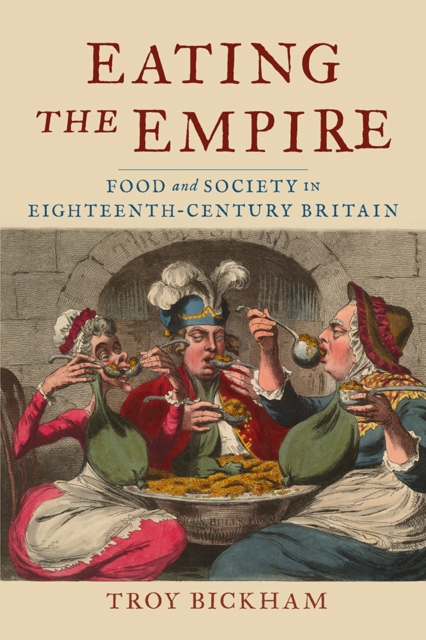
Eating the empire : food and society in eighteenth-century Britain
When students gathered in a London coffeehouse and smoked tobacco; when Yorkshire women sipped sugar-infused tea; or when a Glasgow family ate a bowl of Indian curry, were they aware of the mechanisms of imperial rule and trade that made such goods readily available? In Eating the Empire, Troy Bickham unfolds the extraordinary role that food played in shaping Britain during the long eighteenth century (circa 1660-1837), when such foreign goods as coffee, tea, and sugar went from rare luxuries to some of the most ubiquitous commodities in Britain-reaching even the poorest and remotest of households. Bickham reveals how trade in the empire's edibles underpinned the emerging consumer economy, fomenting the rise of modern retailing, visual advertising, and consumer credit, and, via taxes, financed the military and civil bureaucracy that secured, governed, and spread the British Empire.
eBook