
Catalogue Search | MBRL


Are you sure you want to remove the book from the shelf?

{{itemTitle}}
2,613
result(s) for
"Copyright Canada."
Sort by:


For the Encouragement of Learning
For the Encouragement of Learning addresses the contested history of copyright law in Canada, where the economic and reputational interests of authors and the commercial interests of publishers often conflict with the public interest in access to knowledge. It chronicles Canada’s earliest copyright law to explain how pre-Confederation policy-makers understood copyright’s normative purpose.
Using government and private archives and copyright registration records, Myra Tawfik demonstrates that the nineteenth-century originators of copyright law intended to promote the advancement of learning in schools by encouraging the mass production of educational material. The book reveals that copyright laws were integral features of British North American education policy and highlights the important roles played by teachers, education reformers, and politicians in the emergence and development of the laws. It also explains how policy-makers began to consider the relationship between copyright and cultural identity formation once British interference into domestic copyright affairs increased, and as Canadian Confederation neared. Using methodologies at the intersection of legal history and book history, For the Encouragement of Learning embeds the copyright legal framework within the history of Canada’s book and print culture.
eBook


Spectre: Canadian Copyright and the Mandatory Tariff - Part II
Canadian copyright collectives and the Copyright Board have in recent years advanced the theory that when the Board certifies collectives' tariffs (or fixes the royalties in individual cases), those tariffs become mandatory on users. Users have no choice whether to deal with the collective; they must pay the specified royalties as long as they make a single unauthorized use of a work from the collective's repertoire. Many users, for some strange reason, have also subscribed to this view, despite its extraordinary consequences. This is a second article in a series of two. The previous article showed that the \"mandatory tariff\" theory cannot, as a matter of statutory interpretation and in light of the case law, withstand scrutiny. This article shows that in addition, construing the Act in accordance with the \"mandatory tariff\" theory gives rise to numerous practical challenges, conceptual puzzles, procedural nightmares, and constitutional headaches, each of which should weigh the scales against it. In contrast, the \"voluntary licence\" theory avoids all these quandaries, and, in addition to being consistent with earlier case law, appears clear, simple, and coherent.
Journal Article

Access Copyright and the Proposed Model Copyright Licence Agreement: A Shakespearean Tragedy
The year 2012 proved to be a turning point for copyright law in Canada, with new amending legislation finally passed by Parliament and important decisions delivered by the Supreme Court of Canada expounding on users' rights to deal fairly with works for the purposes of research and private study. As the public battle on whether teachers could make photocopies for distribution to students was being fought by a coalition of primary and secondary institutions all the way up to the Supreme Court, a quiet war had been waged against post-secondary institutions in the field and was being settled privately. Canadian universities faced mounting pressure in early spring to sign a Proposed Model Licence with Access Copyright and many yielded on the basis of certain considerations that now demand further scrutiny: the pressure of timing, assumptions regarding the best means of mitigating risk and a narrow calculation of what risk of litigation and liability might entail. The resulting contracts with Access Copyright may not serve educational institutions well as they create new obligations and undermine any progress made towards a balanced regime for the educational context; they may also have served to destabilize Access Copyright's market position as the best means of ensuring fair access to works for educational institutions. [PUBLICATION ABSTRACT]
Journal Article
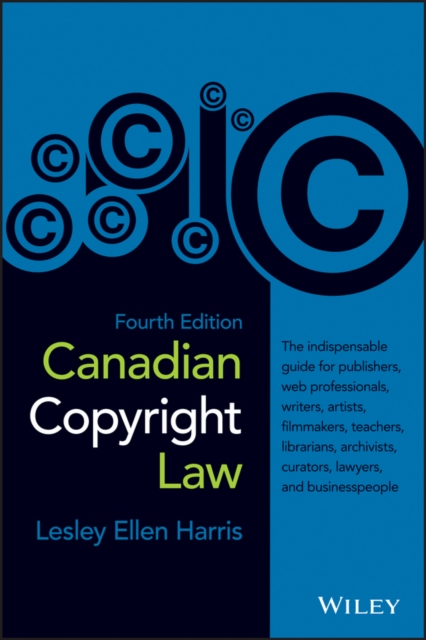
Canadian Copyright Law
An updated guide to Canadian copyright law for an age of reckless infringement
This fourth edition of Canadian Copyright Law brings you the latest updates according to new Canadian legislation and international agreements. Copyright infringement has always been an invisible crime. Now with near-constant access to the Internet and the mainstream explosion of digital formats, copyright is one of the most important issues for creative professionals, consumers of that media, and those who work in related industries. The line between what is protected and what is \"free\" is blurring further, and the copyright issues are more complex than ever.
* Provides a complete update on copyright issues relating to digital media.
* Takes the convoluted legal jargon of the Canadian Copyright Act and sets it out in everyday language.
* Provides concrete examples to offer further clarification of complicated matters.
Whether you are a creator or user of copyright material, Canadian Copyright Law will keep you current on copyright law in Canada and its applications to your situation—to protect your creations, content, and products in these rapidly changing markets.
eBook
The Ambiguous Nature of Copyright Users' Rights
In this article, the author investigates the nature of exceptions to copyright infringement or users' rights as they are laid out in Canada's Copyright Act and in copyright jurisprudence, as well as through their interaction with contracts and technological protection measures. The author begins his analysis with four exceptions to copyright infringement that were added to the Copyright Act in 2012 (i.e., the non-commercial user-generated content, the reproduction for private purposes, the later listening or viewing, and the backup copies exceptions to copyright infringement) with a particular focus on their relevance for consumers and their relation to pre-existing users' rights. The author investigates the nature of these exceptions, including through Hohfeld's theory of jural correlatives. He looks at the policy considerations behind these questions and conclude his article by reflecting on the damaging effects of the uncertain nature of users' rights on the coherence and, ultimately, the legitimacy of copyright law.
Journal Article

Recalibrating Some Copyright Conceptions: Toward a Shared and Balanced Approach to Educational Copying
Most of Canada’s publicly-funded educational institutions have operated since the 1990s under blanket reprographic licences. But recent Copyright Act amendments and Supreme Court decisions in several copyright cases have added legislative and judicial weight to the idea that copyright encompasses both private owners’ rights and public users’ rights in the form of infringement exceptions such as fair dealing. Many educational institutions have responded to these changes by moving toward greater reliance on statutory users’ rights and direct licensing with copyright owners, and by moving away from blanket collective licensing. Not unexpectedly, copyright owners and the societies and collectives that represent them see the changes in copyright law in a different light. Copyright owners’ and educators’ variant conceptions of the kinds of educational copying that are compensable pose a challenging policy problem in need of a principled solution that upholds the legislative underpinnings of copyright law and is perceived to be fair. This article attempts to frame a balanced understanding of underlying issues by considering the nature and purpose of copyright, the purpose of copyright collectives, what is meant by fair dealing, and, ultimately, how we should think about copyright. It suggests that meaningful change may not be achievable without concerted attention paid to the language we use to think and talk about copyright in order to construct a combat-free shared space in which learning, inquiry, and the production of creative works are fostered and, when appropriate, rewarded fairly.
Journal Article
