
Catalogue Search | MBRL


Are you sure you want to remove the book from the shelf?

{{itemTitle}}
7,126
result(s) for
"Copyright licenses"
Sort by:
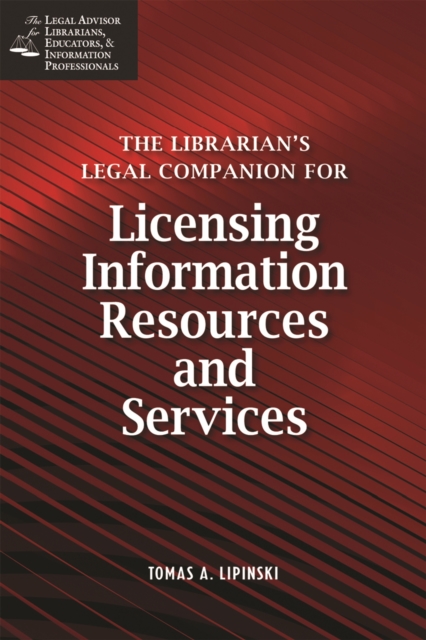
The librarian's legal companion for licensing information resources and services
Here is your go-to for expert guidance in information acquisition including copyright and contract matters. Lipinski covers: basic fair trade and contract law concepts, contract formation, compliance, breech and remedy issues; developments in online and information contracting; and the advantages and disadvantages about licensing. You will find clear guidance on deciphering the legalese in agreements, advice on negotiating them like a pro, and detailed explanations of specific licenses - web-link, shrink-wrap, and others and a discussion of jurisdictional issues regarding online and information contracting. Lipinski features real-world cases involving the acquisitions process.
eBook

Information Technology and Intellectual Property Law
Information Technology and Intellectual Property Law is a complete exploration of the relationship between information technology and intellectual property laws a very wide-ranging and complex, ever changing area of law. It provides up-to-date coverage and analysis of the intellectual property laws applicable to all forms of computer software. placing the law in the context of computer use examining copyright, database rights, patents, trade marks, design rights and the law of confidence. There have been numerous cases before the Court of Justice for the European Union (CJEU) recently, in particular involving the use of trade marks on the Internet, and these are analysed in detail with the implications of the judgments explained in a practical and accessible way. Information Technology and Intellectual Property Law includes developments surrounding ISPs (Internet Service Providers), for example injunctions against ISPs both in the UK and before the Court of Justice of the European Union, and coverage of the Digital Economy Act provisions. It can either be read from cover to cover as a thorough introduction to the subjects addressed or be used as a very useful starting point for a specialist practitioner faced with a particular problem on a particular case. With this in mind Information Technology and Intellectual Property Law is an essential addition to any an IT and IP practitioner’s bookshelf as well as a useful textbook for non-specialists as well as advanced undergraduate and taught postgraduate IT and IP courses.
eBook

The Machine as Author
The use of Artificial Intelligence (\"AI\") machines using deep learning neural networks to create material that facially looks like it should be protected by copyright is growing exponentially. From articles in national news media to music, film, poetry and painting AI machines create material that has economic value and that competes with productions of human authors. The Article reviews both normative and doctrinal arguments for and against the protection by copyright of literary and artistic productions made by AI machines. The Article finds that the arguments in favor of protection are flawed and unconvincing and that a proper analysis of the history, purpose, and major doctrines of copyright law all lead to the conclusion that productions that do not result from human creative choices belong to the public domain. The Article proposes a test to determine which productions should be protected, including in case of collaboration between human and machine. Finally, the Article applies the proposed test to three specific fact patterns to illustrate its application.
Journal Article

The Grapes of Roth
Shortly after Roth Greeting Cards was decided in 1970, its offhand reference to the \"total concept and feel\" of the cards at issue became the dominant standard in copyright law for determining whether two works were substantially similar. That is a remarkable achievement for a phrase that, in the words of the influential Nimmer treatise, \"threatens to subvert the very essence of copyright.\" It nevertheless had enormous appeal for federal judges, and the reason extends well beyond copyright law. \"Total concept and feel\" appeared at a critical juncture for the federal judiciary, as an older model of decision-making, based on discretion and reason, yielded to a more formalized process. For a time, the phrase allowed judges in copyright cases to continue using their discretion and aesthetic judgment in a legal world that had grown cold to both of those things.
Journal Article

THE CLASS ACTION AS LICENSING AND REFORM DEVICE
The age of digital distribution exacerbates transaction costs in two distinct ways. First, the dissemination of large quantities of works requires permissions from myriad copyright holders. Second, new technologies lower the cost of content creation, resulting in millions of individual creators, rather than a discrete set of large industry repeat players. The potential of class actions to address this rising transaction cost problem has gone largely unexplored. Instead, copyright scholars approaching the problem have advocated for either private ordering or legislative reform. But aggregate litigation fulfills a different function—something much closer to an administrative copyright—administering millions of licenses while filling in statutory gaps to address a rapidly shifting technological landscape.
In this sense, copyright class actions also differ from procedural scholars’ understanding of mass litigation as either a regulatory or joinder device to address distinct past harms. Instead, this Article offers a novel view of the class action as both an efficient transactional mechanism—a hybrid public–private licensing scheme—and as substantive legal reform, updating copyright law for new technological uses. Settlements in copyright class actions have been used as blanket licenses—for both past harms and forward-looking royalties—where individual negotiations are impossible. They have also been progenitors to landmark copyright legislation—and indeed, some settlements themselves contain quasi-legislative components that solve long-standing problems in the copyright industry. This Article argues for a vision of copyright class actions as the future and for the promise of licensing and reform by litigation in an age of mass aggregation, far-flung rights, and legislative gridlock.
Journal Article
Against Copyright Customization
Copyright law gives copyright owners tremendous power over their users, but some of them want even more. Copyright law's restrictions on the copying, distribution, adaptation, public performance, and public display of a work are broad, applicable to all stages within the stream of commerce and possession, and places liability on some third parties for merely assisting benefiting or encouraging an infringing activity. However, like any property-law based regime, those restrictions have limitations. The same law that gives copyright owners the power to restrict their users in multiple ways also has built-in boundaries, which means that not every action in connection to a copyrighted good is prohibited by copyright law. Enter contract law. Some copyright owners, software companies in particular, try to use copyright license agreements to expand the rights provided by copyright law and customize them to their needs. They write standard form contracts that give them rights that are not provided for by copyright law, and nevertheless claim that the breach of those privately made arrangements triggers liability under copyright law. In that way, they turn copyright law from a system of strict rules, created by Congress, that balances between the interests of copyright owners and users to one that they can shape as they see fit for their needs. Courts have struggled and mostly failed in preventing copyright owners from using licenses in that way. This Article explains that the leading approach for policing such licenses was shaped in 2010 by two Ninth Circuit decisions: Vernor v. Autodesk, Inc. and MDY Industries, LLC v. Blizzard Entertainment, Inc. This framework, however, missed the mark. This Article shows how both opinions are misguided as a matter of law and harmful as a matter of policy. They, unfortunately, give too much power to large software companies and too little freedom to their consumers. Moreover, a study of the 46 cases that applied MDY 5 test, which was supposed to curb the software companies ' power, reveals that courts could not come up with clear criteria or an effective test to limit that power. Other developments in recent years, including new decisions of the Supreme Court and the Second Circuit, further weakened the Vernor-MDY framework. Those recent developments, as well as the increased centrality of digital distribution channels, make this the perfect time to reevaluate and abandon the currently prevalent framework. This Article shows that core notions of commercial law offer a superior approach to police those licenses in a way that is consistent with copyright policy. Indeed, if the core principles of contract and property law are correctly applied, the balance between copyright law and contract law can be maintained. With it, copyright liability is restored to the scope intended by Congress, and its expansion through customization is successfully restricted.
Journal Article

Reconceptualizing Compulsory Copyright Licenses
United States copyright law generally assumes that by providing property entitlements in creative works, the free market will balance between two competing priorities: incentivizing creators to produce works and ensuring the public has adequate access to this content. But the Copyright Act also outlines several detailed compulsory licensing schemes requiring the owners of certain copyright interests, musical works in particular, to license to anyone at government-set prices. Consistent with broader property theory concepts, scholars tend to treat compulsory copyright licenses as liability rules used only to address market failures caused by transaction costs. This Article questions that account, arguing that compulsory licensing also plays an important and underexplored role in furthering copyright’s specific policy agenda.
A close analysis of the music regulatory regime and its history shows that its primary function has been to recalibrate the balance between creators’ financial incentives and public access to expressive works in situations where free market licensing would yield problematic outcomes. Unlike liability rules designed only to address transaction costs, for which regulators generally try to mimic market rates using market proxies, the compulsory music licensing regime traditionally used rate-setting criteria oriented around copyright policy. Applying these criteria, regulators often chose low royalty rates explicitly designed to allow access-expanding music dissemination technologies—from the player piano to digital radio—to flourish.
In recent years, however, policymakers have begun to lose sight of this access-encouraging role. A series of legislative changes, including the recent Music Modernization Act, has made the compulsory music licensing regime increasingly inconsistent and ill equipped to handle new forms of music dissemination. Policymakers now seem to view compulsory licensing as justified only in the face of transaction-cost-based market failures and have begun privileging market mimicking over copyright policy when choosing royalty rates. This shift has yielded increasingly high royalty rates, which have made it more difficult for new disseminators, such as streaming services, to facilitate access to music.
This Article argues that the shift away from policy-focused compulsory licensing prevents the regime from maintaining balance in the copyright system, a problem that is especially apparent in the experience of the burgeoning music streaming industry. In particular, a copyright-policy-based approach is necessary to prevent the malleability (and manipulability) of market-mimicking rate-setting standards from yielding royalty rates that are unworkable for streaming services. Although the Music Modernization Act has pushed the existing regime even farther away from its original role by implementing a market-focused rate-setting standard, this Article suggests ways that regulators could still further copyright policy goals in future rate-setting proceedings.
Journal Article

Copyright Protection for the Franchised Business
\"4 The law is codified in Title 17 of the United States Code, as amended (the \"Copyright Act\").5 A. Basic Concepts Copyrights protect original, minimally creative authored works, such as writings, music, images, audio or audiovisual recordings, and architectural works6 that are fixed in a tangible medium of expression.7 Only the copyrighted expression is protected, not the underlying ideas, procedures, methods, discoveries, concepts, or \"useful articles. [...]copyright registration is required to bring suit for copyright infringement in the United States.'s Moreover, prompt registration enables the would-be infringement plaintiff to avoid the additional cost associated with expediting registration applications and can entitle the owner to statutory damages of up to of $150,000 per infringement and reasonable attorney's fees.19 In certain cases, attorney fees in copyright infringement cases can far outweigh actual damages.20 The prospect of potential statutory damages can be a powerful deterrent to potential willful infringers. The Copyright Act does not include a definition of \"photograph\" but the term includes photographs that are created with a camera and captured in a digital file or other visual medium such as film.33 (6) Computer Software and Apps. Copyright in software extends to source code, which is copyrightable expression, but does not protect anything functional, such as the program's logic or system design or algorithms.34 HTML (hypertext markup language) is not considered to
Journal Article

LEVEL UP YOUR LEGAL KNOWLEDGE: A GAMER'S GUIDE TO NAVIGATING COPYRIGHT CHALLENGES FOR VIDEO GAME MUSIC COVERS AND SHEET MUSIC ARRANGEMENTS
Video games are a significant part of many people's lives, offering immersive worlds, memorable experiences, and music that stays with us long after the controller has been put down. Fans and players who love video game music often express their appreciation by creating music covers, arranging sheet music, and performing video game compositions. However, the legal complexities surrounding copyright are not always top of mind for these creators. This paper explores the intersection of copyright law and fan-created video game music, focusing on covers and sheet music arrangements. It outlines how ownership of music in the video game industry is structured and how these structures affect fan permissions. The paper also examines key issues such as DMCA takedowns, copyright infringement, and licensing requirements, while considering how game companies shape policies on fan creations. By blending legal analysis with practical guidance, this paper aims to encourage law students, legal professionals, and creative communities to better understand and advocate for legal frameworks that respect copyright holders while supporting creative freedom and fan expression.
Journal Article