
Catalogue Search | MBRL


Are you sure you want to remove the book from the shelf?

{{itemTitle}}
4
result(s) for
"Corporate culture China History 21st century."
Sort by:

The source of innovation in China : highly innovative human systems
\"Given the popular belief that China's comparative advantage is its low labour cost, The Source of Innovation in China argues that the fundamental source for Chinese economic growth is its innovation. Based on qualitative case studies and quantitative surveys of 600 firms, this research describes the competitive advantages of successful Chinese enterprises and builds a theoretical framework for innovative firms and empirically tests the resulting hypothesis. The authors explore the general features of Chinese enterprise and innovation, hypothesizing that the rapid economic development in China is based on innovation. This innovation is not only about technological innovation, but also process and strategy innovation. Cases are drawn from technological innovative firms and from traditional labour-intensive industries. Moreover, the underlying source of Chinese innovation is centred on its people, and the authors discuss this by looking at the philosophical, linguistic and culture influences. They take a broad stakeholder perspective and employ social network theory to explain that, by extension, innovative people surround the organization and create organizational values. At the organizational level, they propose a theoretical framework of a High-Innovative Human System, by integrating both Western and Chinese management systems. \"-- Provided by publisher.
Book
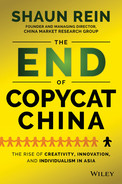
The end of copycat China
The End of Copycat China helps business executives and investors understand how China's economy is shifting from one based on heavy investment to one on services and consumption by providing insight that help shape effective strategy. Drawing from over 50,000 interviews with entrepreneurs, venture capitalists, private equity investors, private Chinese companies, and multinationals, this book describes how Chinese firms are increasingly focused on innovation rather than copying what worked in America and how consumers are evolving with their hopes, dreams and aspirations. China's growth model of the last three decades is becoming increasingly ineffective, as relying on heavy investment and exports is becoming less and less feasible. Fifty percent of China's growth in 2013 stemmed from consumption, the government is establishing a Free Trade zone in Shanghai and ending the dominance of state-owned enterprises. This book provides a roadmap for companies and investors looking to navigate these changes and capture emerging trends, with deep insight and practical guidance on what innovation looks like in the new China
eBook

Shaking the Heavens and Splitting the Earth
This monograph analyzes published Chinese and Western sources about current and future capabilities and employment concepts of the People's Liberation Army Air Force (PLAAF). It describes how those capabilities and concepts might be realized in a conflict over Taiwan, assesses the implications of China implementing them, and provides recommendations about actions that should be taken in response.
eBook

Culture and KM in China
Purpose - This study seeks to present observations on the impact of Chinese culture traits on knowledge management practices in Chinese corporations.Design methodology approach - The paper presents an analysis of the authors' own experience as senior managers in implementing a globalization strategy for a leading Chinese domestic IT services company. It specifically focuses on key culture traits that have been proven to directly impact knowledge management practices.Findings - There are deeply rooted culture traits that work counter to the objectives of a knowledge management program within a Chinese corporation. Information sharing is essential counter culture. The authors' experience is that incremental changes that rely on institutionalized systems of information transfer offer hope for the gradual transformation of corporate cultures that foster effective knowledge management practices and increase corporate competitiveness.Research limitations implications - This study is by no means exhaustive, but is intended as a starting-point to explore alternatives for overcoming culture traits that inhibit knowledge transfer.Originality value - The study provides a basis for companies including Chinese companies, joint ventures or multi-national companies operating in China to assess obstacles to effective knowledge management and to consider various alternatives in adopting a knowledge management plan.
Journal Article