
Catalogue Search | MBRL


Are you sure you want to remove the book from the shelf?

{{itemTitle}}
237
result(s) for
"Corporation law Political aspects United States."
Sort by:

Corporate friction : how corporate law impedes American progress and what to do about it
\"Corporate law in the United States requires directors to manage firms in the interests of shareholders, which means never sacrificing profits in service of other stakeholders or interests. In this timely, groundbreaking book, David Yosifon argues that this rule of \"shareholder primacy\" is logically, ethically, and practically unsound, and should be replaced by a new standard that compels directors of our largest corporations to manage firms in a socially responsible way. In addition to summarizing existing debates on the issue-and giving special attention to the Supreme Court's decision in Citizen's United-Yosifon explores the problem of corporate patriotism and develops a novel approach to the relationship between corporate law and consumer culture. The book's technical acumen will appeal to experts, while its engaging prose will satisfy anyone interested in what our corporate law does, and what it should do better\"-- Provided by publisher.
Book

Lobbying America
Lobbying Americatells the story of the political mobilization of American business in the 1970s and 1980s. Benjamin Waterhouse traces the rise and ultimate fragmentation of a broad-based effort to unify the business community and promote a fiscally conservative, antiregulatory, and market-oriented policy agenda to Congress and the country at large. Arguing that business's political involvement was historically distinctive during this period, Waterhouse illustrates the changing power and goals of America's top corporate leaders.
Examining the rise of the Business Roundtable and the revitalization of older business associations such as the National Association of Manufacturers and the U.S. Chamber of Commerce, Waterhouse takes readers inside the mind-set of the powerful CEOs who responded to the crises of inflation, recession, and declining industrial productivity by organizing an effective and disciplined lobbying force. By the mid-1970s, that coalition transformed the economic power of the capitalist class into a broad-reaching political movement with real policy consequences. Ironically, the cohesion that characterized organized business failed to survive the ascent of conservative politics during the 1980s, and many of the coalition's top goals on regulatory and fiscal policies remained unfulfilled. The industrial CEOs who fancied themselves the \"voice of business\" found themselves one voice among many vying for influence in an increasingly turbulent and unsettled economic landscape.
Complicating assumptions that wealthy business leaders naturally get their way in Washington,Lobbying Americashows how economic and political powers interact in the American democratic system.
eBook

Rethinking Private Authority
Rethinking Private Authorityexamines the role of non-state actors in global environmental politics, arguing that a fuller understanding of their role requires a new way of conceptualizing private authority. Jessica Green identifies two distinct forms of private authority--one in which states delegate authority to private actors, and another in which entrepreneurial actors generate their own rules, persuading others to adopt them.
Drawing on a wealth of empirical evidence spanning a century of environmental rule making, Green shows how the delegation of authority to private actors has played a small but consistent role in multilateral environmental agreements over the past fifty years, largely in the area of treaty implementation. This contrasts with entrepreneurial authority, where most private environmental rules have been created in the past two decades. Green traces how this dynamic and fast-growing form of private authority is becoming increasingly common in areas ranging from organic food to green building practices to sustainable tourism. She persuasively argues that the configuration of state preferences and the existing institutional landscape are paramount to explaining why private authority emerges and assumes the form that it does. In-depth cases on climate change provide evidence for her arguments.
Groundbreaking in scope,Rethinking Private Authoritydemonstrates that authority in world politics is diffused across multiple levels and diverse actors, and it offers a more complete picture of how private actors are helping to shape our response to today's most pressing environmental problems
eBook

All Politics Is Global
Has globalization diluted the power of national governments to regulate their own economies? Are international governmental and nongovernmental organizations weakening the hold of nation-states on global regulatory agendas? Many observers think so. But in All Politics Is Global, Daniel Drezner argues that this view is wrong. Despite globalization, states--especially the great powers--still dominate international regulatory regimes, and the regulatory goals of states are driven by their domestic interests. As Drezner shows, state size still matters. The great powers--the United States and the European Union--remain the key players in writing global regulations, and their power is due to the size of their internal economic markets. If they agree, there will be effective global governance. If they don't agree, governance will be fragmented or ineffective. And, paradoxically, the most powerful sources of great-power preferences are the least globalized elements of their economies. Testing this revisionist model of global regulatory governance on an unusually wide variety of cases, including the Internet, finance, genetically modified organisms, and intellectual property rights, Drezner shows why there is such disparity in the strength of international regulations.
eBook
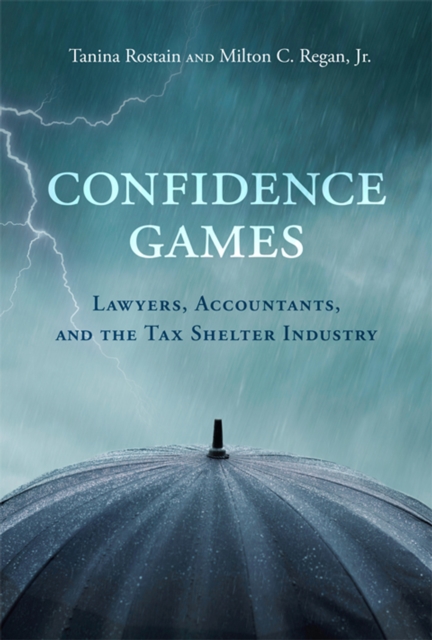
Confidence Games
For ten boom-powered years at the turn of the twenty-first century, some of America's most prominent law and accounting firms created and marketed products that enabled the very rich -- including newly minted dot-com millionaires -- to avoid paying their fair share of taxes by claiming benefits not recognized by law. These abusive domestic tax shelters bore such exotic names as BOSS, BLIPS, and COBRA and were developed by such prestigious firms as KPMG and Ernst & Young. They brought in hundreds of millions of dollars in fees from clients and bilked the U.S. Treasury of billions in revenues before the IRS and Justice Department stepped in with civil penalties and criminal prosecutions. InConfidence Games, Tanina Rostain and Milton Regan describe the rise and fall of the tax shelter industry during this period, offering a riveting account of the most serious episode of professional misconduct in the history of the American bar. Rostain and Regan describe a beleaguered IRS preoccupied by attacks from antitax and antigovernment politicians; heightened competition for professional services; the relaxation of tax practitioner norms against aggressive advice; and the creation of complex financial instruments that made abusive shelters harder to detect. By 2004, the tax shelter boom was over, leaving failed firms, disgraced professionals, and prison sentences in its wake. Rostain and Regan's cautionary tale remains highly relevant today, as lawyers and accountants continue to face intense competitive pressure and regulators still struggle to keep pace with accelerating financial risk and innovation.
eBook

Lawless Capitalism
The subprime mortgage crisis has been blamed on many: the Bush Administration, Bernie Madoff, the financial industry, overzealous housing developers. Yet little scrutiny has been placed on the American legal system as a whole, even though parts of that system, such as the laws that regulate high-risk lending, have been dissected to bits and pieces. In this innovative and exhaustive study, Steven A. Ramirez posits that the subprime mortgage crisis, as well as the global macroeconomic catastrophe it spawned, is traceable to a gross failure of law.The rule of law must appropriately channel and constrain the exercise of economic and political power. Used effectively, it ensures that economic opportunity isn't limited to a small group of elites that enjoy growth at the expense of many, particularly those in vulnerable economic situations. In Lawless Capitalism, Ramirez calls for the rule of law to displace crony capitalism. Only through the rule of law, he argues, can capitalism be reconstructed.
eBook

Oil, Globalization, and the War for the Arctic Refuge
The global consumption of fossil fuels is dramatically rising, while inversely, the supply is in permanent decline. The \"end of oil\" threatens the very future of Western civilization. Oil, Globalization, and the War for the Arctic Refuge examines the politics of drilling for oil in Alaska's Arctic National Wildlife Refuge, and presents this controversy as a precursor of future \"resource wars\" where ideas and values collide and polarize. The reader is introduced to the primary participants involved: global corporations, politicians, nongovernmental organizations, indigenous peoples and organizations, and human rights/religious organizations. Author David M. Standlea argues in favor of seeing this comparatively \"local\" conflict as part of a larger struggle between the proponents of an alternative, positive vision for the future and an American culture presently willing to sacrifice that future for immediate profit.
eBook

Terrified
In July 2010, Terry Jones, the pastor of a small fundamentalist church in Florida, announced plans to burn two hundred Qur'ans on the anniversary of the September 11 attacks. Though he ended up canceling the stunt in the face of widespread public backlash, his threat sparked violent protests across the Muslim world that left at least twenty people dead. InTerrified, Christopher Bail demonstrates how the beliefs of fanatics like Jones are inspired by a rapidly expanding network of anti-Muslim organizations that exert profound influence on American understanding of Islam.
Bail traces how the anti-Muslim narrative of the political fringe has captivated large segments of the American media, government, and general public, validating the views of extremists who argue that the United States is at war with Islam and marginalizing mainstream Muslim-Americans who are uniquely positioned to discredit such claims. Drawing on cultural sociology, social network theory, and social psychology, he shows how anti-Muslim organizations gained visibility in the public sphere, commandeered a sense of legitimacy, and redefined the contours of contemporary debate, shifting it ever outward toward the fringe. Bail illustrates his pioneering theoretical argument through a big-data analysis of more than one hundred organizations struggling to shape public discourse about Islam, tracing their impact on hundreds of thousands of newspaper articles, television transcripts, legislative debates, and social media messages produced since the September 11 attacks. The book also features in-depth interviews with the leaders of these organizations, providing a rare look at how anti-Muslim organizations entered the American mainstream.
eBook

CORPORATE POLITICAL SPEECH: WHO DECIDES?
The Supreme Court spoke clearly this Term on the issue of corporate political speech, concluding in 'Citizens United v. FEC' that the First Amendment protects corporations' freedom to spend corporate funds on indirect support of political candidates. Constitutional law scholars will long debate the wisdom of that holding, as do the authors of the two other Comments in this issue. In contrast, this Comment accepts as given that corporations may not be limited from spending money on politics should they decide to speak. We focus in-stead on an important question left unanswered by Citizens United: who should have the power to decide whether a corporation will engage in political speech?
Journal Article
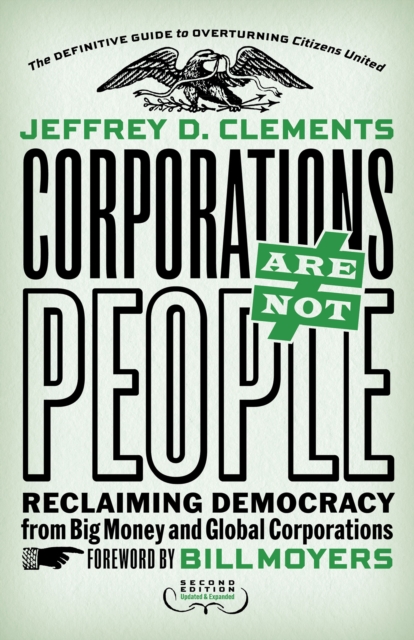
Corporations Are Not People
A revised and updated edition of the definitive guide to overturning Citizens United. Since the Supreme Court's Citizens United ruling that the rights of things--money and corporations--matter more than the rights of people, America has faced a crisis of democracy.
eBook