Catalogue Search | MBRL


Are you sure you want to remove the book from the shelf?

{{itemTitle}}
17
result(s) for
"Cosmic Evolution (book)"
Sort by:

The First Galaxies in the Universe
This book provides a comprehensive, self-contained introduction to one of the most exciting frontiers in astrophysics today: the quest to understand how the oldest and most distant galaxies in our universe first formed. Until now, most research on this question has been theoretical, but the next few years will bring about a new generation of large telescopes that promise to supply a flood of data about the infant universe during its first billion years after the big bang. This book bridges the gap between theory and observation. It is an invaluable reference for students and researchers on early galaxies.
The First Galaxies in the Universestarts from basic physical principles before moving on to more advanced material. Topics include the gravitational growth of structure, the intergalactic medium, the formation and evolution of the first stars and black holes, feedback and galaxy evolution, reionization, 21-cm cosmology, and more.
Provides a comprehensive introduction to this exciting frontier in astrophysicsBegins from first principlesCovers advanced topics such as the first stars and 21-cm cosmologyPrepares students for research using the next generation of large telescopesDiscusses many open questions to be explored in the coming decade
eBook

Mystic Christianity and Cosmic Integration: On a Pilgrim Trail with John Moriarty
This essay takes initial steps on a journey with an Irish eco-spiritual philosopher, the late John Moriarty. As a gateway into his broader oeuvre and way of thinking, we explore Moriarty’s image of the Christian mystical Easter journey—the Triduum Sacrum—as a vision for humanity and the planet. After briefly reviewing his spiritual biography, we consider Moriarty’s re-framing of the story as a journey to the bottom of a symbolic Grand Canyon, a mystical trail beyond historical time to a primordial unity before the evolution of the species. There, the total integration of the natural ecumene is experienced. For Moriarty, this journey leads not only into the past, but prefigures a pilgrimage that everyone can—and should—take. Analyzing primarily his own writing, we highlight the intercultural roots and ecumenical connections of Moriarty’s work, which draws extensively on spiritual traditions and contemporary debates from across the world. On that basis, we sign-post directions for further research into a potential post-Christian ecology as a new way of thinking about the earth and our role on it, based on an attitude of Gelassenheit.
Journal Article

Tribute to Sun Kwok
Sun Kwok was bom in Hong Kong in 1949. He did all his early schooling in Hong Kong and went to the same high school, Pui Ching Middle School, as I did but he was more than a decade later. There are two Education Systems in Hong Kong; the Chinese Language Schools and English Language School. Pui Ching was started by Christian missionaries in China and has a long history of providing quality education. Pui Ching is a Chinese Language School, and during colonial times, school entrance was difficult for students as we were not eligible to apply for admission to the University of Hong Kong, nor were we able to join the civil service. In spite of these handicaps, the school still managed to produce many excellent academics, including one Nobel Prize winner in physics and one Field's medalist in mathematics. Most of its graduates who sought further education went to the U.S. Or Canada as Sun Kwok did. Sun graduated from McMaster University and then went to the University of Minnesota for graduate studies. In the early 1970s, the University of Minnesota had just built one of the world's first infrared bolometers and the astronomers there (Nick Woolf and Ed Ney) were able to make some of the first infrared observations in the mid-infrared region. Through these observations, circumstellar dust was discovered, leading to the realization the evolved stars are losing mass. Sun wrote his PhD thesis on the mass loss mechanism of red giant stars, proposing that the stellar winds are driven by the mechanism of radiation pressure on grains. His 1975 paper is still widely cited to this date. In the same thesis, he showed that OH maser emission is a manifestation of the mass loss process and OH IR stars are the most heavily mass-losing stars known. He went back to Canada for postdoctoral studies, first at UBC and then at York University. While at York, he applied his knowledge of mass loss to the problem of formation of planetary nebulae, leading to now well-established interacting winds theory which revolutionized our understanding of the evolution of planetary nebulae. After he joined the University of Calgary, he collaborated with Bruce Hrivnak to discover many proto-planetary nebulae, the then missing link between asymptotic giant branch and planetary nebulae. Together with his former graduate student Kevin Volk, he analyzed the spectra obtained from the Low Resolution Spectrometer of the IRAS satellite and discovered the mysterious 21 micron emission feature, a feature that is still unidentified to this date. Through his work on millimeter-wave and infrared spectroscopy, Sun promoted the idea that evolved stars are prolific molecular factories. In addition to molecules and minerals, he suggested that evolved stars are also producing complex organics. His paper in Nature in 2004 demonstrated that organic synthesis in the late stages of stellar evolution can contaminate the chemical content of the Galaxy and can even affect the chemical composition of the primordial solar system. In addition to publishing in scientific journals, Sun has also written numerous articles in popular science magazines and given public talks to general audience all over the world. His two popular science books Cosmic Butterflies (Cambridge 2001) and Stardust: the cosmic seeds of life (Springer 2013) are extremely successful in the amateur astronomy communities. Sun is a dedicated teacher. He invested a great deal of efforts in his teaching. From the notes he developed over 20 years, he wrote the textbook Physics and Chemistry of the Interstellar Medium (University Science Books 2006). This book is now widely used all over the world, including leading universities such as Caltech. Sun has also been active in international service, having served as President of the IAU Working Group of Planetary Nebulae, President of IAU Commission 34 Interstellar Matter, and is the current President of IAU Commission F3 Astrobiology. Sun returned to Hong Kong in 2006 to take up the position as the first appointed Dean of Science at the University of Hong Kong. As soon as he arrived, he began to reform the science curriculum at HKU, beginning with the introduction of a flexible major minor system, Faculty common admission, experiential learning requirements, an academic advising system, creation of the interdisciplinary major Environmental Science, introduction of academic induction, undergraduate summer research fellowship and overseas research fellowship, and science service courses for engineering and medicine students. The most significant was his creation of a one-year core sequence of new science foundation courses, which introduced new ways of teaching mathematics and science at the undergraduate level. He is also committed to the internationalization of academic staff, having brought in new hires from many different countries and greatly raising the quality of the staff as a result. In spite of his heavy administration duties, Sun continues to teach every year. He designed and taught the course Our Place in the Universe as part of the Common Core of HKU. The course discusses the impact of 5000 year of astronomical development on society, religion and society. In 2016, Sun Kwok will have completed his 10-year tenure as Dean. I am glad to have the opportunity to dedicate the 11th Pacific Rim Conference on Stellar Astrophysics to celebrate the academic career of Sun Kwok. Many of us present here are well familiar with the influence Sun has effected over his career on the physics and chemistry of the late stages of evolution. I am very glad to see that so many experts in this field are gathered here in Hong Kong and I wish everyone a very successful and productive conference. I also wish Sun will continue his productive scientific research after he no longer has the administrative burdens and we look forward to more exciting science results from Sun in the years to come.
Journal Article

Widening perspectives: the intellectual and social benefits of astrobiology (regardless of whether extraterrestrial life is discovered or not)
Astrobiology is usually defined as the study of the origin, evolution, distribution and future of life in the Universe. As such it is inherently interdisciplinary and cannot help but engender a worldview infused by cosmic and evolutionary perspectives. Both these attributes of the study of astrobiology are, and will increasingly prove to be, beneficial to society regardless of whether extraterrestrial life is discovered or not.
Journal Article

What Are Gamma-Ray Bursts?
Gamma-ray bursts are the brightest--and, until recently, among the least understood--cosmic events in the universe. Discovered by chance during the cold war, these evanescent high-energy explosions confounded astronomers for decades. But a rapid series of startling breakthroughs beginning in 1997 revealed that the majority of gamma-ray bursts are caused by the explosions of young and massive stars in the vast star-forming cauldrons of distant galaxies. New findings also point to very different origins for some events, serving to complicate but enrich our understanding of the exotic and violent universe.What Are Gamma-Ray Bursts?is a succinct introduction to this fast-growing subject, written by an astrophysicist who is at the forefront of today's research into these incredible cosmic phenomena.
Joshua Bloom gives readers a concise and accessible overview of gamma-ray bursts and the theoretical framework that physicists have developed to make sense of complex observations across the electromagnetic spectrum. He traces the history of remarkable discoveries that led to our current understanding of gamma-ray bursts, and reveals the decisive role these phenomena could play in the grand pursuits of twenty-first century astrophysics, from studying gravity waves and unveiling the growth of stars and galaxies after the big bang to surmising the ultimate fate of the universe itself.
What Are Gamma-Ray Bursts?is an essential primer to this exciting frontier of scientific inquiry, and a must-read for anyone seeking to keep pace with cutting-edge developments in physics today.
eBook

From Quantum Unstable Systems to the Decaying Dark Energy: Cosmological Implications
We consider a cosmology with decaying metastable dark energy and assume that a decay process of this metastable dark energy is a quantum decay process. Such an assumption implies among others that the evolution of the Universe is irreversible and violates the time reversal symmetry. We show that if we replace the cosmological time t appearing in the equation describing the evolution of the Universe by the Hubble cosmological scale time, then we obtain time dependent Λ(t) in the form of the series of even powers of the Hubble parameter H: Λ(t)=Λ(H). Our special attention is focused on radioactive-like exponential form of the decay process of the dark energy and on the consequences of this type decay.
Journal Article

KAGAWA'S COSMIC PURPOSE AND MODERNIZATION IN JAPAN
Kagawa Tyohiko (1888–1960), who was a well known Christian leader and social reformer, is re‐evaluated from the perspective of a public philosophy, and as an example of the possibilities for collaboration and conflict between science and the religious humanities in East Asia. His last book, Cosmic Purpose, which appears to be a kind of natural theology, is analyzed from the perspective of the hidden topic of human evil. By considering Kagawa's deep religious sensibility and conscience, the book can be interpreted to reflect on the wrong directionality selected by modern Japan's leaders that resulted in the tragic war.
Journal Article
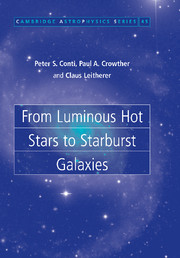
From Luminous Hot Stars to Starburst Galaxies
Luminous hot stars represent the extreme upper mass end of normal stellar evolution. Before exploding as supernovae, they live out their lives of a few million years with prodigious outputs of radiation and stellar winds, dramatically affecting both their evolution and environments. A detailed introduction to the topic, this book connects the astrophysics of massive stars with the extremes of galaxy evolution represented by starburst phenomena. A thorough discussion of the physical and wind parameters of massive stars is presented. HII galaxies, their connection to starburst galaxies, and the contribution of starburst phenomena to galaxy evolution through superwinds, are explored. The book concludes with the wider cosmological implications, including Population III stars, Lyman break galaxies and gamma-ray bursts, for each of which massive stars are believed to play a crucial role. This book is ideal for graduate students and researchers in astrophysics interested in luminous hot stars and galaxy evolution.
eBook

Our place in the universe
Our Place in the Universe tells the story of our world, formation of the first galaxies and stars formed from great clouds containing the primordial elements made in the first few minutes; birth of stars, their lives and deaths in fiery supernova explosions; formation of the solar system, its planets and many moons; life on Earth, its needs and vicissitudes on land and in the seas; finally exoplanets, planets that surround distant stars. Interspersed in the text are short pieces on some of those who revealed these wonders to us. It is written in a very authoritative and readable form and contains more than 100 color prints of the marvelous galaxies, and nebula that have been taken from space-based and land-based telescopes carried by NASA missions, the European Space Agency, the European Southern Laboratory in Chile and many other sources.
eBook