
Catalogue Search | MBRL


Are you sure you want to remove the book from the shelf?

{{itemTitle}}
4,604
result(s) for
"Cosmography."
Sort by:
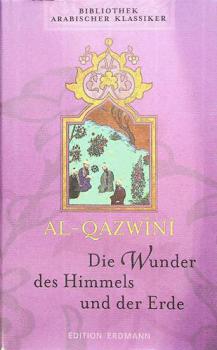
Die Wunder des Himmels und der Erde
In seiner Weltbeschreibung, der wertvollsten Kosmographie der islamischen Kultur, hält der Autor al-Qazwînî (ca. 1203 bis 1283) das Wissen seiner Epoche fest.Dabei verbindet er wissenschaftliche Fakten in geschickter Weise und gefälliger Sprache mit Anekdoten, Versen und Aussprüchen berühmter Leute und erfüllt soden Anspruch, die Menschen nicht nur zu informieren, sondern auch zu unterhalten. Al-Qazwînî weiß, dass die Erde eine Kugel ist; er weiß von der Heilkraftder Pflanzen und vom Einfluss des Mondes auf das Wasser der Meere und das Befinden der Menschen. Dass er aber auch an Wahrsagerei glaubt und an die Existenz von Wassermännern, dass er die Fliegen lobt, weil sie angeblich das rohe Fleisch vor Fäulnis bewahren, darüber wird der heutige Leser schmunzeln- und doch immer wieder die Anschaulichkeit, die Geschlossenheit und den Reichtum dieser frühen Weltbeschreibung bewundern und vergleichend unseren Himmel und unsere Erde betrachten.

Cosmographical Readings of the Qurʾan
The Qurʾan is the primary source of inspiration for Muslims across the ages. As Muslims, the task is to make the Qurʾan relevant to our own context. That task is however challenged every time the conception of the world changes. The change from a medieval Aristotelian to a modern heliocentric view of the world represented just such a challenge. But regardless of the differing worldviews, the Qurʾan’s descriptions of natural phenomena remained relevant. Accordingly, the aim of this article is to demonstrate the correspondence between the Qurʾanic description of natural phenomena and various scientific paradigms. It claims that the Qurʾan is relevant to both past and present scientific paradigms, even if these paradigms conflict with one another. This claim is illustrated through the example of cosmographies. It shows that the Qurʾan’s cosmographical verses can be read considering both ancient and modern paradigms. This multiplicity of correspondences is achieved: (1) by means of subjective descriptions, which are open to interpretation, (2) by means of negative affirmations, which allude to certain paradigms without fully endorsing them, and (3) through a silence about key elements that would unambiguously validate or refute a specific scientific paradigm. The Qurʾan’s interpretatively open cosmographical verses also include particularly apt word choices and morphology when it comes to considering them in the light of modern scientific paradigms. The philosophical and theological consequences of this multiplicity of correspondence are also discussed.
Journal Article


Unveiling the gravitational universe at μ-Hz frequencies
We propose a space-based interferometer surveying the gravitational wave (GW) sky in the milli-Hz to μ-Hz frequency range. By the 2040s, the μ-Hz frequency band, bracketed in between the Laser Interferometer Space Antenna (LISA) and pulsar timing arrays, will constitute the largest gap in the coverage of the astrophysically relevant GW spectrum. Yet many outstanding questions related to astrophysics and cosmology are best answered by GW observations in this band. We show that a μ-Hz GW detector will be a truly overarching observatory for the scientific community at large, greatly extending the potential of LISA. Conceived to detect massive black hole binaries from their early inspiral with high signal-to-noise ratio, and low-frequency stellar binaries in the Galaxy, this instrument will be a cornerstone for multimessenger astronomy from the solar neighbourhood to the high-redshift Universe.
Journal Article

An Ottoman cosmography : translation of Cihānnümā
\"Cihānnümā is the summa of Ottoman geography and one of the axial texts of Islamic intellectual history. Kātib Çelebi (d. 1657) sought to combine the Islamic geographical tradition with the new European discoveries, atlases and surveys. His cosmography included a comprehensive description of the regions of the world, extending westward from Japan and as far as the eastern Ottoman provinces. Ebū Bekr b. Behrām ed-Dimaşḳī(d. 1691) continued with a survey of the Arab countries and the remaining Ottoman provinces of Anatolia. İbrāhīm Müteferriḳa combined the two, with additional notes and maps of his own, in one of the earliest Ottoman printed books, Kitāb-ı Cihānnümā (1732). Our translation includes the entire text of Müteferriḳa's edition, distinguishing clearly between the contributions of the three authors. Based on Kātib Çelebi's original manuscript we have made hundreds of corrections to Müteferriḳa's text. Additional corrections are based on comparison with Kātib Çelebi's Arabic, Persian, Turkish, Latin and Italian sources\"-- Provided by publisher.
P_MAP

Sacred Habitat
Known as a time of revolutions in science, the early modern era
in Europe was characterized by the emergence of new disciplines and
ways of thinking. Taking this conceit a step further, Sacred
Habitat shows how Spanish friars and missionaries used new
scholarly approaches, methods, and empirical data from their
studies of ecology to promote Catholic goals and incorporate
American nature into centuries-old church traditions.
Ran Segev examines the interrelated connections between
Catholicism and geography, cosmography, and natural history-fields
of study that gained particular prominence during the sixteenth and
seventeenth centuries-and shows how these new bodies of knowledge
provided innovative ways of conceptualizing and transmitting
religious ideologies in the post-Reformation era. Weaving together
historical narratives on Spain and its colonies with scholarship on
the Catholic Reformation, Atlantic science, and environmental
history, Segev contends that knowledge about American nature
allowed pious Catholics to reconnect with their religious
traditions and enabled them to apply their beliefs to a foreign
land.
Sacred Habitat presents a fresh perspective on Catholic
renewal. Scholars of religion and historians of Spain, colonial
Latin America, and early modern science will welcome this
provocative intervention in the history of empire, science,
knowledge, and early modern Catholicism.
eBook

The worldmakers : global imagining in early modern Europe
Ayesha Ramachandran reconstructs the imaginative struggles of early modern artists, philosophers, and writers to make sense of something that we take for granted: the world, imagined as a whole. 'The Worldmakers' moves beyond histories of globalisation to explore how 'the world' itself - variously understood as an object of inquiry, a comprehensive category, and a system of order - was self-consciously shaped by human agents.
Book

Franciscus Monachus' 'De Orbis situ ac descriptione' - a parallel translation
Ad reverendissimo Domino Archiepiscopum Panonnitanum, Francisci, monachi ordinis Franciscani, epistola sane quam luculenta. In qua Ptolemaei, caeterorumque superiorum geographorum hallucinatio refellitur; aliaque praeterea de recens inventis terris, mari, insulis. De ditione Papae Joannis. De situ Paradisi et dimensione miliarium ad proportionem graduum coeli, praeclara et memoratu digna recensentur.
Cum Privilegio Invictissimi Romanorum imperatoris Caroli quinti, ad quinquennium, ne quis vel typis excudeat, vel excudendos curet hos codices geographicos, una cum globis, sub mulcta ammitendorum exemplarium aliaque poena principis severitate inferenda.
Journal Article


A Roadmap to Gamma-Ray Bursts: New Developments and Applications to Cosmology
Gamma-ray bursts are the most powerful explosions in the universe and are mainly placed at very large redshifts, up to z≃9. In this short review, we first discuss gamma-ray burst classification and morphological properties. We then report the likely relations between gamma-ray bursts and other astronomical objects, such as black holes, supernovae, neutron stars, etc., discussing in detail gamma-ray burst progenitors. We classify long and short gamma-ray bursts, working out their timescales, and introduce the standard fireball model. Afterwards, we focus on direct applications of gamma-ray bursts to cosmology and underline under which conditions such sources would act as perfect standard candles if correlations between photometric and spectroscopic properties were not jeopardized by the circularity problem. In this respect, we underline how the shortage of low-z gamma-ray bursts prevents anchor gamma-ray bursts with primary distance indicators. Moreover, we analyze in detail the most adopted gamma-ray burst correlations, highlighting their main differences. We therefore show calibration techniques, comparing such treatments with non-calibration scenarios. For completeness, we discuss the physical properties of the correlation scatters and systematics occurring during experimental computations. Finally, we develop the most recent statistical methods, star formation rate, and high-redshift gamma-ray burst excess and show the most recent constraints obtained from experimental analyses.
Journal Article