
Catalogue Search | MBRL


Are you sure you want to remove the book from the shelf?

{{itemTitle}}
384
result(s) for
"Cosmology, Ancient"
Sort by:

Cosmos in the ancient world
How did the ancient Greeks and Romans conceptualise order? This book answers that question by analysing the formative concept of kosmos ('order', 'arrangement', 'ornament') in ancient literature, philosophy, science, art, and religion. This concept encouraged the Greeks and Romans to develop theories to explain core aspects of human life, including nature, beauty, society, politics, the individual, and what lies beyond human experience. Hence, Greek kosmos, and its Latin correlate mundus, are subjects of profound reflection by a wide range of important ancient figures, including philosophers (Parmenides, Empedocles, the Pythagoreans, Democritus, Plato, Aristotle, the Stoics, Lucretius, Cicero, Seneca, Plotinus), poets and playwrights (Sophocles, Euripides, Aristophanes, Plautus, Marcus Argentarius, Nonnus), intellectuals (Gorgias, Protagoras, Varro), and religious exegetes (Philo, the Gospel Writers, Paul). By revealing kosmos in its many ancient manifestations, this book asks us to rethink our own sense of 'order', and to reflect on our place within a broader cosmic history.
Book
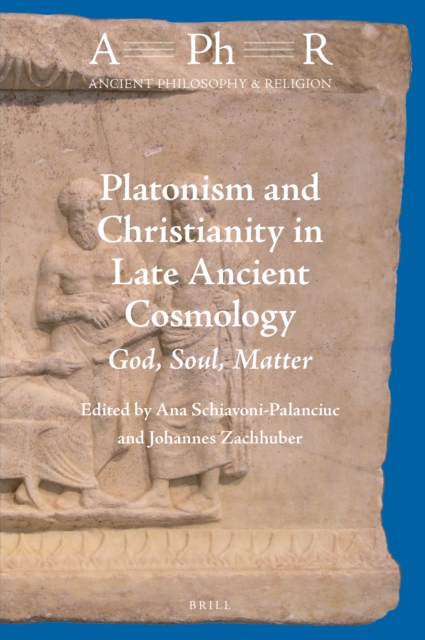
Platonism and Christianity in late ancient cosmology : God, soul, matter
The book breaks new ground by examining ideas about the cosmos, its shape, and its origin in late antiquity. Leading international experts discuss key texts and situate them in their historical environment. Les articles innovants de ce volume examinent les idées sur le cosmos, sa forme et son origine dans l'Antiquité tardive. Des spécialistes internationaux de premier plan présentent des éditions inédites de nouveaux fragments, en approfondissant les textes clés, les situant dans leur cadre historique complexe.
eBook
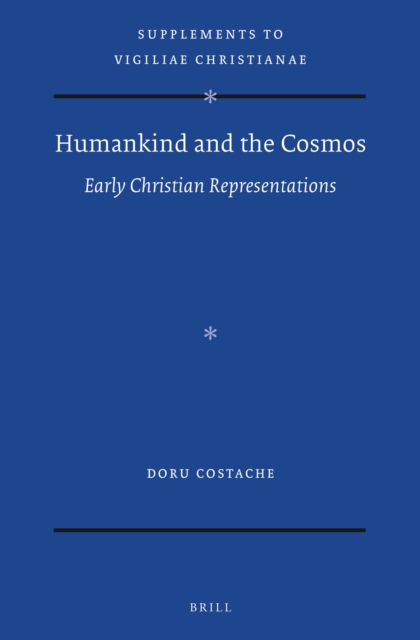
Humankind and the Cosmos: Early Christian Representations
In this volume, Costache endeavours to map the world as it was understood and experienced by the early Christians. Progressing from initial fears, they came to adopt a more positive view of the world through successive shifts of perception. This did not happen overnight. Tracing these shifts, Costache considers the world of the early Christians through an interdisciplinary lens, revealing its meaningful complexity. He demonstrates that the early Christian worldview developed at the nexus of several perspectives. What facilitated this process was above all the experience of contemplating nature. When accompanied by genuine personal transformation, natural contemplation fostered the theological interpretation of the world as it had been known to the ancients.
eBook


The Tomb of the Artisan God
A far-reaching reinterpretation of Plato'sTimaeusand its engagement with time, eternity, body, and soul that in its original French edition profoundly influenced Derrida
The Tomb of the Artisan Godprovides a radical rereading of Timaeus, Plato's metaphysical text on time, eternity, and the relationship between soul and body. First published in French in 1995, the original edition of Serge Margel's book included an extensive introductory essay by Jacques Derrida, who drew on Margel's insights in developing his own concepts of time, the promise, the world, andkhōra. Now available in English with a new preface by Margel, this engagement with Platonic thought proceeds from two questions that span the history of philosophy: What is time? What is the body?
Margel's twinned interrogation centers around Plato's concept of the demiurge (divine artisan or craftsman): its body, its anthropomorphic attributes, its productive capacities and regulatory functions in the ordering/organization/assembling of the world. He posits that this paradoxical figure is not merely a cosmological metaphor for the living body but also the site of its destruction, dissolution, and disappearance. Torn between the finite and the infinite, being and becoming, the concept of demiurge also poses metaphysical questions about time, time before time, and the end of time. The ontological status of the demiurge's body, Margel argues, would become increasingly decisive in the history of philosophy, particularly in Christianity and the dogma of incarnation.
eBook

Humankind and the Cosmos
In this volume Costache traces the progress of early Christians from fearing the world to embracing it through personal transformation, natural contemplation, and multidisciplinary perspectives.
eBook

Big Bang and Relative Immortality
This series of brief and sparkling philosophical essays explores the Principle of Continuity as it impacts discussions of the Big Bang and the expansion of the universe, God, infinity, biological immortality and evolution. From Ancient Greece to the frontiers of modern science, some egregious blunders have been made in both philosophy and in theoretical physics. The old theory of Continuous Creation was blown up by the Big Bang theory, but the author shows that this is just another ontological quagmire that conflicts with the First Law of Thermodynamics (conservation)and common sense. Surveying scientific principles, he discerns where they can and cannot illuminate our understanding.
eBook

'Harare' burial pottery in north-East Zimbabwe
Group cemeteries in the Harare area of north-east Zimbabwe are commonly associated with ancestral Shona, predating the northward extension of the Great Zimbabwe state in the mid-15th century AD. A reconsideration of the ethnographic data, burial patterns and burial pottery calls this interpretation into question. Harare pottery most likely represents a southern extension of Musengezi people who had moved south across the Zambezi. Rather than ancestral Shona, these Late Iron Age burials are the remains of people from Central Africa. If accurate, Harare pottery was made by Tavara, or Tavara-related people, who were either displaced or absorbed by incoming Karanga speakers. Ceramic traditions in Central Africa provide a framework for understanding these conclusions.
Journal Article
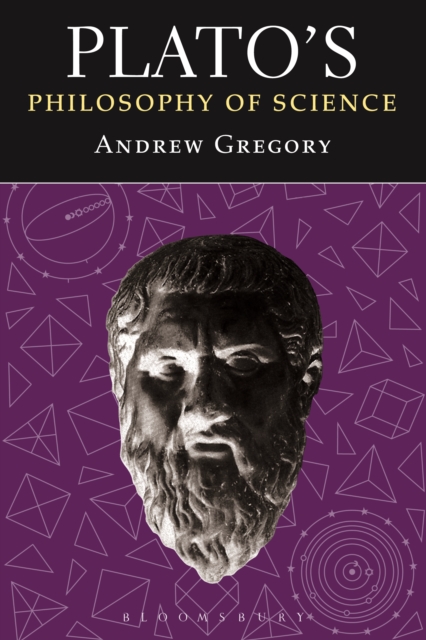
Plato’s Philosophy of Science
In this illuminating book Andrew Gregory takes an original approach to Plato’s philosophy of science by reassessing Plato’s views on how we might investigate and explain the natural world. He demonstrates that many of the common charges against Plato-disinterest, ignorance, dismissal of observation-are unfounded, and shows instead that Plato had a series of important and cogent criticisms to make of the early atomists and other physiologoi. Plato’s views on science, and on astronomy and cosmology in particular, are shown to have developed in interesting ways. Thus, the book argues, Plato can best be seen as a philosopher struggling with the foundations of scientific realism, and as someone, moreover, who has interesting epistemological, cosmological and nomological reasons for his approach. Plato’s Philosophy of Science is important reading for all those with an interest in Ancient Philosophy and the History of Science.
eBook