
Catalogue Search | MBRL


Are you sure you want to remove the book from the shelf?

{{itemTitle}}
277
result(s) for
"Counterinsurgency Pakistan."
Sort by:

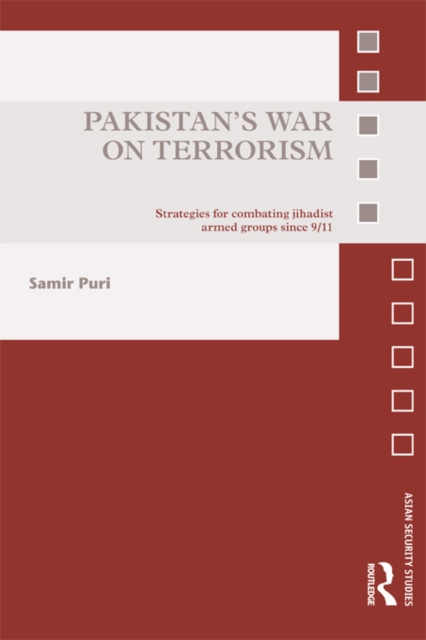
Pakistan's war on terrorism : strategies for combating jihadist armed groups since 9/11
This book examines Pakistan's strategies in the war against Islamist armed groups that began late 2001, following the 9/11 attacks. The significance of the war inside Pakistan can hardly be understated. Starting in the tribal territories adjacent to Afghanistan, Pakistan's war has come to engulf the majority of the country through a brutal campaign of suicide bombings. Thousands of Pakistani lives have been lost and the geostrategic balance of the region has been thrown into deep uncertainty. Pakistan's War on Terrorism is an account of a decade-long war following the 9/11 attacks, that is yet to be chronicled in systematic fashion as a campaign of military maneuver and terrorist reprisal. It is also an analytic account of Pakistan’s strategic calculus during this time, both in military and political terms, and how these factors have been filtered by Pakistan’s unique strategic culture.
eBook
Counterinsurgency in Pakistan
Pakistan has undertaken a number of operations against militant groups since 2001. There have been some successes, but such groups as al Qa'ida continue to present a significant threat to Pakistan, the United States, and other countries. Pakistan needs to establish a population-centric counterinsurgency that better protects the local population and addresses grievances. It also needs to abandon militancy as a tool of foreign and domestic policy.
eBook

Organizing Insurgency: Networks, Resources, and Rebellion in South Asia
A central question in civil war research is how state sponsorship, overseas funding, involvement in illicit economics, and access to lootable resources affect the behavior and organization of insurgent groups. Existing research has not arrived at any consensus, as resource wealth is portrayed as a cause of both undisciplined predation and military resilience. A social-institutional theory explains why similar resource wealth can be associated with such different outcomes. The theory argues that the social networks on which insurgent groups are built create different types of organizations with differing abilities to control resource flows. There is no single effect of resource wealth: instead, social and organizational context determines how these groups use available resources. A detailed comparative study of armed groups in the insurgency in Kashmir supports this argument. A number of indigenous Kashmiri insurgent organizations received substantial funding, training, and support from Pakistan from 1988 to 2003, but they varied in their discipline and internal control. Preexisting networks determined how armed organizations were built and how material resources were used. Evidence from other South Asian wars shows that this is a broader pattern. Scholars of civil conflict should therefore explore the social and organizational processes of war in their research.
Journal Article

Israel Is Trying to Hijack the Baloch Struggle
As Israel loudly beat the drums of war one day before its unprovoked surprise attack on Iran, a small but significant piece of news slipped by almost unnoticed: The announcement of a new research project on the website of a Washington DC think tank. On June 12, the Middle East Media Research Institute (MEMRI) announced the launch of the Balochistan Studies Project (BSP). Significantly, in addition to mentioning Balochistan's abundance of natural resources \"such as oil, gas, uranium, copper, coal, rare earth elements and the two deep seaports of Gwadar and Chabahar,\" MEMRI's statement justifies the project's necessity by identifying the region as \"the perfect outpost to counter and keep under control Iran, its nuclear ambitions, and its dangerous relations with Pakistan, which may provide Tehran with tactical nukes.\" MEMRI is well known for its selective translation of snippets of Arabic, Persian and Turkish-language media, screenshots from which often end up being shared as memes on social media platforms.
Journal Article

Why Some Persistent Problems Persist
Recent work on counter-insurgency, client states, foreign aid, and proxy wars uses a principal–agent framework to study the principal’s ability to induce an agent to exert effort on the principal’s behalf. This work broadly emphasizes the moral hazard problem and the actors’ limited commitment power. The latter is usually addressed through the logic of repeated games in which reneging on an agreement triggers future punishment. This study analyzes a related incentive problem that undermines the principal’s ability to induce an agent to exert effort on its behalf. The repeated-game’s enforcement mechanism tends to break down if the principal is trying to get the agent to resolve a problem that, if resolved, (i) creates an ongoing problem for the agent and (ii) simultaneously significantly reduces the agent’s ability to impose future costs on the principal. The principal cannot induce the agent to exert much effort in these circumstances, and the problem persists.
Journal Article

Decline of Insurgency in Pakistan's FATA
The Tehrik-i-Taliban Pakistan insurgency seriously challenged the Pakistani government's writ of state in FATA from 2004 to 2008. However, by 2017, the insurgency collapsed. This paper argues that Pakistan's counterinsurgency campaign after 2009 caused the decline of the Taliban insurgency by targeting the TTP through a true counterinsurgency operation, rather than the conventional warfare tactics used earlier. This counterinsurgency shift involved a more judicious use of force, rather than simply more force, and deployed both enemy-centric and population-centric approaches, but with a marked emphasis on the former over the latter.
Journal Article

Campaign disconnect: operational progress and strategic obstacles in Afghanistan, 2009-2011
Success in war depends on alignment between operations and strategy. Commonly, such alignment takes time as civilian and military leaders assess the effectiveness of operations and adjust them to ensure that strategic objectives are achieved. This article assesses prospects for the US-led campaign in Afghanistan. Drawing on extensive field research, the authors find that significant progress has been made at the operational level in four key areas: the approach to counterinsurgency operations, development of Afghan security forces, growth of Afghan sub-national governance and military momentum on the ground. However, the situation is bleak at the strategic level. The article identifies three strategic obstacles to campaign success: corruption in Afghan national government, war-weariness in NATO countries and insurgent safe havens in Pakistan. These strategic problems require political developments that are beyond the capabilities of the International Security Assistance Force (ISAF). In other words, further progress at the operational level will not bring 'victory'. It concludes, therefore, that there is an operational—strategic disconnect at the heart of the ISAF campaign.
Journal Article