
Catalogue Search | MBRL


Are you sure you want to remove the book from the shelf?

{{itemTitle}}
234
result(s) for
"Counterpoint History."
Sort by:

Polyphonic minds : music of the hemispheres
Polyphony - the interweaving of simultaneous sounds - is a crucial aspect of music that has deep implications for how we understand the mind. Peter Pesic examines the history and significance of \"polyphonicity\" - of \"many-voicedness\" - in human experience. He presents the emergence of Western polyphony, its flowering, its horizons, and the perspective it offers on our own polyphonic brains. When we listen to polyphonic music, how is it that we can hear several different things at once? How does a single mind experience those things as a unity (a motet, a fugue) rather than an incoherent jumble? Pesic argues that polyphony raises fundamental issues for philosophy, theology, literature, psychology, and neuroscience - all searching for the apparent unity of consciousness in the midst of multiple simultaneous experiences. After tracing the development of polyphony in Western music from ninth-century church music through the experimental compositions of Glenn Gould and John Cage, Pesic considers the analogous activity within the brain, the polyphonic \"music of the hemispheres\" that shapes brain states from sleep to awakening. He discusses how neuroscientists draw on concepts from polyphony to describe the \"neural orchestra\" of the brain. Pesic's story begins with ancient conceptions of God's mind and ends with the polyphonic personhood of the human brain and body. An enhanced e-book edition allows the sound examples to be played by a touch.
Book
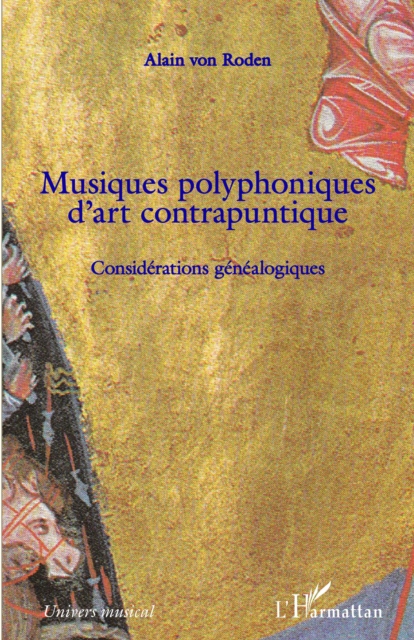
Musiques polyphoniques d'art contrapuntique
Un triptyque d'essais sur les musiques polyphoniques d'art contrapuntique cherche à faire savoir et connaître ces musiques nées à Paris, à l'École Notre-Dame au XIIIe siècle. Ces « considérations généalogiques », complétant et synthétisant les trois premiers essais suscités, visent maintenant à faire comprendre ces musiques polyphoniques, à la fois héritières des musiques monodiques et origines de toute la musique savante d'Europe, incluant d'ailleurs Russie et Amérique ! Ces musiques polyphoniques d'art contrapuntique réalisent, de façon magistrale, la théorie, l'expérimentation et les développements vocaux et instrumentaux, dans une des plus extraordinaires manifestations culturelles du beau, du vrai et de l'harmonie, tant cosmique qu'humaine.
eBook

A stakeholder-based view of the evolution of intellectual property institutions
In this article, we address several limitations of prior international business studies that investigate how and why intellectual property rights (IPR) institutions evolve in ways of consequence to multinationals. To do this, we develop a dynamic stakeholder-based view (SBV) of micro- and macroprocesses shaping the evolution of formal institutions. The SBV microprocesses include (1) establishment of endogenous and exogenous stakeholders, (2) formation of stakeholders’ interests, (3) evaluation of stakeholders’ salience, (4) governance of the focal institution, and (5) interpretation of the impacts from institutional governance. The SBV macroprocesses include (1) feedback loops among the micro-processes and (2) the stickiness of each stakeholder process. We demonstrate the explanatory power of our framework by offering historical examples of how and why the SBV processes have shaped the heterogeneous evolution of IPR institutions in China, the US, and other countries. We argue that IPR institutions, despite experiencing significant convergence in places, will continue to diverge across countries in ways of consequence to multinationals due to the stickiness of stakeholder processes. We also illustrate that the third SBV micro-process, evaluation of stakeholders’ salience, most immediately explains IPR institutions’ evolution. Our work challenges recent assertions about the evolution of IPR institutions and what this means for multinational firms doing business across borders.
Journal Article
Shifting MNE taxation from national to global profits
The current “Separate Accounting” taxation of corporations gives governments the right to tax the national incomes of firms operating within their borders. However, multinational and increasingly digital business models beg the question: what is national taxable income? We argue that a radical rethink of the corporate taxation – moving away from a separate taxation of national corporate income to a taxation of global corporate income allocated via “Formula Apportionment” – is long overdue. Global corporate income as a basis for taxation is supported both by recent theoretical developments and corroborating empirical evidence, with the EU and emerging economies including China already considering its adoption. Nor is it new. As we relate, formula apportionment of global corporate income was used a century ago before commercial and political interests promoted separate accounting, thereby providing both precedent and experience to inform its re-adoption.
Journal Article

Embedded Dissonance in Eighteenth- and Nineteenth-Century Harmonic Theory and Practice
Seeking to elucidate aspects of harmonic practice that originated in contrapuntal patterns, this article traces a specific set of voice-leading configurations in which the generative roles of dissonance, counterpoint, and harmonic progression are blurred. These configurations, originating in early eighteenth-century practice, feature upper-voice suspensions, which are notable for their interlocking qualities and for their compatibility with an extended range of thoroughbass patterns and bass motions (Harrison 2003). Segments of such patterns were partially assimilated into later compositional practice and appeared in treatises on fundamental-bass and scale-step systems of harmony, but these configurations revealed a degree of friction between counterpoint-based idioms and the emerging harmonic theories attempting to explain them according to singular principles. The continued appearance of these configurations in subsequent compositional practice raises the question of what aspects of dissonance and counterpoint have been both embedded in harmonic practice and increasingly subordinated to chord structure in the harmonic theories that stretch from Rameau to Schenker. This dialectical engagement between historical theory and compositional practice offers a critique of our inherited harmonic theories, exposing competing conceptions of dissonance and discrepancies over its autonomy relative to harmonic principles. Tracing this history also reveals that the essential connections among rhythm/meter, dissonance treatment, and harmonic progression that are clearly present in eighteenth-century practice—Kirnberger’s “rhythmic harmony” (Aldrich 1970)—become increasingly subordinated to harmonic principles in nineteenth-century theory. The historical path of embedded dissonance appears to exemplify Adorno’s notion of sedimentation, which offers several interesting disciplinary and aesthetic conclusions about harmonic theory.
Journal Article

“Only in The History of the Formation of the Self-Conscious Soul Did Bugaev Reveal His Ideas about Music”: Music in the System of Andrei Bely
Symbolism distinguished itself in world culture in that its representatives were inclined to a dialogue and intersection of different types of art. In Russian literature, one of the brightest examples of such a synthesis is the work of Andrei Bely (Boris Bugaev; 1880–1934). The aim of the present article is to consider the writer’s ideas about music itself. As the main source we use Bely’s treatise The History of the Formation of the Self-Conscious Soul. Bely in his Symbolist articles of the 1900s laid down the idea of musical art as an antinomy, which emphasized the troubling importance of the problem, but did not principally imply any positive answer. However, in his anthroposophic treatise The History of the Formation of the Self-Conscious Soul (1926–1931), enormous in volume and scale of the material, the author’s antinomical understanding of music was transformed into a structure which is extremely complicated, but consistent. That is why Andrei Bely does not apply the word “antinomy” to music, but he extensively uses the musical term “counterpoint” (together with other musical terms). Whereas the word “antinomy” pointed at some irreconcilable conflicts, on the contrary, a “counterpoint” introduces these clashes into the frame of a single structure of a system, thus reconciling them. Accordingly, the romance “It is so sweet to be with you” by Mikhail Glinka (called in The History “the greatest genius”) contains, in Andrei Bely’s texts, the message of a wide spectrum.
Journal Article
Thomas Campion’s “Chordal Counterpoint” and Tallis’s Famous Forty-Part Motet
The compositional process behind the iconic Tallis forty-part motet, Spem in alium (ca. 1570) remains an enigma. Did he really check every pair of voices for illegal parallels? The author proposes a scenario based on Thomas Campion’s “Rule” for connecting notes in three voices above a bass. This very clever system ensures the presence of all three interval-classes above the bass (third, fifth, and root), and makes parallels impossible. The treatise was widely reprinted, and it is likely that the system was known well before its appearance around 1614. Any composer who knew this system could have grouped the melodic motions above the bass in such a way as to make the task of writing in so many parts more manageable. Campion believed that the bass was the principal melodic voice, and glimpses into the disposition of the soggetti in Tallis’s motet reveal that the bass is indeed the soggetto in the thick-textured sections.
Journal Article

Zarlinov nauk o kontrapunktu in antična glasbena teorija
This paper discusses connections between Gioseffo Zarlino’s theory of counterpoint and the ancient theoretical tradition. Basic definitions and the placement of the theory of counterpoint in the broader context of Zarlino’s treatise Harmonic Institutions (Le istitutioni harmoniche, 1558) are followed by examples of various rules of counterpoint: the use of dissonances, the use of the fourth, the characteristics of minor and major thirds, the use of chromaticism and enharmony, and rules for setting text to music.
Journal Article
On the Connection of Musico-rhetorical Strategies and Marian Topic/Topos in Renaissance Motets
The text summarizes some of the research results from my doctoral dissertation. In the broadest sense, the following text discusses the influence of rhetorical concepts and practices on the composition practice of the Renaissance. The methodological approach is interdisciplinary and multilayered, and it leads to the interpretation of Marian motifs dating from the late fifteenth to the end of the sixteenth century, in the context of rhetorical ideas and principles, and the Marian topic / topos. The most significant result of this text is the formation of a special analytical method by which the interpretive-contextual reading of musical marking is achieved.
Journal Article
