
Catalogue Search | MBRL


Are you sure you want to remove the book from the shelf?

{{itemTitle}}
810,136
result(s) for
"Counties"
Sort by:

Amish paradox
Winner, 2011 Dale Brown Book Award for Outstanding Scholarship in Anabaptist and Pietist Studies. Young Center for Anabaptist and Pietist Studies at Elizabethtown College
Holmes County, Ohio, is home to the largest and most diverse Amish community in the world. Yet, surprisingly, it remains relatively unknown compared to its famous cousin in Lancaster, Pennsylvania. Charles E. Hurst and David L. McConnell conducted seven years of fieldwork, including interviews with over 200 residents, to understand the dynamism that drives social change and schism within the settlement, where Amish enterprises and nonfarming employment have prospered. The authors contend that the Holmes County Amish are experiencing an unprecedented and complex process of change as their increasing entanglement with the non-Amish market causes them to rethink their religious convictions, family practices, educational choices, occupational shifts, and health care options.
The authors challenge the popular image of the Amish as a homogeneous, static, insulated society, showing how the Amish balance tensions between individual needs and community values. They find that self-made millionaires work alongside struggling dairy farmers; successful female entrepreneurs live next door to stay-at-home mothers; and teenagers both embrace and reject the coming-of-age ritual, rumspringa.
An Amish Paradox captures the complexity and creativity of the Holmes County Amish, dispelling the image of the Amish as a vestige of a bygone era and showing how they reinterpret tradition as modernity encroaches on their distinct way of life.
eBook

DEVELOPING AN INTERACTIVE COUNTY MAPPING TOOL TO ADVANCE AGE-FRIENDLY PROGRESS IN NEW JERSEY
Abstract
This presentation will describe how a multidisciplinary team at Rutgers, The State University of New Jersey, leveraged a small, internal grant opportunity to partner with leaders of two County government systems to develop a “proof of concept” age-friendly County mapping tool. Based on the Image:NYC mapping tool, the team designed the tool to display the spatial locations of high concentrations of older adults with shared characteristics (e.g., by health status, income) alongside the spatial locations of assets in local communities (e.g., libraries, senior activity centers) at the census tract level within each of the two counties. The presenters will explain how gerontological expertise—in combination with insights, data, and resources from other disciplines and project contributors—were essential to design, produce, and disseminate the map. The presenters will describe how the mapping tool is one component of a growing body of work across the public, private, and academic sectors in New Jersey to advance and support the age-friendly communities movement. The presenters also will reflect on how the age-friendly mapping tool has served to kickstart age-friendly planning and systems change at the county level, with implications for advancing both state- and municipal-level efforts.
Journal Article

Folsom
In the late 1920s outside a sleepy remote New Mexico village, prehistory was made. Spear points, found embedded between the ribs of an extinct Ice Age bison at the site of Folsom, finally resolved decades of bitter scientific controversy over whether the first Americans had arrived in the New World in Ice Age times. Although Folsom is justly famous in the history of archaeology for resolving that dispute, for decades little was known of the site except that it was very old. This book for the first time tells the full story of Folsom. David J. Meltzer deftly combines the results of extensive new excavations and laboratory analyses from the late 1990s, with the results of a complete examination and analysis of all the original artifacts and bison remains recovered in the 1920s - now scattered in museums and small towns across the country. Using the latest in archaeological method and technique, and bringing in data from geology and paleoecology, this interdisciplinary study provides a comprehensive look at the adaptations and environments of the late Ice Age Paleoindian hunters who killed a large herd of bison at this spot, as well as a measure of Folsom's pivotal role in American archaeology.
eBook

Moral laboratories
Moral Laboratoriesis an engaging ethnography and a groundbreaking foray into the anthropology of morality. It takes us on a journey into the lives of African American families caring for children with serious chronic medical conditions, and it foregrounds the uncertainty that affects their struggles for a good life. Challenging depictions of moral transformation as possible only in moments of breakdown or in radical breaches from the ordinary, it offers a compelling portrait of the transformative powers embedded in day-to-day existence. From soccer fields to dinner tables, the everyday emerges as a moral laboratory for reshaping moral life. Cheryl Mattingly offers vivid and heart-wrenching stories to elaborate a first-person ethical framework, forcefully showing the limits of third-person renderings of morality.
eBook

Lynching to Belong
Thousands of black men died violently at the hands of mobs in the post–Civil War South. But in Brazos County, Texas, argues Cynthia Nevels, five such deaths in particular point to an emerging social phenomenon of the time: the desire of newly arrived European immigrants to assert their place in society, and the use of racially motivated violence to achieve that end.
Driven by economics and the forces of history, the Italian, Irish, and Czech immigrants to this rich agricultural region were faced with the necessity of figuring out where they fit in a culture that had essentially two categories: white and black. In many ways, the newcomers realized, they belonged in neither position.
In the end, they found ways to resolve the ambiguity by taking advantage of and sometimes participating directly in the South’s most brutal form of racial domination. For each of the immigrant groups caught up in the violence, the deaths of black men helped to establish racial identity and to bestow the all-important privileges of whiteness.
This compelling and superbly written study will appeal to students and scholars of social and racial history, both regional and national.
eBook
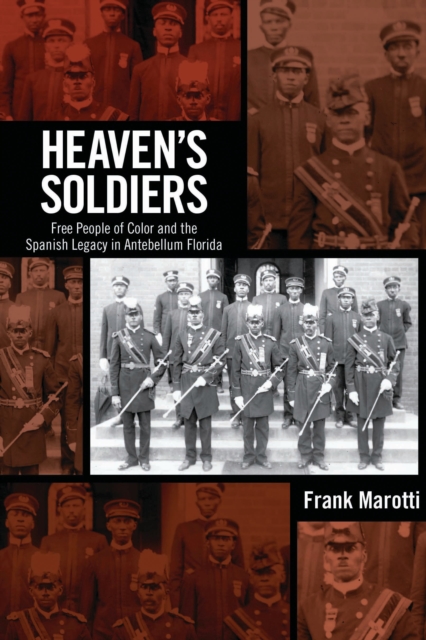
Heaven's Soldiers
Heaven’s Soldiers chronicles the history of a
community of free people of African descent who lived and
thrived, while resisting the constraints of legal bondage, in
East Florida in the four decades leading up to the Civil
War.
Historians have long attributed the relatively flexible
system of race relations in pre–Civil War East Florida to
the area’s Spanish heritage. While acknowledging the
importance of that heritage, this book gives more than the usual
emphasis to the role of African American agency in exploiting the
limited opportunities that such a heritage permitted. Spanish
rule presented institutions and customs that talented, ambitious,
and fortunate individuals might, and did, exploit. Although
racial prejudice was never absent, persons of color aspired to
lives of dignity, security, and prosperity. Frank Marotti’s
subjects are the free people of African descent in the broad
sense of the term “free,” that is, not just those who
were legally free, but all those who resisted the constraints of
legal bondage and otherwise asserted varying degrees of control
over themselves and their circumstances. Collectively, this
population was indispensable to the evolution of the existing
social order. In
Heaven’s Soldiers , Marotti studies four pillars of
black liberty that emerged during Spain’s rule and
continued through the United States’ acquisition of Florida
in 1821: family ties to the white community, manumission,
military service, and land ownership. The slaveowning culture of
the United States eroded a number of these pillars, though black
freedom and agency abided in ways unparalleled anywhere else in
the pre–Civil War United States. Indeed, a strong black
martial tradition arguably helped to topple Florida’s
slave-holding regime, leading up to the start of the Civil War.
Marotti surveys black opportunities and liabilities under the
Spaniards; successful defenses of black rights in the 1820s as
well as chilling statutory assaults on those rights; the black
community’s complex involvement in the Patriot War and the
Second Seminole War; black migration in the two decades leading
up to the US Civil War; and African American efforts to preserve
marriage and emancipation customs, and black land
ownership.
eBook

The Neogene transition from C3 to C4 grasslands in North America: assemblage analysis of fossil phytoliths
The rapid ecological expansion of grasses with C4 photosynthesis at the end of the Neogene (8-2 Ma) is well documented in the fossil record of stable carbon isotopes. As one of the most profound vegetation changes to occur in recent geologic time, it paved the way for modern tropical grassland ecosystems. Changes in CO2 levels, seasonality, aridity, herbivory, and fire regime have all been suggested as potential triggers for this broadly synchronous change, long after the evolutionary origin of the C4 pathway in grasses. To date, these hypotheses have suffered from a lack of direct evidence for floral composition and structure during this important transition. This study aimed to remedy the problem by providing the first direct, relatively continuous record of vegetation change for the Great Plains of North America for the critical interval (ca. 12-2 Ma) using plant silica (phytolith) assemblages. Phytoliths were extracted from late Miocene–Pliocene paleosols in Nebraska and Kansas. Quantitative phytolith analysis of the 14 best-preserved assemblages indicates that habitats varied substantially in openness during the middle to late Miocene but became more uniformly open, corresponding to relatively open grassland or savanna, during the late Miocene and early Pliocene. Phytolith data also point to a marked increase of grass short cells typical of chloridoid and other potentially C4 grasses of the PACMAD clade between 8 and 5 Ma; these data suggest that the proportion of these grasses reached up to ∼50–60% of grasses, resulting in mixed C3-C4 and highly heterogeneous grassland communities by 5.5 Ma. This scenario is consistent with interpretations of isotopic records from paleosol carbonates and ungulate tooth enamel. The rise in abundance of chloridoids, which were present in the central Great Plains since the early Miocene, demonstrates that the “globally” observed lag between C4 grass evolution/taxonomic diversification and ecological expansion occurred at the regional scale. These patterns of vegetation alteration imply that environmental change during the late Miocene–Pliocene played a major role in the C3-C4 shift in the Great Plains. Specifically, the importance of chloridoids as well as a decline in the relative abundance of forest indicator taxa, including palms, point to climatic drying as a key trigger for C4 dominance.
Journal Article

The Maroons of Prospect Bluff and Their Quest for Freedom in the Atlantic World
Nathaniel Millett examines how the Prospect Bluff maroons constructed their freedom, shedding light on the extent to which they could fight physically and intellectually to claim their rights. Millett considers the legacy of the Haitian Revolution, the growing influence of abolitionism, and the period’s changing interpretations of race, freedom, and citizenship among whites, blacks, and Native Americans.
eBook

Almost Free
In Almost Free, Eva Sheppard Wolf uses the story of Samuel Johnson, a free black man from Virginia attempting to free his family, to add detail and depth to our understanding of the lives of free blacks in the South. There were several paths to freedom for slaves, each of them difficult. After ten years of elaborate dealings and negotiations, Johnson earned manumission in August 1812. An illiterate \"mulatto\" who had worked at the tavern in Warrenton as a slave, Johnson as a freeman was an anomaly, since free blacks made up only 3 percent of Virginia's population. Johnson stayed in Fauquier County and managed to buy his enslaved family, but the law of the time required that they leave Virginia if Johnson freed them. Johnson opted to stay. Because slaves' marriages had no legal standing, Johnson was not legally married to his enslaved wife, and in the event of his death his family would be sold to new owners. Johnson's story dramatically illustrates the many harsh realities and cruel ironies faced by blacks in a society hostile to their freedom. Wolf argues that despite the many obstacles Johnson and others faced, race relations were more flexible during the early American republic than is commonly believed. It could actually be easier for a free black man to earn the favor of elite whites than it would be for blacks in general in the post-Reconstruction South. Wolf demonstrates the ways in which race was constructed by individuals in their day-to-day interactions, arguing that racial status was not simply a legal fact but a fluid and changeable condition. Almost Free looks beyond the majority experience, focusing on those at society's edges to gain a deeper understanding of the meaning of freedom in the slaveholding South. A Sarah Mills Hodge Fund Publication
eBook

Landscapes of privilege
James and Nancy Duncan look at how the aesthetics of physical landscapes are fully enmeshed in producing the American class system. Focusing on an archetypal upper class American suburb-Bedford in Westchester County, NY-they show how the physical presentation of a place carries with it a range of markers of inclusion and exclusion.
James Duncan is a University Lecturer in Geography at Cambridge University, and Nancy Duncan is Affiliated Lecturer of Geography at Cambridge University.
eBook