
Catalogue Search | MBRL


Are you sure you want to remove the book from the shelf?

{{itemTitle}}
21,793
result(s) for
"Country house"
Sort by:


Hunting and Agriculture: An Examination of the Functional Aspects of Landscape Architecture in Post-Restoration Scotland
The primary focus of the architectural historiography of Scottish country house landscapes in the long eighteenth century has been on formal and stylistic elements. However, these landscapes consisted of much more than ornamental and exotic gardens. Although landscapes were vehicles for conspicuous consumption, they also were the chief sites of food production and leisurely pursuits. As such, this paper instead endeavors to examine what the practical influences, specifically agriculture and hunting, were on these landscapes at the turn of the eighteenth century. This analysis derives from an evaluation of available literature and the 1685 Scottish Game Act. The ultimate conclusion drawn here is that formal elements, agriculture, and hunting were all powerful influences on early 18th-century landscape design. Further research, particularly through individual case studies, would only serve to show how landscape architects dealt with creating stunning yet useful landscapes.
Journal Article

Cabin : two brothers, a dream, and five acres in Maine
The account of a years spent building a small post-and-beam cabin in the hills of western Maine tells a deeper story about brotherly bonds, home and nature. It explores the satisfaction of building and of physical labor. Inspired by his From the Ground Up New York Times blog, this is the author's memoir about building and brotherhood. Confronted with the disappointments and knockdowns that can come in middle age-job loss, the death of his mother, a health scare, a divorce, Lou needed a project that would engage the better part of him and put him back in life's good graces. City-bound for a decade, he decided he needed to build a simple post-and-beam cabin in the woods. He bought five acres in the hills of western Maine and asked his younger brother, Paul, to help him. Twenty years earlier the brothers had built a house together. Now Lou saw working with Paul as a way to reconnect with their shared history and to rediscover his truest self. As the brothers, with the help of Paul's sons, undertake the challenging construction, nothing seems to go according to plan. But as they raise the cabin, Lou reveals his own evolving insights into the richness and complexity of family relationships, the healing power of nature, and the need to root oneself in a place one can call home.
Book

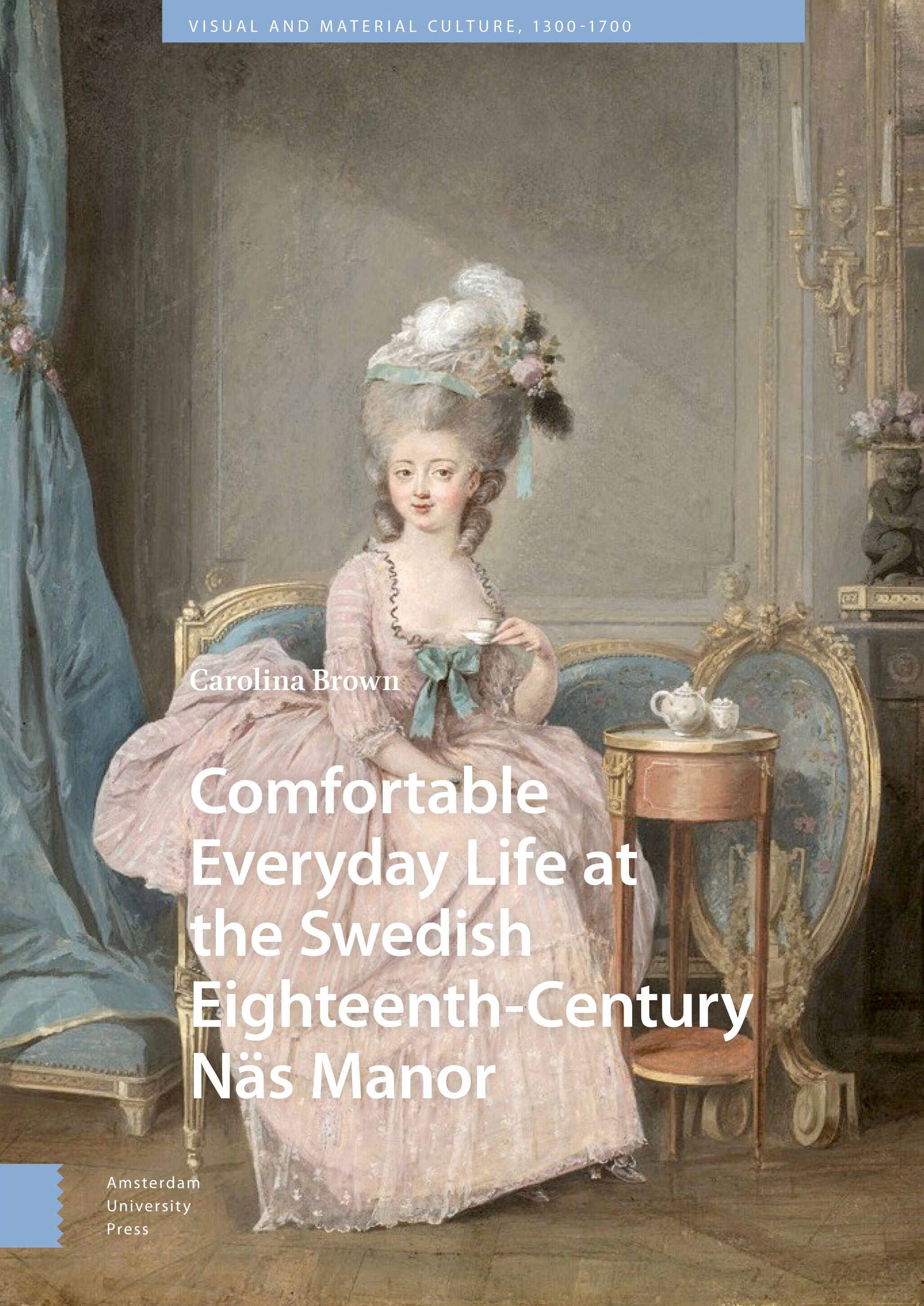
Comfortable Everyday Life at the Swedish Eighteenth-Century Näs Manor
During the eighteenth century, comfortable everyday life became a new ideal. The good life was no longer about grand representation or the manifestation of material opulence. The new luxury was instead the comfortably arranged life at home. This book is about the traces of this change, its approach and consequences and its anchoring in the material and social life of the Swedish manor. The comfort revolution of the eighteenth century was clearly associated with both new types of furniture and new ways of furnishing. An important aspect of the development of comfort was the new mobility and flexibility in form and function that the home and its interior now showed. Through the home of the Wadenstierna family on the country estate of Näs, north of Stockholm, the comfortable everyday life was set by their various tables - at writing desks, sewing tables, dressing tables, coffee tables and games tables.
eBook

Cottagecore simplified : a guide to countryside charm, comfort & happiness
\"Imagine this: you have a hot cup of tea and a good book in front of you, the aroma of freshly baked bread in the air as sunlight streams in through the window. Daydreaming of a simpler life? Go back to the basics with Cottagecore Simplified. It might not be practical to drop everything and live out your fairytale fantasy, but it's easy to embrace countryside comfort while coexisting with the modern world--find inspiration in the crafts, décor, and lifestyle tips in this book. This guide is designed to bring peace and relaxation to your life.\" Publisher's website.
Book

Participation beyond expectation: Contemporary art installation provokes unexpected responses in an English country house
In 2019 artist Layla Khoo created and installed a participatory artwork at Nunnington Hall, a property owned by the National Trust, UK. The artwork, named Change in Attitudes, was a response to the taxidermy collection of hunting trophies displayed on site, all shot and collected by the last owner of the house, Colonel Ronald Fife. The work sought to encourage visitors to consider their thoughts on this difficult part of the collection, both in its historical context and in light of current societal norms, by inviting them to participate with the artwork through choice-making. This case study first analyzes the impact of this work on visitor engagement at the site, both in the participation methods intended by the artist and in the unexpected participation methods employed by the visitors as the installation evolved. The questions raised by this case study are then considered, as well as the research currently under way which seeks to answer them.
Journal Article

The Void of Mies: Unfolding Unbuilt Projects of Mies van der Rohe
The core of Mies van der Rohe still remains as a vast void. Since the Friedrichstrasse Skyscraper Project in 1921, Mies’s manifestos have always been mediated to the world through the unbuilt projects. In Mies’s planes, there is a dialectic between the manifesto and the realized works in the unbuilt projects, which complement each other’s dimensions, and only in this way can Mies the architect be historicized. However, upon examining the unbuilt projects in detail, hidden qualities have been uncovered that have not yet been recognized by historians and critics. Thus far, more than 35 unbuilt projects have been analyzed academically, both known and unknown, creating hypothetical spaces in the form of drawings, 3D modeling, and physical models. The unexplored qualities that have emerged in this process are, in short, the phenomenological manifestation of space and Mies’s particular view of nature, as well as the spiritual boundaries that lie behind these planes of perception.
Journal Article

Inventory Materials of Wooden Country Houses in Soce Village, Narew Municipality
The paper presents material collected during field research and inventory of old village houses from the village of Soce in the municipality of Narew. Its purpose was to collect architectural-ethnographic information about buildings important in terms of cultural values. They were described in the article in order to document the disappearing local heritage and to supplement the research and inventory of documentary resources. Drawings of plans, sections and facades of the buildings and their furnishings were prepared as well.
Journal Article

The installation and impact of artificial lighting at Hatfield House: Lord Salisbury's adoption of gas and electric lighting in the later nineteenth century
Until recently a focus on the architects and owners who built and lived in great country houses has generally overshadowed a more practical analysis of the introduction of technology into country houses. In this paper the author seeks to contribute to a now expanding field of research into country house technology through a technical and social study of the lighting technology introduced at Hatfield House during the later nineteenth century. The author makes use of previously unpublished records held at Hatfield House Archive to uncover the complex and involved process carried out by Robert Gascoyne-Cecil, Third Marquess of Salisbury, in order to successfully install gas lighting in 1868-9 and electric lighting in 1881. Each technology is considered in terms of when and how it was installed, where in the building it was placed and the effect it had on the functioning of the house and the lives of the family. The author observes that, despite the large amount of work required for each installation, there was not an immediate transition from old technology to new. Additionally, whilst both gas and electric lighting provided greater comfort and convenience, they did not have a major impact on the lives of those who lived and worked at Hatfield.
Journal Article