
Catalogue Search | MBRL


Are you sure you want to remove the book from the shelf?

{{itemTitle}}
37,557
result(s) for
"Country risk."
Sort by:


The Fat Tail
As Ian Bremmer and Preston Keat reveal in this innovative book, volatile political events such as the 2008 Georgia-Russia confrontation--and their catastrophic effects on business--happen much more frequently than investors imagine. On the curve that charts both the frequency of these events and the power of their impact, the \"tail\" of extreme political instability is not reassuringly thin but dangerously fat. Featuring a new Foreward that accounts for the cataclysmic effects of the 2008 financial crisis, The Fat Tail is the first book to both identify the wide range of political ris
eBook


Risk propensity in the foreign direct investment location decision of emerging multinationals
A distinguishing feature of emerging economy multinationals is their apparent tolerance for host country institutional risk. Employing behavioral decision theory and quasi-experimental data, we find that managers’ domestic experience satisfaction increases their relative risk propensity regarding controllable risk (legally protectable loss), but decreases their tendency to accept noncontrollable risk (e.g., political instability). In contrast, firms’ potential slack reduces relative risk propensity regarding controllable risk, yet amplifies the tendency to take noncontrollable risk. We suggest that these counterbalancing effects might help explain prior ambiguous findings on the relationship between experience, slack, and FDI decisions. The study provides a new understanding of why firms exhibit heterogeneous responses to host country risks, and the varying effects of institutions.
Journal Article

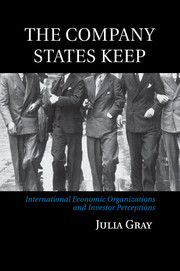
The Company States Keep
This book argues that investor risk in emerging markets hinges on the company a country keeps. When a country signs on to an economic agreement with states that are widely known to be stable, it looks less risky. Conversely, when a country joins a group with more unstable members, it looks more risky. Investors use the company a country keeps as a heuristic in evaluating that country's willingness to honor its sovereign debt obligations. This has important implications for the study of international cooperation as well as of sovereign risk and credibility at the domestic level.
eBook


Derivatives in Islamic Finance
The Islamic finance industry faces the challenging task of attempting to reconcile the risk management demands of business entities with the difficulties posed by the seemingly rigid stance taken by some Shari'ah scholars over hedging practices. Offering a fresh perspective, Sherif Ayoub confronts the challenge by reformulating how we might think about the theorisation of economic matters in the Islamic faith. Readers will come to understand the issues surrounding the avoidance of Riba (usury), Gharar (excessive uncertainty) and Maysir (gambling).
eBook

Guide to country risk : how to identify, manage and mitigate the risks of doing business across borders
\"A systematic approach to identifying, managing and mitigating country risks, backed up by case studies.\"--P. [4] of cover.
Book
Old risks-new solutions, or is it the other way around?
Events like the Multilateral Investment Guarantee Agency (MIGA), Georgetown symposium demonstrate that there is much to be learned through the sharing of experiences and thinking together about the critical issues that confront our industry as well as new products and ideas. MIGA opened a new Asian hub in Singapore with underwriters in Hong Kong SAR, China and business development staff in Beijing and Tokyo. This hub aims to capitalize on Asian emerging as a new center of outbound investment growth. We have seen a growing base of investors in China as well as other Asian countries looking to go into the challenging market. MIGA also opened a business development office in Paris, which will focus on new business opportunities in Europe as well as the Middle East and North Africa. We view both of these hubs as providing an excellent opportunity for MIGA to support the economic growth of low-income countries through providing the support to South-South investments. Providing political risk insurance (PRI) for outbound investment from the rich and other middle-income countries has become more important as the level of Foreign Direct Investment (FDI) growth from these countries has increased.
eBook