
Catalogue Search | MBRL


Are you sure you want to remove the book from the shelf?

{{itemTitle}}
16,959
result(s) for
"Creative teaching"
Sort by:


Using Structural Equation Modeling to Assess a Model for Measuring Creative Teaching Perceptions and Practices in Higher Education
Considering the differences in academic backgrounds and majors, diversity of faculty members’ perceptions, and complete shift to digital education, energy must be expended toward ensuring that the teaching practices of faculty members are innovative and distinctive by providing advanced methods and models for evaluation operations. Thus, this study aimed to assess a model for measuring perceptions of both the teaching profession and creative teaching practices among faculty members that explains the relationship between faculty members’ perceptions about teaching and their creative practices that was constructed to explain the nature of this relationship and enable the development of the faculty members’ academic and professional performance. Two instruments were developed in this study, and the study sample consisted of 250 faculty members. Structural equation modeling was used to assess the proposed model. The results of the modified construction model showed an improvement in the goodness of fit indicators, which points toward this being the best model for interpreting the study data. The developed assessment model and scales can be used as tools to measure faculty members’ perceptions and predict the improvement of their creative teaching practices as well as for their professional development during distance learning.
Journal Article


Creative teaching behaviors of health care school teachers in Taiwan: mediating and moderating effects
Background
Considerable attention has been paid to the variables for creative abilities of teachers and the creative climate of the schools in which they teach, as well as the direct relationships between these variables. However, research on the indirect links between these variables concerning creativity in higher education has been limited. Researches on creative teaching behaviors among health care teachers are scant, particularly in Taiwan.
Methods
This study used a cross-sectional descriptive design to investigate potential mediating and moderating effects of Taiwanese health care school teachers’ creative teaching self-efficacy and a school’s creative climate, the relationship between these variables, and the relationship between creative teaching self-efficacy and creative teaching behaviors. Participants were purposively selected from five vocational and technical health care schools in Northern Taiwan representing the departments of nursing, gerontological care and management, and nutrition and health. Data were collected from five self-report questionnaires regarding teaching, the school environment, and creativity. Data were analyzed using Pearson’s correlation coefficient and simple and hierarchical multiple regression models.
Results
A total of 53 teachers completed the questionnaires. Pearson’s correlation analysis showed the teamwork component of school creative climate was correlated with the creative teaching behavior of characteristics and motivations. The mediation model indicated creative teaching self-efficacy fully mediated the effect of teamwork on teachers’ characteristics and motivations. The moderation model indicated that teamwork negatively moderated the effect of teachers’ creative teaching abilities for characteristics and motivations on creative teaching behaviors (β = − 0.01,
p
< 0.001).
Conclusions
Our findings fill a gap in the literature regarding creative teaching behaviors and school climate in Taiwan. School teachers’ creative teaching self-efficacy and creative teaching abilities are crucial mediating and moderating variables on the relationship between school creative climate and creative teaching behaviors, respectively. The empirical data confirm the validity of our proposed mediation and moderation models of creative teaching behaviors. Therefore, our findings may be effective references for health care teachers regarding creative teaching. Improving creative teaching behaviors of teachers responsible for educating students in health care schools could be facilitated by enhancing teachers’ creative self-efficacy and creative abilities.
Journal Article

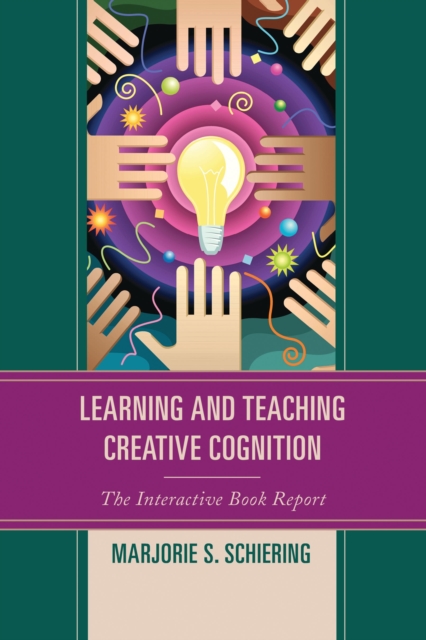
Learning and teaching creative cognition
At the onset, this book provides explanations/definitions for what it is to be \"creative.\" Research-based viewpoints and personal perspectives on creativity lead to an introduction of an Interactive Methodology (IM) and interactive instructional strategies focused on The Interactive Book Report (IBR).Learning-through-play is emphasized.
eBook


Imaginative Teaching through Creative Writing
Growing out of recent pedagogical developments in creative writing studies and perceived barriers to teaching the subject in secondary education schools, this book creates conversations between secondary and post-secondary teachers aimed at introducing and improving creative writing instruction in teaching curricula for young people. Challenging assumptions and lore regarding the teaching of creative writing, this book examines new and engaging techniques for infusing creative writing into all types of language arts instruction, offering inclusive and pedagogically sound alternatives that consider the needs of a diverse range of students. With careful attention given to creative writing within current standards-based educational systems, Imaginative Teaching through Creative Writing confronts and offers solutions to the perceived difficulty of teaching the subject in such environments. Divided into two sections, section one sees post-secondary instructors address pedagogical techniques and concerns such as workshop, revision, and assessment before section two explores hands-on activities and practical approaches to instruction. Focusing on an invaluable and underrepresented area of creative writing studies, this book begins a much-needed conversation about the future of creative writing instruction at all levels and the benefits of collaboration across the secondary/post-secondary divide.
eBook


Effect of synchronous web-based teaching combined with visually creative teaching under the background of information science
Purpose
The paper aims to study the effects of the combination of synchronous Web-based teaching with visually creative teaching on art students’ creativity. The twenty-first century is the society of information technology and knowledge-based economy. To cope with the information society, teaching methods would be changed. Traditional chalk and talk can no longer adapt to the changing society. In addition to passing down the tradition, new ideas should also be introduced. In the informational age, the internet becomes an essential living element and synchronous Web-based teaching breaks through the obstacle of space, provides instant and multiple communication channels and creates alternative creativity learning environment.
Design/methodology/approach
With experimental design, totally, 208 students in Fujian University of Technology, as the research objects, were led to a 15-week (3 hours per week for total 45 hours) experimental teaching. The study uses analysis of variance for discussing the effect of synchronous Web-based teaching on art students’ creativity and further understanding the effect of the combination of synchronous Web-based teaching with visually creative teaching on art students’ creativity.
Findings
The research results show significant effects of synchronous Web-based teaching on creativity, visually creative teaching on creativity and the combination of synchronous Web-based teaching with visually creative teaching on the promotion of creativity.
Research limitations/implications
First, the sample size taken in this study was not large enough to fully reflect the results of the study. The survey sample didn’t cover all the major cities in China, which had a small coverage and couldn’t reflect the research situation of the whole country. Second, the evaluation criteria for artistic students’ creativity were too broad. More specific evaluation rules should be set and the creativity standards should be graded to better guide the implementation of art courses and the cultivation of students’ creativity.
Practical implications
The synchronous Web-based learning environment provides favorable individual thinking space to effectively reduce disturbance among classmates. Synchronous Web-based teaching shares sound, pictures and even films with each other to enrich the learning media. What is more, teachers would be more convenient and fast to deal with materials or handouts or rapidly updating materials and avoiding the loss of handouts.
Originality/value
This paper studied the effects of the combination of synchronous Web-based teaching with visually creative teaching on art students’ creativity, which was a meaningful and innovative topic. And this study can provide more enlightenment and reference for future education.
Journal Article