
Catalogue Search | MBRL


Are you sure you want to remove the book from the shelf?

{{itemTitle}}
2,401
result(s) for
"Credit Mathematical models."
Sort by:

Credit risk
Modelling credit risk accurately is central to the practice of mathematical finance. This volume of the Mastering Mathematical Finance series offers a comprehensive and accessible introduction to the subject tailored specially for master's students. The book focuses on the two mainstream modelling approaches to credit risk, namely structural models and reduced form models, and on pricing selected credit risk derivatives. Balancing rigorous theory with real-world examples from the post-credit crisis financial markets, it takes readers through a natural development of mathematical ideas and financial intuition. Students, practitioners and researchers alike will benefit from the compact presentation and detailed worked examples, exercises and solutions.
Book
Counterparty Credit Risk, Collateral and Funding
\"The book's content is focused on rigorous and advanced quantitative methods for the pricing and hedging of counterparty credit and funding risk. The new general theory that is required for this methodology is developed from scratch, leading to a consistent and comprehensive framework for counterparty credit and funding risk, inclusive of collateral, netting rules, possible debit valuation adjustments, re-hypothecation and closeout rules. The book however also looks at quite practical problems, linking particular models to particular 'concrete' financial situations across asset classes, including interest rates, FX, commodities, equity, credit itself, and the emerging asset class of longevity. The authors also aim to help quantitative analysts, traders, and anyone else needing to frame and price counterparty credit and funding risk, to develop a 'feel' for applying sophisticated mathematics and stochastic calculus to solve practical problems. The main models are illustrated from theoretical formulation to final implementation with calibration to market data, always keeping in mind the concrete questions being dealt with. The authors stress that each model is suited to different situations and products, pointing out that there does not exist a single model which is uniformly better than all the others, although the problems originated by counterparty credit and funding risk point in the direction of global valuation. Finally, proposals for restructuring counterparty credit risk, ranging from contingent credit default swaps to margin lending, are considered\"--provided by publisher.
eBook


Credit Models and the Crisis
The recent financial crisis has highlighted the need for better valuation models and risk management procedures, better understanding of structured products, and has called into question the actions of many financial institutions. It has become commonplace to blame the inadequacy of credit risk models, claiming that the crisis was due to sophisticated and obscure products being traded, but practitioners have for a long time been aware of the dangers and limitations of credit models. It would seem that a lack of understanding of these models is the root cause of their failures but until now little analysis had been published on the subject and, when published, it had gained very limited attention. Credit Models and the Crisis is a succinct but technical analysis of the key aspects of the credit derivatives modeling problems, tracing the development (and flaws) of new quantitative methods for credit derivatives and CDOs up to and through the credit crisis. Responding to the immediate need for clarity in the market and academic research environments, this book follows the development of credit derivatives and CDOs at a technical level, analyzing the impact, strengths and weaknesses of methods ranging from the introduction of the Gaussian Copula model and the related implied correlations to the introduction of arbitrage-free dynamic loss models capable of calibrating all the tranches for all the maturities at the same time. It also illustrates the implied copula, a method that can consistently account for CDOs with different attachment and detachment points but not for different maturities, and explains why the Gaussian Copula model is still used in its base correlation formulation. The book reports both alarming pre-crisis research and market examples, as well as commentary through history, using data up to the end of 2009, making it an important addition to modern derivatives literature. With banks and regulators struggling to fully analyze at a technical level, many of the flaws in modern financial models, it will be indispensable for quantitative practitioners and academics who want to develop stable and functional models in the future.
eBook

Semi-Markov migration models for credit risk
Credit risk is one of the most important contemporary problems for banks and insurance companies. Indeed, for banks, more than forty percent of the equities are necessary to cover this risk. Though this problem is studied by large rating agencies with substantial economic, social and financial tools, building stochastic models is nevertheless necessary to complete this descriptive orientation. This book presents a complete presentation of such a category of models using homogeneous and non-homogeneous semi-Markov processes developed by the authors in several recent papers.
Book
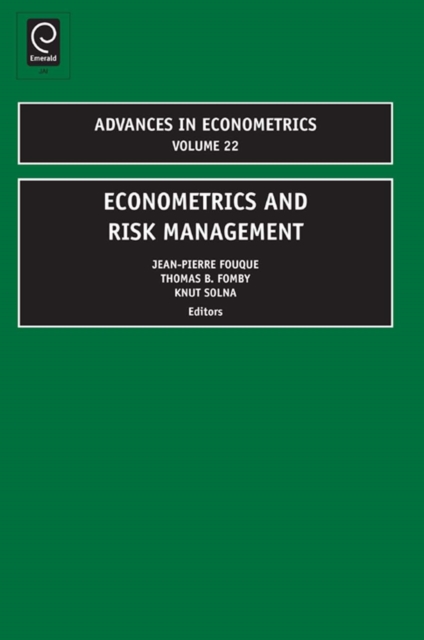
Econometrics and Risk Management
The main theme of this volume is credit risk and credit derivatives. Recent developments in financial markets show that appropriate modeling and quantification of credit risk is fundamental in the context of modern complex structured financial products. The reader will find several points of view on credit risk when looked at from the perspective of Econometrics and Financial Mathematics. The volume consists of eleven contributions by both practitioners and theoreticians with expertise in financial markets, in general, and econometrics and mathematical finance in particular. The challenge of modeling defaults and their correlations is addressed, and new results on copula, reduced form and structural models, and the top-down approach are presented. After the so-called subprime crisis that hit global markets in the summer of 2007, the volume is very timely and will be useful to researchers in the area of credit risk.
eBook


Credit Market in Morocco
In this paper we use a disequilibrium framework common in the \"credit crunch\" literature, first to examine whether the slow credit growth in Morocco during the rapid expansion of liquidity in the first half of the decade can be attributed to credit rationing, and second to investigate the role of asset price increases in the recent acceleration of credit growth. Our results do not support the credit rationing hypothesis in the first half of the decade. They do however, show that the recent increase in real estate prices stimulated credit supply and demand, with a stronger effect on the latter
Book


Econometrics and Risk Management
Covers credit risk and credit derivatives. This book offers several points of view on credit risk when looked at from the perspective of Econometrics and Financial Mathematics. It addresses the challenge of modeling defaults and their correlations, and results on copula, reduced form and structural models, and the top-down approach.
Book