
Catalogue Search | MBRL


Are you sure you want to remove the book from the shelf?

{{itemTitle}}
834
result(s) for
"Crete (Greece)-Civilization"
Sort by:


Island and empire : how civil war in Crete mobilized the Ottoman world
\"In the 1890s, conflict erupted on the Ottoman island of Crete. At the heart of the Crete Question, as it came to be known around the world, were clashing claims of sovereignty between Greece and the Ottoman Empire. The island was of tremendous geostrategic value, boasting one of the deepest natural harbors in the Mediterranean, and the conflict quickly gained international dimensions with an unprecedented collective military intervention by six European powers. Island and Empire shows how events in Crete ultimately transformed the Middle East. Ugur Zekeriya Peçe narrates a connected history of international intervention, mass displacement, and popular mobilization. The conflict drove a wedge between the island's Muslims and Christians, quickly acquiring a character of civil war. Civil war in turn unleashed a humanitarian catastrophe with the displacement of more than seventy thousand Muslims from Crete. In years following, many of thos
eBook

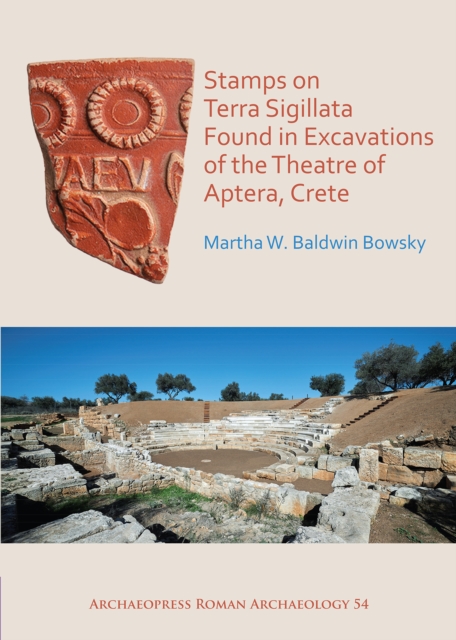
Stamps on Terra Sigillata Found in Excavations of the Theatre of Aptera, Crete
Stamps on Terra Sigillata Found in Excavations of the Theatre of Aptera, Crete presents a group of stamped fragments of Italian and eastern sigillata found in excavations of the theatre of Aptera (Crete). A total of 258 stamped sherds have been discovered and identified: 28 already published by the author and another 230 included here. Aptera now yields more stamped fragments of terra sigillata than any other Cretan city to date, including Knossos.
The sigillata stamps from the theatre of Aptera can be analysed so as to address a series of fundamental questions. Three of these constitute traditional uses of the evidence available from an analysis of terra sigillata: which potters supplied the theatre of Aptera and its environs; where these potters were active; when these potters were active and therefore what production centres supplied the theatre and its area over time. Two questions go further, in an effort to take advantage of this kind of material's ability to testify to patterns of contact and exchange, as well as to details of life within the Roman imperial system: what distribution patterns might have brought terra sigillata to the theatre and its vicinity; and whether we can suggest how terra sigillata was consumed in Aptera's theatre and its environs.
Aptera's theatre was a venue not only for performances but also for drinking, eating, and serving by the theatre-goers, spectators, actors and other performers. These activities took place during a period of prosperity for Roman Aptera in the first and second centuries, a period that coincides nicely with the production and distribution of terra sigillata. The people of Aptera and the surrounding area took full advantage of Crete's strategic position amid crossroads of transit and exchange as well as integration into the Roman economy, to display their prosperity and status in public and in private.
eBook

Seals, craft, and community in Bronze Age Crete
\"Generations of scholars have grappled with the origins of 'palace' society on Minoan Crete, seeking to explain when and how life on the island altered monumentally. Emily Anderson turns light on the moment just before the palaces, recognizing it as a remarkably vibrant phase of socio-cultural innovation. Exploring the role of craftspersons, travelers and powerful objects, she argues that social change resulted from creative work that forged connections at new scales and in novel ways. This study focuses on an extraordinary corpus of sealstones which have been excavated across Crete. Fashioned of imported ivory and engraved with images of dashing lions, these distinctive objects linked the identities of their distant owners. Anderson argues that it was the repeated but pioneering actions of such diverse figures, people and objects alike, that dramatically changed the shape of social life in the Aegean at the turn of the second millennium BCE\"-- Provided by publisher.
Book

South by Southeast: The History and Archaeology of Southeast Crete from Myrtos to Kato Zakros
South by Southeast: The History and Archaeology of Southeast
Crete from Myrtos to Kato Zakros publishes the proceedings of
the conference of the same name held in Pacheia Ammos (Crete) in
July 2017. Its aim is to investigate the settlement patterns,
maritime connectivity, and material culture of the southeast of
Crete in a diachronic fashion, in an attempt to define it as a
region and trace its history. The title South by
Southeast , an ironic take on Alfred Hitchcock's movie,
North by Northwest , encapsulates the uncertainty of what
exactly the Southeast means and our need to clarify its
geographical limits and cultural span. The papers presented focus
primarily on the archaeology of the sites along the coastal strip
spanning between the Myrtos Valley and Kato Zakros, an area that
has time and again produced evidence of interconnection. Indeed one
of the most important aspects surfacing from the volume is the
evidence for the diachronic existence of the Southeast as a
distinct cultural entity. The elements that tied the sites together
shifted at times, forcing us to evaluate the concept of region as a
flexible one that reflects different ways of defining a community.
eBook

South by Southeast
Contributions investigate the settlement patterns, maritime connectivity, and material culture of the southeast of Crete in a diachronic fashion, in an attempt to define it as a region and trace its history. Papers focus primarily on the archaeology of the sites along the coastal strip spanning between the Myrtos Valley and Kato Zakros.
eBook

Travels in Crete
Robert Pashley (1805-59) spent 1833-4 exploring Greece and Turkey as a Trinity College, Cambridge Travelling Fellow and contributor to a British survey of the Mediterranean, yet it was the island of Crete that most captivated his attention; his travels there became the subject of this two-volume account, published in 1837. The following year, Pashley's notes, collected artefacts and books were destroyed in a fire, so this work is all that remains from his expedition to the island. Crete at various points in its history had been ruled by Romans, Byzantines, Venetians and Ottomans. At the time of Pashley's arrival it was under Egyptian administration and there were palpable tensions between Christians and Muslims. In Volume 1, Pashley begins his journey in the western town of Chania, and his lively narrative weaves contemporary observations about Cretans with a discussion of the island's rich history.
Book

Architecture of Minoan Crete
Ever since Sir Arthur Evans first excavated at the site of the Palace at Knossos in the early twentieth century, scholars and visitors have been drawn to the architecture of Bronze Age Crete. Much of the attraction comes from the geographical and historical uniqueness of the island. Equidistant from Europe, the Middle East, and Africa, Minoan Crete is on the shifting conceptual border between East and West, and chronologically suspended between history and prehistory. In this culturally dynamic context, architecture provided more than physical shelter; it embodied meaning. Architecture was a medium through which Minoans constructed their notions of social, ethnic, and historical identity: the buildings tell us about how the Minoans saw themselves, and how they wanted to be seen by others. Architecture of Minoan Crete is the first comprehensive study of the entire range of Minoan architecture—including houses, palaces, tombs, and cities—from 7000 BC to 1100 BC. John C. McEnroe synthesizes the vast literature on Minoan Crete, with particular emphasis on the important discoveries of the past twenty years, to provide an up-to-date account of Minoan architecture. His accessible writing style, skillful architectural drawings of houses and palaces, site maps, and color photographs make this book inviting for general readers and visitors to Crete, as well as scholars.
eBook