
Catalogue Search | MBRL


Are you sure you want to remove the book from the shelf?

{{itemTitle}}
257
result(s) for
"Criminal justice, Administration of -- Australia"
Sort by:

Black lives, white law : locked up and locked out in Australia
Indigenous Australians are the most incarcerated people on the planet. Indigenous men are fifteen times more likely to be locked up than their non-Indigenous counterparts; Indigenous women are twenty-one times more likely. Featuring vivid case studies and drawing on a deep sense of history, Black Lives, White Law explores Australia's deplorable record of locking up First Nations people. It examines Australia's system of criminal justice - the web of laws and courts and police and prisons - and how that system interacts with First Nations peoples and communities. How is it that so many are locked up? Why have imprisonment rates increased in recent years? Is this situation fair? Almost everyone agrees that it's not. And yet it keeps getting worse.
BOOK

Penal Culture and Hyperincarceration
What are the various forces influencing the role of the prison in late modern societies? What changes have there been in penality and use of the prison over the past 40 years that have led to the re-valorization of the prison? Using penal culture as a conceptual and theoretical vehicle, and Australia as a case study, this book analyses international developments in penality and imprisonment. Authored by some of Australia's leading penal theorists, the book examines the historical and contemporary influences on the use of the prison, with analyses of colonialism, post colonialism, race, and what they term the 'penal/colonial complex,' in the construction of imprisonment rates and on the development of the phenomenon of hyperincarceration. The authors develop penal culture as an explanatory framework for continuity, change and difference in prisons and the nature of contested penal expansionism. The influence of transformative concepts such as 'risk management', 'the therapeutic prison', and 'preventative detention' are explored as aspects of penal culture. Processes of normalization, transmission and reproduction of penal culture are seen throughout the social realm. Comparative, contemporary and historical in its approach, the book provides a new analysis of penality in the 21st century.
eBook

Murder, Medicine and Motherhood
Since the early 1990s, unexplained infant death has been reformulated as a criminal justice problem within many western societies. This shift has produced wrongful convictions in more than one jurisdiction. This book uses a detailed case study of the murder trial and appeals of Kathleen Folbigg to examine the pragmatics of proof beyond a reasonable doubt. It explores how legal process, medical knowledge and expectations of motherhood work together when a mother is charged with killing infants who have died in mysterious circumstances. The author argues that Folbigg, who remains in prison, was wrongly convicted. The book also employs Folbigg’s trial and appeals to consider what lessons courts have learned from prior wrongful convictions, such as those of Sally Clark and Angela Cannings. The author’s research demonstrates that the Folbigg court was misled about the state of medical knowledge regarding infant death, and that the case proceeded on the incorrect assumption that behavioural and scientific evidence provided independent proofs of guilt. Individual chapters critically assess the relationships between medical research and expert testimony; the operation of unexamined cultural assumptions about good mothering; and the manner in which contested cases are reported by the press as overwhelming.
eBook

Letters to Lindy
'The most powerful thing that has been done on my story, and the most true to what I lived through.' - Lindy Chamberlain-Creighton The court case captivated a nation.A mother accused of murdering her child, her claim - that the baby was taken by a dingo - denied and discredited by zealous police and a flawed legal system.
eBook
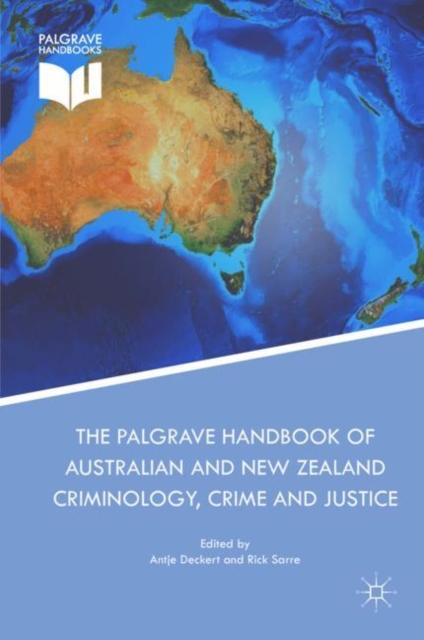
The Palgrave handbook of Australian and New Zealand criminology, crime and justice
This handbook engages key debates in Australian and New Zealand criminology over the last 50 years.In six sections, containing 56 original chapters, leading researchers and practitioners investigate topics such as the history of criminology; crime and justice data; law reform; gangs; youth crime; violent, white collar and rural crime; cybercrime.
eBook


Courtroom Talk and Neocolonial Control
The book uses critical sociolinguistic analysis to examine the social consequences of courtroom talk. The focus of the study is the cross-examination of three Australian Aboriginal boys who were prosecution witnesses in the case of six police officers charged with their abduction. The analysis reveals how the language mechanisms allowed by courtroom rules of evidence serve to legitimize neocolonial control over Indigenous people. In the propositions and assertions made in cross-examination, and their adoption by judicial decision-makers, the three boys were constructed not as victims of police abuse, but rather in terms of difference, deviance and delinquency. This identity work addresses fundamental issues concerning what it means to be an Aboriginal young person, as well as constraints about how to perform or live this identity, and the rights to which Aboriginal people can lay claim, while legitimizing police control over their freedom of movement. Understanding this courtroom talk requires analysis of the sociopolitical and historical actions and structures within which the courtroom hearing was embedded. Through this analysis, the interrelatedness of structure, agency, constraint and change, which is central to critical sociolinguistics, becomes apparent. In its investigation of language ideologies that underpin courtroom talk, as well as the details of how language is used, and the social consequences of this talk, the book highlights the need for far-reaching changes to courtroom rules of evidence.
eBook

Indigenous People, Crime and Punishment
Indigenous People, Crime and Punishment examines criminal sentencing courts' changing characterisations of Indigenous peoples' identity, culture and postcolonial status. Focusing largely on Australian Indigenous peoples, but drawing also on the Canadian experiences, Thalia Anthony critically analyses how the judiciary have interpreted Indigenous difference. Through an analysis of Indigenous sentencing remarks over a fifty year period in a number of jurisdictions, the book demonstrates how judicial discretion is moulded to dominant white assumptions about Indigeneity. More specifically, Indigenous People, Crime and Punishment shows how the increasing demonisation of Indigenous criminality and culture in sentencing has turned earlier 'gains' in the legal recognition of Indigenous peoples on their head. The recognition of Indigenous difference is thereby revealed as a pliable concept that is just as likely to remove concessions as it is to grant them. Indigenous People, Crime and Punishment suggests that Indigenous justice requires a two-way recognition process where Indigenous people and legal systems are afforded greater control in sentencing, dispute resolution and Indigenous healing.
eBook


A child's capacity to commit crime: Examining the operation of doli incapax in Victoria (Australia)
The rebuttable presumption of 'doli incapax' is available in all Australian states and territories and provides that, where a child is unable to comprehend the distinction between actions that are 'seriously wrong' and those that are 'naughty or mischievous', they cannot be held criminally responsible for their actions. Despite the key role that doli incapax should play in diverting the youngest offenders away from the criminal justice system, its operation to date has been largely unexamined. This article seeks to directly address this gap. Drawing on the experiences of those involved in all aspects of the youth justice system, this article examines the need for, and the effectiveness of, the presumption of doli incapax in Victoria, Australia. Revealing inconsistencies in the use of the presumption, the article also examines the need for future reform of this area of law.
Journal Article