
Catalogue Search | MBRL


Are you sure you want to remove the book from the shelf?

{{itemTitle}}
2,765
result(s) for
"Critical phenomena (Physics)"
Sort by:


Quantum critical behaviour at the many-body localization transition
Phase transitions are driven by collective fluctuations of a system’s constituents that emerge at a critical point
1
. This mechanism has been extensively explored for classical and quantum systems in equilibrium, whose critical behaviour is described by the general theory of phase transitions. Recently, however, fundamentally distinct phase transitions have been discovered for out-of-equilibrium quantum systems, which can exhibit critical behaviour that defies this description and is not well understood
1
. A paradigmatic example is the many-body localization (MBL) transition, which marks the breakdown of thermalization in an isolated quantum many-body system as its disorder increases beyond a critical value
2
–
11
. Characterizing quantum critical behaviour in an MBL system requires probing its entanglement over space and time
4
,
5
,
7
, which has proved experimentally challenging owing to stringent requirements on quantum state preparation and system isolation. Here we observe quantum critical behaviour at the MBL transition in a disordered Bose–Hubbard system and characterize its entanglement via its multi-point quantum correlations. We observe the emergence of strong correlations, accompanied by the onset of anomalous diffusive transport throughout the system, and verify their critical nature by measuring their dependence on the system size. The correlations extend to high orders in the quantum critical regime and appear to form via a sparse network of many-body resonances that spans the entire system
12
,
13
. Our results connect the macroscopic phenomenology of the transition to the system’s microscopic structure of quantum correlations, and they provide an essential step towards understanding criticality and universality in non-equilibrium systems
1
,
7
,
13
.
Quantum critical behaviour at the many-body localization transition in a disordered Bose–Hubbard system of bosonic rubidium atoms in an optical lattice is observed, connecting the macroscopic phenomenology of the transition to the system’s microscopic quantum correlations.
Journal Article

Ralph Kenna’s Scaling Relations in Critical Phenomena
In this note, we revisit the scaling relations among “hatted critical exponents”, which were first derived by Ralph Kenna, Des Johnston, and Wolfhard Janke, and we propose an alternative derivation for some of them. For the scaling relation involving the behavior of the correlation function, we will propose an alternative form since we believe that the expression is erroneous in the work of Ralph and his collaborators.
Journal Article

Non–cooperative equilibria of Fermi systems with long range interactions
The authors define a Banach space $\\mathcal{M}_{1}$ of models for fermions or quantum spins in the lattice with long range interactions and make explicit the structure of (generalised) equilibrium states for any $\\mathfrak{m}\\in \\mathcal{M}_{1}$. In particular, the authors give a first answer to an old open problem in mathematical physics--first addressed by Ginibre in 1968 within a different context - about the validity of the so-called Bogoliubov approximation on the level of states. Depending on the model $\\mathfrak{m}\\in \\mathcal{M}_{1}$, the authors' method provides a systematic way to study all its correlation functions at equilibrium and can thus be used to analyse the physics of long range interactions. Furthermore, the authors show that the thermodynamics of long range models $\\mathfrak{m}\\in \\mathcal{M}_{1}$ is governed by the non-cooperative equilibria of a zero-sum game, called here thermodynamic game.
eBook

MAX phases : properties of machinable ternary carbides and nitrides
In this comprehensive yet compact monograph, Michel W.Barsoum, one of the pioneers in the field and the leading figure in MAX phase research, summarizes and explains, from both an experimental and a theoretical viewpoint, all the features that are necessary to understand and apply these new materials.
eBook
Critical Phenomena in Light–Matter Systems with Collective Matter Interactions
We study the quantum phase diagram and the onset of quantum critical phenomena in a generalized Dicke model that includes collective qubit–qubit interactions. By employing semiclassical techniques, we analyze the corresponding classical energy surfaces, fixed points, and the smooth Density of States as a function of the Hamiltonian parameters to determine quantum phase transitions in either the ground (QPT) or excited states (ESQPT). We unveil a rich phase diagram, the presence of new phases, and new transitions that result from varying the strength of the qubits interactions in independent canonical directions. We also find a correspondence between the phases emerging due to qubit interactions and those in their absence but with varying the strength of the non-resonant terms in the light–matter coupling. We expect our work to pave the way and stimulate the exploration of quantum criticality in systems combining matter–matter and light–matter interactions.
Journal Article

Why stock markets crash
The scientific study of complex systems has transformed a wide range of disciplines in recent years, enabling researchers in both the natural and social sciences to model and predict phenomena as diverse as earthquakes, global warming, demographic patterns, financial crises, and the failure of materials. In this book, Didier Sornette boldly applies his varied experience in these areas to propose a simple, powerful, and general theory of how, why, and when stock markets crash. Most attempts to explain market failures seek to pinpoint triggering mechanisms that occur hours, days, or weeks before the collapse. Sornette proposes a radically different view: the underlying cause can be sought months and even years before the abrupt, catastrophic event in the build-up of cooperative speculation, which often translates into an accelerating rise of the market price, otherwise known as a \"bubble.\" Anchoring his sophisticated, step-by-step analysis in leading-edge physical and statistical modeling techniques, he unearths remarkable insights and some predictions--among them, that the \"end of the growth era\" will occur around 2050. Sornette probes major historical precedents, from the decades-long \"tulip mania\" in the Netherlands that wilted suddenly in 1637 to the South Sea Bubble that ended with the first huge market crash in England in 1720, to the Great Crash of October 1929 and Black Monday in 1987, to cite just a few. He concludes that most explanations other than cooperative self-organization fail to account for the subtle bubbles by which the markets lay the groundwork for catastrophe. Any investor or investment professional who seeks a genuine understanding of looming financial disasters should read this book. Physicists, geologists, biologists, economists, and others will welcome Why Stock Markets Crash as a highly original \"scientific tale,\" as Sornette aptly puts it, of the exciting and sometimes fearsome--but no longer quite so unfathomable--world of stock markets.
eBook

Critical endpoints of three-dimensional finite density SU(3) spin model with tensor renormalization group
A
bstract
We investigate the phase diagram of the three-dimensional SU(3) spin model with finite chemical potential, which is an effective Polyakov loop model for finite density QCD, using the tensor renormalization group method. We successfully determine the location of the critical endpoints being free from the complex action problem in the standard Monte Carlo approach. The critical values of the parameters show the consistency with previous ones obtained by other analytic and numerical methods.
Journal Article

Population biology and criticality
The present book describes novel theories of mutation pathogen systems showing critical fluctuations, as a paradigmatic example of an application of the mathematics of critical phenomena to the life sciences. It will enable the reader to understand the implications and future impact of these findings, yet at same time allow him to actively follow the mathematical tools and scientific origins of critical phenomena. This book also seeks to pave the way to further fruitful applications of the mathematics of critical phenomena in other fields of the life sciences.
eBook
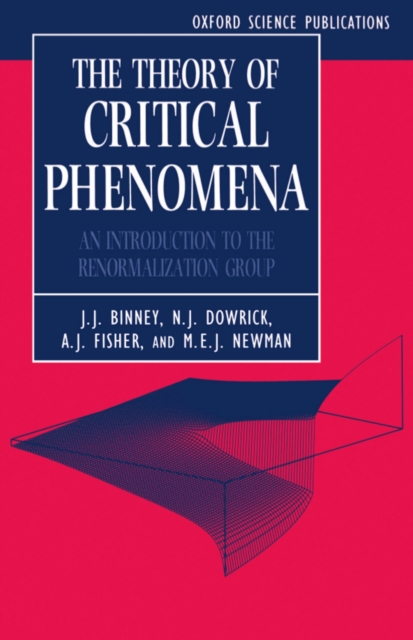
The Theory of critical phenomena : an introduction to the renormalization group
The successful calculation of critical exponents for continuous phase transitions is one of the main achievements of theoretical physics over the last quarter-century. This was achieved through the use of scaling and field-theoretic techniques which have since become standard equipment in many areas of physics, especially quantum field theory. This book provides a thorough introduction to these techniques. Continuous phase transitions are introduced, then the necessary statistical mechanics is summarized, followed by standard models, some exact solutions and techniques for numerical simulations. The real-space renormalization group and mean-field theory are then explained and illustrated. The final chapters cover the Landau-Ginzburg model, from physical motivation, through diagrammatic perturbation theory and renormalization to the renormalization group and the calculation of critical exponents above and below the critical temperature.
eBook