
Catalogue Search | MBRL


Are you sure you want to remove the book from the shelf?

{{itemTitle}}
1,410
result(s) for
"Criticism, Redaction"
Sort by:
The Composition of the Pentateuch
For well over two centuries the question of the composition of the Pentateuch has been among the most central and hotly debated issues in the field of biblical studies. In this book, Joel Baden presents a fresh and comprehensive argument for the Documentary Hypothesis. Critically engaging both older and more recent scholarship, he fundamentally revises and reorients the classical model of the formation of the Pentateuch. Interweaving historical and methodological chapters with detailed textual case studies, Baden provides a critical introduction to the history of Pentateuchal scholarship, discussions on the most pressing issues in the current debate, and a practical model for the study of the biblical text.
eBook
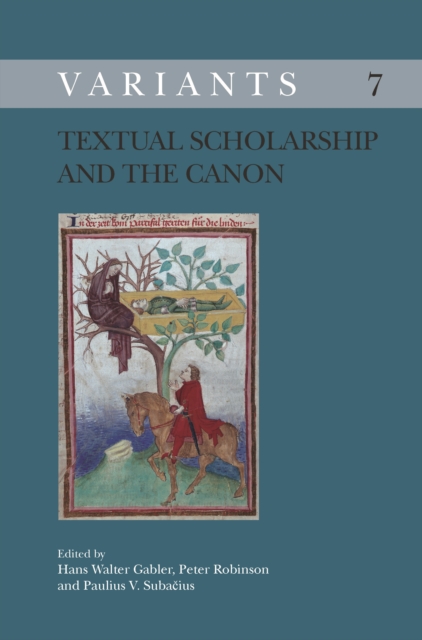
Textual Scholarship and the Canon
Textual scholarship has always been closely linked to questions of canonicity, both in terms of what texts are edited and how they are edited. As attitudes towards the canon have altered over the last decade, textual scholarship too has changed, both in practice and theory. The essays in this collection examine the connections between textual scholarship and the canon, and the implications for textual scholarship of changing attitudes to the canon within the wider academic environment. As is now characteristic of Variants, essays range widely over time and space in their focus, reflecting the breadth of the Society's membership and interests. Two essays focus on different aspects of the distinctive Lithuanian experience of the canon. Other essays trace the influence of the concept in Sweden, the problematic nature of the canon when dealing with unstable medieval texts, the debate within the German scholarly community about modes of editing, developments in the canon outside the academic world in the last decades, and an account of the problems of editing a very non-canonical text. Three essays not linked to the theme of the volume close the collection: an account of the galley proofs of Pynchon's V., a survey of developments in book design for scholarly editions through print and beyond, and an account of the reception of Ossian, which fuses book history, textual scholarship and intellectual history.
eBook
Poetic Imagination in Proverbs
No fewer than 223 verses in Proverbs appear two times (79 sets), three times (15 sets), or even four times (5 sets) in identical or slightly altered form—more than 24% of the book. Heim analyzes all of these, presenting them in delineated Hebrew lines and in English translation. Where appropriate, the translations are followed by textual notes that discuss uncertainties regarding the textual witnesses (textual criticism) and explore lexical, grammatical, and syntactical problems. Heim also analyzes the way the parallelism in each verse of a variant set has been constructed, presenting diagrams and tables with columns that highlight the corresponding similarities and differences among repeated verses. Key to this investigation is the search for links between the variants and their surrounding verses, such as repetitions of sound and sense.
Heim shows that most variant repetitions result from skillful poetic creativity. Reconstruction of the editorial and creative poetic process highlights what poets did, how they did it, and why they did it. He develops criteria for determining the direction of borrowing between the verses and demonstrates that the phenomenon of variant repetition is an editorial concern that operates on the level of the book as a whole. He develops and refines a range of interpretive techniques and skills, arrives at fresh interpretations, and shows that ancient proverbial wisdom is relevant to modern societies.
This study sheds new light on the nature of biblical poetry and on the methods and virtues best suited for its study. While specific to the book of Proverbs in the first instance, the findings in this study apply to poetry elsewhere. Three fundamental insights should inform future work on poetry: the creative combination of repetition with variation is the very essence of poetry; what has been written with imagination should be read with imagination; imaginative interpretation values the normal features of poetic expression and celebrates the truly unusual.
eBook

Compilation or Redaction in the Pentateuch: Reassessing Numbers 25
Although Num 25 is clearly a composite text, the manner of its compilation is still debated. This article presents a new analysis of the chapter as a test case for a fundamental issue in contemporary pentateuchal studies: whether the Pentateuch represents mainly a compilation of independent sources or a series of redactional strata. The analysis is focused on internal considerations of Num 25, suspending any theory of the formation of the Pentateuch, the nature of the Priestly writings, or the status of the book of Numbers. I conclude that Num 25 is more likely to consist of three independent narratives than several layers placed one on top of the other, and suggest several methodological considerations that can be helpful in analyzing other texts in the Pentateuch.
Journal Article

The Formation of Judges and Samuel and the Deuteronomistic Composition
Abstract
The formation of the books Judges and Samuel is re-examined in this article. The author maintains that two main editions of the book of Samuel were created. The first was composed in Jerusalem during the reign of Solomon. The author of this edition was also the author of the second edition of the Book of Judges (\"B\"). The first edition of Judges, the \"book of saviors,\" which was composed in the north at the beginning of the age of monarchy (\"A\"), was also one of the four main sources which were incorporated into the first edition of Samuel. The other sources were: the \"acts of Saul\"; the \"acts of David,\" and the \"book of Jashar.\" The second edition of Samuel and the third of Judges were edited by a single person, the Deuteronomist, in Babylonia, ca. 560 BCE. He prepared an extensive composition describing the history of Israel from Moses to Jeremiah. In Deuteronomy the path was delineated and norms were determined. The main body (Joshua-Kings) records the ups and downs in Israel's relationship with God; and the epilogue (the book of Jeremiah) focuses on the destruction and Exile, explaining the events and informing the exiles of the message of redemption.
Journal Article

The culture of the Babylonian Talmud
In this pathbreaking study Jeffrey L. Rubenstein reconstructs the cultural milieu of the rabbinic academy that produced the Babylonian Talmud, or Bavli, which quickly became the authoritative text of rabbinic Judaism and remains so to this day. Unlike the rabbis who had earlier produced the shorter Palestinian Talmud (the Yerushalmi) and who had passed on their teachings to students individually or in small and informal groups, the anonymous redactors of the Bavli were part of a large institution with a distinctive, isolated, and largely undocumented culture.
The Culture of the Babylonian Talmud explores the cultural world of these Babylonian rabbis and their students through the prism of the stories they included in the Bavli, showing how their presentation of earlier rabbinic teachings was influenced by their own values and practices. Among the topics explored in this broad-ranging work are the hierarchical structure of the rabbinic academy, the use of dialectics in teaching, the functions of violence and shame within the academy, the role of lineage in rabbinic leadership, the marital and family lives of the rabbis, and the relationship between the rabbis and the rest of the Jewish population. This book provides a unique and new perspective on the formative years of rabbinic Judaism and will be essential reading for all students of the Talmud.
eBook

From Gods to God : how the Bible debunked, suppressed, or changed ancient myths & legends
The ancient Israelites believed things that the writers of the Bible wanted them to forget: myths and legends from a pre-biblical world that the new monotheist order needed to bury, hide, or reinterpret.
Ancient Israel was rich in such literary traditions before the Bible reached the final form that we have today. These traditions were not lost but continued, passed down through the ages. Many managed to reach us in post-biblical sources: rabbinic literature, Jewish Hellenistic writings, the writings of the Dead Sea sect, the Aramaic, Greek, Latin, and other ancient translations of the Bible, and even outside the ancient Jewish world in Christian and Islamic texts. The Bible itself sometimes alludes to these traditions, often in surprising contexts.
Written in clear and accessible language, this volume presents thirty such traditions. It voyages behind the veil of the written Bible to reconstruct what was told and retold among the ancient Israelites, even if it is \"not what the Bible tells us.\"
eBook
The Jehu Revolution
This monograph re-evaluates the literary development of 2 Kings 9–10 within the context of the Deuteronomistic History. This undertaking opens with a thorough text and literary critical examination of the pericope, arriving at the conclusion that the narrative of 2 Kings 9–10 represents neither an insertion into the Deuteronomistic corpus, nor an independent literary tradition. Rather, when considering the Greek textual traditions of the biblical narrative (most especially B and Ant.), one can appreciate the narrative of Jehu's revolution within the literary context of an extensive politically motivated narrative about the Israelite monarchy covering the period from the reigns of Jeroboam I to Jeroboam II. The identification of this pro-Jehuide source within the book of Kings enables a reliable dating into the 8th century BCE for much of the material in Kings focusing on the Northern Kingdom. Comparing this biblical narrative to other (mostly Mesopotamian and Syrian) texts relevant to Israelite history of the period advances the discourse about the veracity of the biblical narrative when contrasted with extrabiblical traditions and permits the plausible reconstruction of Israelite history spanning the 8th and 9th centuries BCE.
eBook
The Composition and Redaction of the Book of Amos
This Oxford dissertation offers a fresh redactional analysis of the Book of Amos. It starts with a critical survey of existing approaches and an examination of the methodological issues involved and proceeds with a detailed exegetical analysis of the prophetic text which forms the basis for the redactional conclusions. It steers a middle course between extreme conservative treatments which trace all the material back to the prophet Amos and more radical sceptical approaches which attribute most of the prophetic oracles to the work of later redactors. The composition of the book began with two collections: the Polemical scroll written not long after the end of Amos' ministry and the Repentance scroll composed shortly before 722 BC. The Repentance scroll was reworked in Judah towards the end of the 8th century BC and the two scrolls were combined to form a single work sometime during the 7th century BC. The Book underwent only one redaction during the exilic period which sought to actualise its message in a new historical context. The study pays special attention to the literary structure, aim and probable historical circumstances of the various collections which gradually evolved into the present Book of Amos and seeks to show how the prophetic message lived on and spoke to the various communities which preserved and transmitted it.
eBook
From Author to Copyist
Zipi Talshir's work on the evolution, formation, and transmission of the Hebrew Bible throughout her academic career, her remarkable ability to integrate the Septuagint into this research, and her profound understanding of the late books of the Hebrew Bible and the process of canonization are well known and appreciated. In this volume, 21 of Talshir's colleagues and students contribute essays in her honor on these topics that are so close to her heart. A bibliography of her publications and a short biography open and complete this compelling volume presented by renowned authors in the field from all over Europe, Israel, and the U.S.
eBook