
Catalogue Search | MBRL


Are you sure you want to remove the book from the shelf?

{{itemTitle}}
32
result(s) for
"Criticism, Textual Data processing."
Sort by:

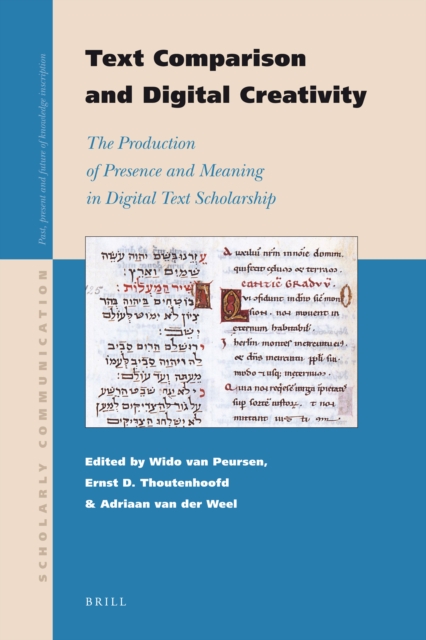
Text Comparison and Digital Creativity
Combining both case studies and theoretical reflections, this book offers a varied range of assessments about digital conditions of philological inquiry. The book details instruments and processes of digital text criticism along with reflection on the increasingly unstable reconstructions of authorship and presence in e-philology.
eBook

PyPlutchik: Visualising and comparing emotion-annotated corpora
The increasing availability of textual corpora and data fetched from social networks is fuelling a huge production of works based on the model proposed by psychologist Robert Plutchik, often referred simply as the “Plutchik Wheel”. Related researches range from annotation tasks description to emotions detection tools. Visualisation of such emotions is traditionally carried out using the most popular layouts, as bar plots or tables, which are however sub-optimal. The classic representation of the Plutchik’s wheel follows the principles of proximity and opposition between pairs of emotions: spatial proximity in this model is also a semantic proximity, as adjacent emotions elicit a complex emotion (a primary dyad) when triggered together; spatial opposition is a semantic opposition as well, as positive emotions are opposite to negative emotions. The most common layouts fail to preserve both features, not to mention the need of visually allowing comparisons between different corpora in a blink of an eye, that is hard with basic design solutions. We introduce PyPlutchik the Pyplutchik package is available as a Github repository ( http://github.com/alfonsosemeraro/pyplutchik ) or through the installation commands pip or conda . For any enquiry about usage or installation feel free to contact the corresponding author, a Python module specifically designed for the visualisation of Plutchik’s emotions in texts or in corpora. PyPlutchik draws the Plutchik’s flower with each emotion petal sized after how much that emotion is detected or annotated in the corpus, also representing three degrees of intensity for each of them. Notably, PyPlutchik allows users to display also primary, secondary, tertiary and opposite dyads in a compact, intuitive way. We substantiate our claim that PyPlutchik outperforms other classic visualisations when displaying Plutchik emotions and we showcase a few examples that display our module’s most compelling features.
Journal Article

Sarcasm identification in textual data: systematic review, research challenges and open directions
Sarcasm is a form of sentiment whereby people express the implicit information, usually the opposite of the message content in order to hurt someone emotionally or criticise something in a humorous way. Sarcasm identification in textual data, being one of the hardest challenges in natural language processing (NLP), has recently become an interesting research area due to its importance in improving the sentiment analysis of social media data. A few studies have carried out a comprehensive literature review on sarcasm identification in the existing primary study within the last 11 years. Thus, this study carried out a review on the classification techniques for sarcasm identification under the aspects of datasets, pre-processing, feature engineering, classification algorithms, and performance metrics. The study has considered the published article from the period of 2008 to 2019. Forty (40) academic literature were selected from the 7 standard academic databases in order to carry out the review and realize the objectives. The study revealed that most researchers created their own datasets since there is no standard available datasets in the domain of sarcasm identification. Context and content-based linguistic features were used in most of the studies. This review shows that n-gram and parts of speech tagging techniques were the most commonly used feature extraction techniques. However, binary representation and term frequency were utilized for feature representation whereas Chi squared and information gain were used for the feature selection scheme. Moreover, classification algorithm such as support vector machine, Naïve Bayes, random forest, maximum entropy, and decision tree algorithm were mostly applied using accuracy, precision, recall and F-measure for performance measures. Finally, research challenges and future direction are summarized in this review. This review reveals the impact of sarcasm identification in building effective product reviews and would serve as handle resources for researchers and practitioners in sarcasm identification and text classification in general.
Journal Article

Stylometric Criticism of Latin Literature: From Exploratory Data Analysis to Close Reading
Despite impressive advances in computational philology for attribution and textual criticism, more general questions of classical literary criticism remain underserved by quantitative methods. This article uses machine learning and exploratory data analysis to address such questions regarding the stylistics of genre and character speech in Latin literature. We describe a set of interpretable features, largely comprising function words and syntactic elements, and show how they can reveal distinguishing aspects of genres, subgenres, and individual characters. In the final part of the article, we present a complete critical workflow, which begins with open-ended exploration of mortal and divine speech in Latin epic and culminates with the testing of specific hypotheses about Vergil's Juno and Juturna.
Journal Article

Enabling discovery of the social determinants of health: using a specialized lens to see beyond the surface
Background: Investigators encounter challenges in uncovering valuable studies when they are researching health disparities and minority health literature. This evidence scan and qualitative/quantitative crosswalk analysis looked at maternal health literature to gain a better understanding of the nuances in articulating the social determinates of health (SDoH) concepts aligned with the NIMHD Research Framework. SDoH concepts describe the multifaceted causes of health disparities, as opposed to effects that result in health outcomes. Methods: An evidence scan was conducted to identify literature for a health disparity population using infant low birth weight as a sample population. A qualitative and quantitative analysis of results was performed to examine the medical subject headings (MeSH) terms used to index the literature, along with the terminology used to describe various concepts related to the SDoH within the literature. A crosswalk of MeSH terms to SDoH concepts was used to see if a concentrated focus on SDoH concepts would improve discoverability of the literature. Results: The 31 articles selected demonstrated that 80% of the MeSH indexed keywords are unique within this collection of full text articles, despite the commonality of the topic. VOSviewer and a Python term counting program were used to visualize the diffusion of terminology. NVivo textual analysis revealed SDoH concepts within meaningful phrases within the literature. Major SDoH themes emerged from the analysis, although were not indexed. Authors used a crosswalk approach with SDoH concepts, to demonstrate that MeSH terms could be used to identify content with a more granular SDoH focus. Conclusion: Identifying literature that has SDoH concepts within the full text is difficult, due to the diffused nature of the terminology used to describe these concepts. This paper proposes to demonstrate how a crosswalk approach from MeSH terminology to SDoH concepts can provide a methodology for improving the discoverability of the literature. New technologies such as natural language processing, combined with existing technologies to normalize disparate ways of describing similar or related constructs, could be used to help discover and synthesize literature related to SDoH. Investigators, indexers, and librarians can work together to create an improved process for researchers.
Journal Article

CapekDraCor: A New Contribution to the European Programable Drama Corpora
The aim of this paper is to present the new
corpus and the
project with its research-oriented concept of a programmable corpora focused on quantitative analyses within the framework of computational literary studies. This digital platform extends the possibilities of large-scale drama analysis with a focus on the dramatic character(s). The basic operationalisation is the interaction within a dramatic configuration, i.e., the scenic co-presence of two speakers, from which network data are automatically extracted, both global networks of interactions of dramas and data characterising individual actors, i.e., literary characters.
The paper demonstrates the
corpus, a new contribution to the extensive
database, and presents the way the data are processed with respect to their specific multi-layered structure. The corpus contains all the plays written by Karel and Josef Čapek and the data are processed in a standardized format based on XML and general TEI guidelines for processing drama with a defined basic drama tagset.
also uses the newly created EZdrama format for data processing, which works as an intermediate step from .txt to .xml file as a lightweight YAML-like markup language. A file in this format can be automatically converted into a DraCor-ready XML file with a TEI header.
The advantage of the programmable corpora concept is the possibility to use suitably structured data for drama research outside the
platform and with other methods or tools for textual analysis. Simultaneously, this approach moves the researcher from the technical requirements of the analysis to operationalised computational analysis based on research questions and pre-prepared and flexible tools.
is a unique open infrastructure (both in terms of data and tools) for the analysis of European drama, currently comprising 15 corpora in 10 different languages with a total of about 3,000 plays from a wide range of periods.
Journal Article

Mathematics and Information in the Philosophy of Michel Serres
This book introduces the reader to Serres’ unique manner of ‘doing philosophy’ that can be traced throughout his entire oeuvre: namely as a novel manner of bearing witness. It explores how Serres takes note of a range of epistemologically unsettling situations, which he understands as arising from the short-circuit of a proprietary notion of capital with a praxis of science that commits itself to a form of reasoning which privileges the most direct path (simple method) in order to expend minimal efforts while pursuing maximal efficiency. In Serres’ universal economy, value is considered as a function of rarity, not as a stock of resources. This book demonstrates how Michel Serres has developed an architectonics that is coefficient with nature. Mathematic and Information in the Philosophy of Michel Serres acquaints the reader with Serres’ monist manner of addressing the universality and the power of knowledge - that is at once also the anonymous and empty faculty of incandescent, inventive thought. The chapters of the book demarcate, problematize and contextualize some of the epistemologically unsettling situations Serres addresses, whilst also examining the particular manner in which he responds to and converses with these situations.
eBook

The Role of Reader Characteristics in Processing and Learning from Informational Text
This article considers the role of reader characteristics in processing and learning from informational text, as revealed in think-aloud research. A theoretical framework for relevant aspects of readers' processing and products was developed. These relevant aspects included three attentional foci for processing (comprehension, monitoring, and evaluation) and five types of processing behaviors (use of strategies, metacognition, monitoring, goal setting and pursuit, and use of prior knowledge). Relevant aspects of products included mental representations of text (textbase, situation model of text, situation model of phenomenon, and author model) and the quality of those representations. A body of 45 studies was identified, considering reader characteristics of ability, experience, knowledge, and interest. Overall, low levels of all these were associated with an emphasis on local-level processing and effortful construction of a textbase, whereas higher levels were associated with more globally directed, more effective, more flexible engagement, leading to better quality mental representations and greater learning.
Journal Article