
Catalogue Search | MBRL


Are you sure you want to remove the book from the shelf?

{{itemTitle}}
116
result(s) for
"Cryptographie."
Sort by:

The hidden history of code-breaking : the secret world of cyphers, uncrackable codes, and elusive encryptions
A fascinating exploration of the uncrackable codes and secret cyphers that helped win wars, spark revolutions and change the faces of nations.
BOOK

Quantum Computing
Quantum mechanics, the subfield of physics that describes the behavior of very small (quantum) particles, provides the basis for a new paradigm of computing. First proposed in the 1980s as a way to improve computational modeling of quantum systems, the field of quantum computing has recently garnered significant attention due to progress in building small-scale devices. However, significant technical advances will be required before a large-scale, practical quantum computer can be achieved.
Quantum Computing: Progress and Prospects provides an introduction to the field, including the unique characteristics and constraints of the technology, and assesses the feasibility and implications of creating a functional quantum computer capable of addressing real-world problems. This report considers hardware and software requirements, quantum algorithms, drivers of advances in quantum computing and quantum devices, benchmarks associated with relevant use cases, the time and resources required, and how to assess the probability of success.
eBook


Hands-On Cryptography with Python
Learn to evaluate and compare data encryption methods and attack cryptographic systemsAbout This Book• Explore popular and important cryptographic methods• Compare cryptographic modes and understand their limitations• Learn to perform attacks on cryptographic systemsWho This Book Is ForHands-On Cryptography with Python is for security professionals who want to learn to encrypt and evaluate data, and compare different encryption methods.What You Will Learn• Protect data with encryption and hashing• Explore and compare various encryption methods• Encrypt data using the Caesar Cipher technique• Make hashes and crack them• Learn how to use three NIST-recommended systems: AES, SHA, and RSA• Understand common errors in encryption and exploit themIn DetailCryptography is essential for protecting sensitive information, but it is often performed inadequately or incorrectly. Hands-On Cryptography with Python starts by showing you how to encrypt and evaluate your data. The book will then walk you through various data encryption methods, such as obfuscation, hashing, and strong encryption, and will show how you can attack cryptographic systems. You will learn how to create hashes, crack them, and will understand why they are so different from each other. In the concluding chapters, you will use three NIST-recommended systems: the Advanced Encryption Standard (AES), the Secure Hash Algorithm (SHA), and the Rivest-Shamir-Adleman (RSA). By the end of this book, you will be able to deal with common errors in encryption.Style and approachA practical guide that will help the readers to encrypt their data with ease
eBook


Cryptomonnaie. La comptabilité des Masternodes
Au cours des dernières années, le monde des cryptomonnaies a vu son lexique, déjà bien fourni, s'enrichir de trois nouveaux termes : Stacking, Proof of Stack et Masternode. Si ces expressions ne vous parlent pas ou peu, il est important de les comprendre pour saisir le changement intervenu dans le monde des cryptomonnaies et leur enjeu économique. Détails. Pas de chiffres.
Journal Article

Asymmetric cryptography : primitives and protocols
\"Public key cryptography was introduced by Diffie and Hellman in 1976, and it was soon followed by concrete instantiations of public-key encryption and signatures; these led to an entirely new field of research with formal definitions and security models. Since then, impressive tools have been developed with seemingly magical properties, including those that exploit the rich structure of pairings on elliptic curves. Asymmetric Cryptography starts by presenting encryption and signatures, the basic primitives in public-key cryptography. It goes on to explain the notion of provable security, which formally defines what \"secure\" means in terms of a cryptographic scheme. A selection of famous families of protocols are then described, including zero-knowledge proofs, multi-party computation and key exchange. After a general introduction to pairing-based cryptography, this book presents advanced cryptographic schemes for confidentiality and authentication with additional properties such as anonymous signatures and multi-recipient encryption schemes. Finally, it details the more recent topic of verifiable computation.\"-- Page 4 of cover.
Book
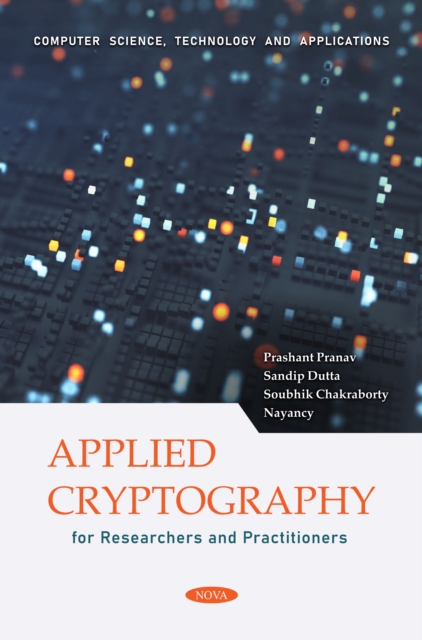
Applied Cryptography for Researchers and Practitioners
The book will introduce readers to the broader concept of cryptography and its allied areas. Introduction to various cryptographic protocols such as symmetric and asymmetric encryption algorithms are provided in this book. New techniques such as blockchain and lightweight cryptography are also discussed in this book. The book additionally focuses on the musical cryptography concept and many new algorithms to secure communication are shown to be achieved using Indian music. Integer factorization is also discussed in this book with a plausible algorithm to break it in polynomial time. The book should be found useful to advanced undergraduate and post-graduate students, researchers and practitioners of computing science.
eBook

Codename Nemo : the hunt for a Nazi U-boat and the elusive Enigma machine
On June 4, 1944, the course of World War II was forever changed. That day, a US Navy task force achieved the impossible--capturing German U-boat U-505. Called Operation Nemo, it was the first seizure of an enemy ship in battle since the War of 1812, one of the greatest achievements of the US Navy and a victory that shortened the duration of the war.
Book

Learning and Experiencing Cryptography with CrypTool and SageMath
This book provides a broad overview of cryptography and enables cryptography for trying out. It emphasizes the connections between theory and practice, focuses on RSA for introducing number theory and PKI, and links the theory to the most current recommendations from NIST and BSI. The book also enables readers to directly try out the results with existing tools available as open source. It is different from all existing books because it shows very concretely how to execute many procedures with different tools. The target group could be self-learners, pupils and students, but also developers and users in companies. All code written with these open-source tools is available. The appendix describes in detail how to use these tools. The main chapters are independent from one another. At the end of most chapters, you will find references and web links. The sections have been enriched with many footnotes. Within the footnotes you can see where the described functions can be called and tried within the different CrypTool versions, within SageMath or within OpenSSL.
eBook