
Catalogue Search | MBRL


Are you sure you want to remove the book from the shelf?

{{itemTitle}}
28,838
result(s) for
"Cult"
Sort by:


The Mother of the Gods, Athens, and the Tyranny of Asia
Among maternal deities of the Greek pantheon, the Mother of the Gods was a paradox. She is variously described as a devoted mother, a chaste wife, an impassioned lover, and a virgin daughter; she is said to be both foreign and familiar to the Greeks. In this erudite and absorbing study, Mark Munn examines how the cult of Mother of the Gods came from Phrygia and Lydia, where she was the mother of tyrants, to Athens, where she protected the laws of the Athenian democracy. Analyzing the divergence of Greek and Asiatic culture at the beginning of the classical era, Munn describes how Kybebe, the Lydian goddess who signified fertility and sovereignty, assumed a different aspect to the Greeks when Lydia became part of the Persian empire. Conflict and resolution were played out symbolically, he shows, and the goddess of Lydian tyranny was eventually accepted by the Athenians as the Mother of the Gods, and as a symbol of their own sovereignty. This book elegantly illustrates how ancient divinities were not static types, but rather expressions of cultural systems that responded to historical change. Presenting a new perspective on the context in which the Homeric and Hesiodic epics were composed, Munn traces the transformation of the Asiatic deity who was the goddess of Sacred Marriage among the Assyrians and Babylonians, equivalent to Ishtar. Among the Lydians, she was the bride to tyrants and the mother of tyrants. To the Greeks, she was Aphrodite. An original and compelling consideration of the relations between the Greeks and the dominant powers of western Asia, The Mother of the Gods, Athens, and the Tyranny of Asia is the first thorough examination of the way that religious cult practice and thought influenced political activities during and after the sixth and fifth centuries B.C.
eBook

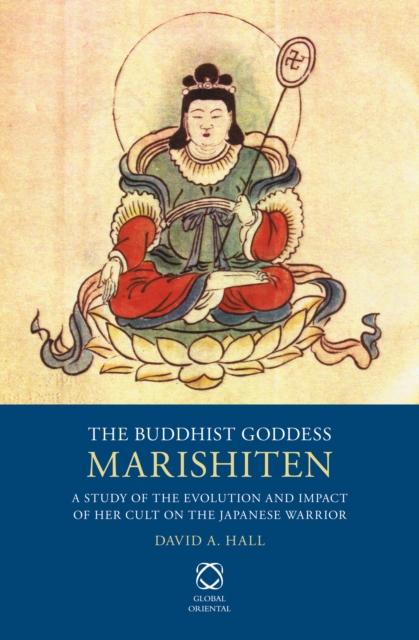
The Buddhist Goddess Marishiten
In The Buddhist Goddess Marishiten, David A. Hall provides an in-depth exploration of the Buddhist cult of the warrior goddess Mārīcī, its evolution, and its efficacy and psychological impact on the Japanese warrior.
eBook

Frankenstein
James Whale's Frankenstein (1931) spawned a phenomenon that has been rooted in world culture for decades. This cinematic Prometheus has generated countless sequels, remakes, rip-offs, and parodies in every media, and this granddaddy of cult movies constantly renews its followers in each generation. Along with an in-depth critical reading of the original 1931 film, this book tracks Frankenstein the monster's heavy cultural tread from Mary Shelley's source novel to today's Internet chat rooms. --Back cover.
Book
Handbook of Nordic new religions electronic resource / edited by James R. Lewis, Inga Bårdsen T²llefsen
When James R. Lewis, one of the editors of the current collection, first moved to Norway in late 2009, he was unprepared to discover that so many researchers in Nordic countries were producing innovative scholarship on new religions and on the new age subculture. In fact, over the past dozen years or so, an increasingly disproportionate percentage of new religions scholars have arisen in Nordic countries and teach at universities in Denmark, Finland, Norway, Sweden and the Baltic countries. Nordic New Religions, co-edited with Inga B. Tøllefsen, surveys this rich field of study in this area of the world, focusing on the scholarship being produced by scholars in this region of northern Europe.
eBook


Military Saints in Byzantium and Rus, 900–1200
The rulers of the Byzantine Empire and its commonwealth were protected both by their own soldiers and by a heavenly army: the military saints. The transformation of Saints George, Demetrios, Theodore and others into the patrons of imperial armies was one of the defining developments of religious life under the Macedonian emperors. This book provides a comprehensive study of military sainthood and its roots in late antiquity. The emergence of the cults is situated within a broader social context, in which mortal soldiers were equated with martyrs and martyrs of the early Church recruited to protect them on the battlefield. Dr White then traces the fate of these saints in early Rus, drawing on unpublished manuscripts and other under-utilised sources to discuss their veneration within the princely clan and their influence on the first native saints of Rus, Boris and Gleb, who eventually joined the ranks of their ancient counterparts.
eBook

Redefining Ancient Orphism
This book examines the fragmentary and contradictory evidence for Orpheus as the author of rites and poems to redefine Orphism as a label applied polemically to extra-ordinary religious phenomena. Replacing older models of an Orphic religion, this richer and more complex model provides insight into the boundaries of normal and abnormal Greek religion. The study traces the construction of the category of 'Orphic' from its first appearances in the Classical period, through the centuries of philosophical and religious polemics, especially in the formation of early Christianity and again in the debates over the origins of Christianity in the nineteenth and twentieth centuries. A paradigm shift in the study of Greek religion, this study provides scholars of classics, early Christianity, ancient religion and philosophy with a new model for understanding the nature of ancient Orphism, including ideas of afterlife, cosmogony, sacred scriptures, rituals of purification and initiation, and exotic mythology.
eBook