
Catalogue Search | MBRL


Are you sure you want to remove the book from the shelf?

{{itemTitle}}
70,548
result(s) for
"Cultural Pluralism"
Sort by:

The Oxford handbook of superdiversity
Superdiversity is one of the most prominent contemporary concepts advancing our current understanding of international migration and its societal outcomes. This handbook brings together chapters that link the numerous social scientific debates, approaches, and methodologies developed in light of superdiversity. The handbook offers students, educators, researchers, and practitioners a much sought-after compendium of major advances made in studying complex transformations in light of superdiversity.
Book

The New Political Economy of Urban Education
\"Urban education and its contexts have changed in powerful ways. Old paradigms are being eclipsed by global forces of privatization and markets and new articulations of race, class, and urban space. These factors and more set the stage for Pauline Lipman's insightful analysis of the relationship between education policy and the neoliberal economic, political, and ideological processes that are reshaping cities in the United States and around the globe.
Using Chicago as a case study of the interconnectedness of neoliberal urban policies on housing, economic development, race, and education, Lipman explores larger implications for equity, justice, and \"\"the right to the city\"\". She draws on scholarship in critical geography, urban sociology and anthropology, education policy, and critical analyses of race. Her synthesis of these lenses gives added weight to her critical appraisal and hope for the future, offering a significant contribution to current arguments about urban schooling and how we think about relations between neoliberal education reforms and the transformation of cities. By examining the cultural politics of why and how these relationships resonate with people's lived experience, Lipman pushes the analysis one step further toward a new educational and social paradigm rooted in radical political and economic democracy.\"
eBook

Interculturalism : the new era of cohesion and diversity
\"Interculturalism is a new concept for managing community relations in a world defined by globalization and \"super diversity.\" This book argues that as all countries become more multicultural a new framework of interculturalism is needed to mediate these relationships and that this will require new systems of governance to support it.\"--Publisher's website.
Book

Being Together in Place
Being Together in Placeexplores the landscapes that convene Native and non-Native people into sustained and difficult negotiations over their radically different interests and concerns. Grounded in three sites-the Cheslatta-Carrier traditional territory in British Columbia; the Wakarusa Wetlands in northeastern Kansas; and the Waitangi Treaty Grounds in Aotearoa/New Zealand-this book highlights the challenging, tentative, and provisional work of coexistence around such contested spaces as wetlands, treaty grounds, fishing spots, recreation areas, cemeteries, heritage trails, and traditional village sites. At these sites, activists learn how to articulate and defend their intrinsic and life-supportive ways of being, particularly to those who are intent on damaging or destroying these places.
Using ethnographic research and a geographic perspective, Soren C. Larsen and Jay T. Johnson show how the communities in these regions challenge the power relations that structure the ongoing (post)colonial encounter in liberal democratic settler-states. Emerging from their conversations with activists was a distinctive sense that the places for which they cared had agency, a \"call\" that pulled them into dialogue, relationships, and action with human and nonhuman others. This being-together-in-place, they find, speaks in a powerful way to the vitalities of coexistence: where humans and nonhumans are working to decolonize their relationships; where reciprocal guardianship is being stitched back together in new and unanticipated ways; and where a new kind of \"place thinking\" is emerging on the borders of colonial power.
eBook

Sharing our global community
This books explains to young readers that being part of a community allows us to make friendships and work together to solve problems at home, at school, and in our cultures.
Book

Building Modern Turkey
Building Modern Turkeyoffers a critical account of how the built environment mediated Turkey's transition from a pluralistic (multiethnic and multireligious) empire into a modern, homogenized nation-state following the collapse of the Ottoman Empire at the end of World War I. Zeynep Kezer argues that the deliberate dismantling of ethnic and religious enclaves and the spatial practices that ensued were as integral to conjuring up a sense of national unity and facilitating the operations of a modern nation-state as were the creation of a new capital, Ankara, and other sites and services that embodied a new modern way of life. The book breaks new ground by examining both the creative and destructive forces at play in the making of modern Turkey and by addressing the overwhelming frictions during this profound transformation and their long-term consequences. By considering spatial transformations at different scales-from the experience of the individual self in space to that of international geopolitical disputes-Kezer also illuminates the concrete and performative dimensions of fortifying a political ideology, one that instills in the population a sense of membership in and allegiance to the nation above all competing loyalties and ensures its longevity.
eBook

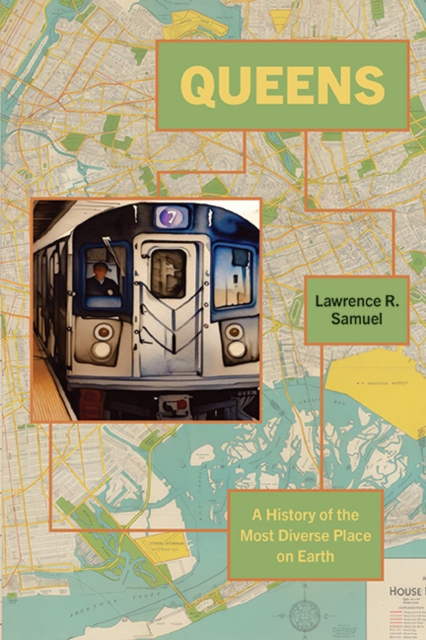
Queens
Charts the historical development of Queens from the
1920s to today, focusing on its profound
diversity.
Queens charts the history of residential development
of the New York City borough from the 1920s to today. The work
focuses on the borough's most remarkable aspect: its profound
diversity as a multiethnic, multiracial, and multireligious
place. The narrative traces the evolution of Queens from a
quasi-suburb of Manhattan for the white middle class into the
most diverse county in the United States and, many contend, the
most diverse place on the planet. Following this trajectory
adds much to our understanding of the borough, the city, the
country, and even the world.
eBook

Russia's People of Empire
A fundamental dimension of the Russian historical experience has been the diversity of its people and cultures, religions and languages, landscapes and economies. For six centuries this diversity was contained within the sprawling territories of the Russian Empire and the Soviet Union, and it persists today in the entwined states and societies of the former USSR. Russia's People of Empire explores this enduring multicultural world through life stories of 31 individuals-famous and obscure, high born and low, men and women-that illuminate the cross-cultural exchanges at work from the late 1500s to post-Soviet Russia. Working on the scale of a single life, these microhistories shed new light on the multicultural character of the Russian Empire, which both shaped individuals' lives and in turn was shaped by them.
eBook