
Catalogue Search | MBRL


Are you sure you want to remove the book from the shelf?

{{itemTitle}}
24
result(s) for
"Cultural property -- Protection -- Great Britain"
Sort by:

The archaeology of improvement in Britain, 1750-1850
Sarah Tarlow shows how the archaeology of Britain in the period 1750-1850 manifests a widespread and cross-cutting ethic of improvement, one of the most current concepts of eighteenth and nineteenth century Britain.
Book

The Archaeology of Improvement in Britain, 1750–1850
In this innovative 2007 study, Sarah Tarlow shows how the archaeology of this period manifests a widespread and cross-cutting ethic of improvement. Theoretically informed and drawn from primary and secondary sources in a range of disciplines, the author considers agriculture and the rural environment, towns, and buildings such as working-class housing and institutions of reform. From bleach baths to window glass, rubbish pits to tea wares, the material culture of the period reflects a particular set of values and aspirations. Tarlow examines the philosophical and historical background to the notion of improvement and demonstrates how this concept is a useful lens through which to examine the material culture of later historical Britain.
eBook

A jewel in the crown
Weeks after the evacuation of Dunkirk, Germany is poised to invade a near-defenseless Britain. To safeguard the Crown Jewels from the Nazis, Winston Churchill devises a daring gamble to have them shipped overseas. The priceless artifacts will be secretly removed from the Tower of London and driven north to Scotland by two operatives posing as a young married couple, to be taken from there to Canada. Caitrin Colline--a Welsh coalminer's daughter and an ardent socialist--will play the wife of Lord Marlton, Hector Neville-Percy. A less likely couple is at first difficult to imagine. Yet Caitrin's bold, streetwise confidence and sharp wits complement Hector's social ease and connections, essential to a second part of their mission: uncovering Nazi sympathizers within the highest ranks of Britain's aristocracy.
BOOK

The Past in Contemporary Society
First published in 2002. Routledge is an imprint of Taylor & Francis, an informa company.
eBook
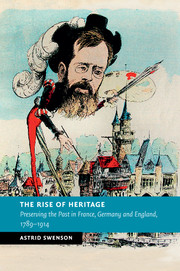
The Rise of Heritage
Where does our fascination for 'heritage' originate? This groundbreaking comparative study of preservation in France, Germany and England looks beyond national borders to reveal how the idea of heritage emerged from intense competition and collaboration in a global context. Astrid Swenson follows the 'heritage-makers' from the French Revolution to the First World War, revealing the importance of global networks driving developments in each country. Drawing on documentary, literary and visual sources, the book connects high politics and daily life and uncovers how, through travel, correspondence, world fairs and international congresses, the preservationists exchanged ideas, helped each other campaign and dreamed of establishing international institutions for the protection of heritage. Yet, these heritage-makers were also animated by fierce rivalry as international tension grew. This mixture of international collaboration and competition created the European culture of heritage, which defined preservation as integral to modernity, and still shapes current institutions and debates.
eBook

Development and Design of Heritage Sensitive Sites
This is the first book to provide readers with the skills to assess development potential from a holistic standpoint. Until now, architectural books on conservation matters have focused on preservation at a strategic level and restoration at a technical level. This book offers the architect, developer or planner the rules and tools needed to gauge development prospects in an objective and comprehensive manner. Written by an expert in the field it provides the reader with: • the latest legislation relating to heritage in the UK • insight into local planning authorities and government advisory boards • basic strategies for approaching developments • an understanding of the options available for developing a heritage site • illustrative case studies to highlight strategy successes. This book is a one-stop-shop for any professional or student working in, or learning about, development in heritage environments.
eBook

The Past in Contemporary Society
Fowler assesses the influence of our heritage in the last decade of the 20th century, and, with a wide range of examples, judges the consequences of the increasing pressures of the heritage industry, providing suggestions for responsible development.
eBook
Twyford Down
The Twyford Down story is set in a political and historical framework in order to examine the key issues affecting road planning and environmental protection: the system of route selection; Crown development; government agents, NGOs and locally elected authorities; conservation legislation; subsidiarity; lobbying techniques; and the role of the press. Written in a lively style and vividly illustrated, Twyford Down will appeal to environmental advisors, policy makers and planners as well as lobbyists and those interested in the environment.
Preface. Acknowledgements. Introduction: a brief history. Part One. The campaigner's story. Part Two. The lawyer's assessment. Part Three. The environmentalist's conclusions. Glossary. Appendix. Index.
eBook
