
Catalogue Search | MBRL


Are you sure you want to remove the book from the shelf?

{{itemTitle}}
2,832
result(s) for
"Culture Terminology."
Sort by:

Keywords for American cultural studies
\"Since its initial publication, scholars and students alike have turned to Keywords for American Cultural Studies as an invaluable resource for understanding key terms and debates in the fields of American studies and cultural studies. As scholarship has continued to evolve, this revised and expanded second edition offers indispensable meditations on new and developing concepts used in American studies, cultural studies, and beyond. It is equally useful for college students who are trying to understand what their teachers are talking about, for general readers who want to know what's new in scholarly research, and for professors who just want to keep up. Designed as a print-digital hybrid publication, Keywords collects more than 90 essays--30 of which are new to this edition--from interdisciplinary scholars, each on a single term such as \"America,\" \"culture,\" \"law,\" and \"religion.\" Alongside \"community,\" \"prison,\" \"queer,\" \"region,\" and many others, these words are the nodal points in many of today's most dynamic and vexed discussions of political and social life, both inside and outside of the academy. The Keywords website, which features 33 essays, provides pedagogical tools that engage the entirety of the book, both in print and online. The publication brings together essays by scholars working in literary studies and political economy, cultural anthropology and ethnic studies, African American history and performance studies, gender studies and political theory. Some entries are explicitly argumentative; others are more descriptive. All are clear, challenging, and critically engaged. As a whole, Keywords for American Cultural Studies provides an accessible A to Z survey of prevailing academic buzzwords and a flexible tool for carving out new areas of inquiry. \"-- Provided by publisher.
Book

Keywords
Now revised to include new words and updated essays, Keywords focuses on the sociology of language, demonstrating how the key words we use to understand our society take on new meanings and how these changes reflect the political bent and values of society.
eBook

Legal and Non-Legal Image of Fox Hunting and Shooting – the Impact of Globalization on National and International Perceptions of the World
The aim of this paper is to provide some insight into legal definitions of fox hunting in the United Kingdom and polowanie na lisy in the Republic of Poland and to scrutinize the differences in the legal meaning of the two terms in question and their social perception. The goal of the study is to show that apparently similar concepts may in fact differ significantly and treating them as equivalents may lead to miscommunication. The author will apply the following research methods: the comparative law analysis of legal concepts of fox hunting and polowanie na lisy, and the lexical analysis of the terms in question in legal and non-legal genres. The research findings strongly indicated that globalization and social media have a massive impact on perceptions of various phenomena by people, who frequently stereotype the reality, assuming that well-distributed and popularized “foreign” is identical to “native”. The misunderstanding of such culture-bound terminology may have serious consequences which are already visible in social debates and may negatively affect the legislative process.
Journal Article


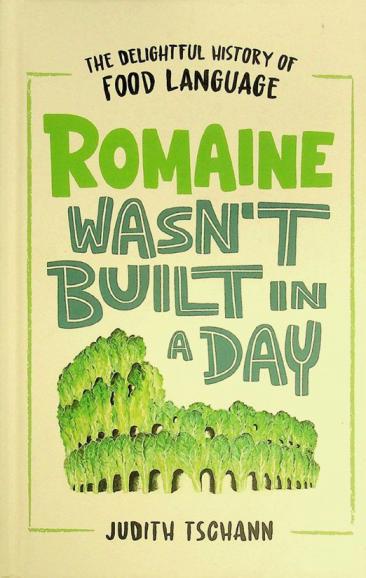
Romaine wasn't built in a day : the delightful history of food language
All food has a story, reaching as far back into history as language itself. As languages followed and reflected the tides of civilisations, food language came to represent some of the highs and lows of how humans communicate: from the highbrow 'Chateauneuf du Pape: (the Pope's new castle)' to the 'nun's farts' of Jamaica (also known as 'beignets'). Chock full of food puns, linguistic did-you-knows and delectable trivia, 'Romaine Wasn't Built in A Day' is a gift for your trivia nerds, your history buffs, your crossword fiends, and your Scrabble diehards. This is the surprising and hilarious history of food, told through the lens of the fascinating evolution of language.
Book

Callus, Dedifferentiation, Totipotency, Somatic Embryogenesis: What These Terms Mean in the Era of Molecular Plant Biology?
Recent findings call for the critical overview of some incorrectly used plant cell and tissue culture terminology such as dedifferentiation, callus, totipotency, and somatic embryogenesis. Plant cell and tissue culture methods are efficient means to preserve and propagate genotypes with superior germplasm as well as to increase genetic variability for breading. Besides, they are useful research tools and objects of plant developmental biology. The history of plant cell and tissue culture dates back to more than a century. Its basic methodology and terminology were formulated preceding modern plant biology. Recent progress in molecular and cell biology techniques allowed unprecedented insights into the underlying processes of plant cell/tissue culture and regeneration. The main aim of this review is to provide a theoretical framework supported by recent experimental findings to reconsider certain historical, even dogmatic, statements widely used by plant scientists and teachers such as \"plant cells are totipotent\" or \"callus is a mass of dedifferentiated cells,\" or \"somatic embryos have a single cell origin.\" These statements are based on a confused terminology. Clarification of it might help to avoid further misunderstanding and to overcome potential \"terminology-raised\" barriers in plant research.
Journal Article