
Catalogue Search | MBRL


Are you sure you want to remove the book from the shelf?

{{itemTitle}}
15
result(s) for
"Culture diffusion Middle East."
Sort by:

The Druze : a new cultural and historical appreciation
The Druze - a much-misunderstood Muslim sect primarily inhabiting the Levant - have endured centuries of persecution by orthodox elements hostile to Islam's rich sectarian diversity on account of their esoteric divergence from mainstream Islam. As a result, they have become a 'fighting minority,' as described by one of their most illustrious leaders. Druze religious belief branched out from 10th- and 11th-century Shi'ism, and includes elements derived from Greek philosophy, Eastern religions and Islamic mysticism. It enshrines all religious schools, but posits itself as the sole path to mystical knowledge. Druze teachings are kept secret, so libel and slander by their opponents have been generally left uncorrected. The Druze have preferred taqiyya (dissimulation) when independence or freedom of belief proved unattainable, which has exacerbated ignorance of their faith. Such mystification makes any enquiry into Druze doctrine or history a delicate endeavor. In this valuable study, author Abbas Halabi (himself from a prominent Druze family and closely involved in Lebanese Druze policy) elucidates misconceptions about Druze origins. In a clear style, rich in chronology and analysis, Halabi elaborates on the political role played by the Druze in the history of the region and evaluates their chances of survival in an era when religious tolerance and political democracy are still nascent.
Book

Classical Literary Criticism
This chapter contains sections titled:
Introduction to the Classical Period
Plato (428–ca. 347
BC
)
Aristotle (384–322
BC
)
Book Chapter

After the American century : the ends of U.S. culture in the Middle East
\"When Henry Luce announced in 1941 that we were living in the 'American century,' he believed that the international popularity of American culture made the world favorable to U.S. interests. Now, in the digital twenty-first century, the American century has been superseded, as American movies, music, video games, and television shows are received, understood, and transformed in unexpected ways. How do we make sense of this shift? Building on a decade of fieldwork in Cairo, Casablanca, and Tehran, Brian T. Edwards maps new routes of cultural exchange that are innovative, accelerated, and full of diversions. Shaped by the digital revolution, these paths are entwined with the growing fragility of American 'soft' power. They indicate an era after the American century, in which popular American products and phenomena--such as comic books, teen romances, social-networking sites, and ways of expressing sexuality--are stripped of their associations with the United States and recast in very different forms. Arguing against those who talk about a world in which American culture is merely replicated or appropriated, Edwards focuses on creative moments of uptake, in which Arabs and Iranians make something unpredicted. He argues that these products do more than extend the reach of the original. They reflect a world in which culture endlessly circulates and gathers new meanings\"--From publisher's website.
Book
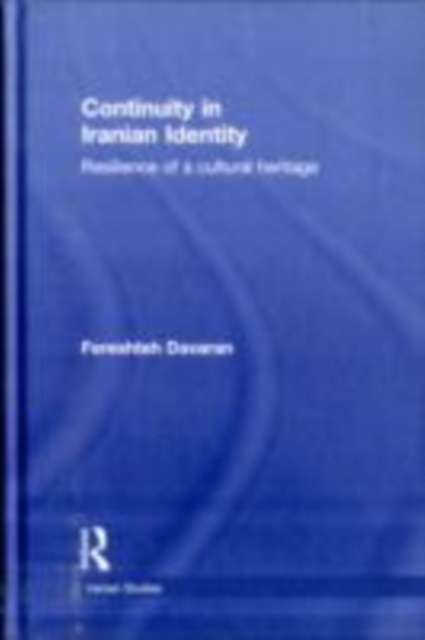
Continuity in Iranian Identity
Despite changes in sovereignty and in religious thought, certain aspects of Iranian culture and identity have persisted since antiquity. Drawing on an exploration of history, religion and literature to define Iranian cultural identity and link the Persian past with more recent cultural and political phenomena, this book examines the history of Iran from its ancient roots to the Islamic period, paying particular attention to pre-Islamic Persian religions and their influence upon later Muslim practices and precepts in Iran.
Accessible English translations of the pre-Islamic Andarz (Advice) literature and of the Adab (Counsel) genre of the Islamic era illustrate the convergence of religion and literature in Iranian culture and how the explicitly religious Adab texts were very much influenced and shaped by the Andarz sources. Within the context of this historical material, and in particular the pre-Islamic religious material, the author highlights its literary and ethical implications on post-Islamic Iranian identity.
Exploring the link between a consistent pre-Islamic Iranian identity and a unique post-Islamic one, this book will be of interest to students of Iranian Studies, Middle Eastern studies and Religious Studies, as well as anyone wishing to learn more about Persian history and culture.
Fereshteh Davaran teaches Persian language courses in the San Francisco Bay area, most recently at the University of California, Berkeley, and at De Anza and Diablo Valley Colleges. She has translated three classic works of English literature into Persian and has published many literary reviews in both languages.
Introduction 1. Old Iranians 2. Middle Iranians 3. Iranian Religions 4. Middle Persian Literature: Andarz 5. Iranian Persistence in the Islamic Era 6. Islamic-Era Persian Literature: Adab. Conclusion
eBook

Reflections on the revolutionary wave in 2011
The \"Arab Spring\" was a surprising event not just because predicting revolutions is a difficult task, but because current theories of revolution are ill equipped to explain revolutionary waves where interactive causal mechanisms at different levels of analysis and interactions between the units of analysis predominate. To account for such dynamics, a multidimensional social science of revolution is required. Accordingly, a meta-framework for revolutionary theory that combines multiple levels of analysis, multiple units of analysis, and their interactions is offered. A structured example of theory building is then given by detailing how the development of world cultural models and practices challenge existing political structures, affect mobilization processes, and make diffusion more likely. A structured example of study design using qualitative comparative analysis of 16 Middle Eastern and North African countries provides support for the interaction of subnational conditions for mobilization, statecentered causes, and transnational factors, including a country's linkage to world society, as one explanation of the Revolutions of 2011.
Journal Article

Contrasting Cosmographies for the Development of Science in Pre-Industrial Europe and Late Imperial China
After two decades of heuristic debate on the Great Divergence the consensus view is that polities and economies of the West began their transitions to modern industrial market economies at least two centuries before Imperial China. Furthermore, Europe’s earlier transition and China’s retardation can be plausibly attributed in some significant (but, alas, unmeasurable degree) to historically observable and explicable differences in their beliefs and institutions for the discovery and diffusion of useful and reliable knowledge. This essay has been designed as a bibliographical survey and critique of recently published literatures for political, economic, social, intellectual, religious and cultural histories and, above all, from the history of science that might (as Joseph Needham hoped) help to explain divergence in the contrasting histories promoting and restraining the accumulation of such knowledge in early modern Europe and Imperial China.
Journal Article

A Comparison of Y-Chromosome Variation in Sardinia and Anatolia Is More Consistent with Cultural Rather than Demic Diffusion of Agriculture
Two alternative models have been proposed to explain the spread of agriculture in Europe during the Neolithic period. The demic diffusion model postulates the spreading of farmers from the Middle East along a Southeast to Northeast axis. Conversely, the cultural diffusion model assumes transmission of agricultural techniques without substantial movements of people. Support for the demic model derives largely from the observation of frequency gradients among some genetic variants, in particular haplogroups defined by single nucleotide polymorphisms (SNPs) in the Y-chromosome. A recent network analysis of the R-M269 Y chromosome lineage has purportedly corroborated Neolithic expansion from Anatolia, the site of diffusion of agriculture. However, the data are still controversial and the analyses so far performed are prone to a number of biases. In the present study we show that the addition of a single marker, DYSA7.2, dramatically changes the shape of the R-M269 network into a topology showing a clear Western-Eastern dichotomy not consistent with a radial diffusion of people from the Middle East. We have also assessed other Y-chromosome haplogroups proposed to be markers of the Neolithic diffusion of farmers and compared their intra-lineage variation--defined by short tandem repeats (STRs)--in Anatolia and in Sardinia, the only Western population where these lineages are present at appreciable frequencies and where there is substantial archaeological and genetic evidence of pre-Neolithic human occupation. The data indicate that Sardinia does not contain a subset of the variability present in Anatolia and that the shared variability between these populations is best explained by an earlier, pre-Neolithic dispersal of haplogroups from a common ancestral gene pool. Overall, these results are consistent with the cultural diffusion and do not support the demic model of agriculture diffusion.
Journal Article

Beyond the Pre-Pottery Neolithic B interaction sphere
This article aims to provide a critical evaluation of the influence of the culture-historical paradigm in the Neolithic archaeology of Western Asia through the re-assessment of currently established theoretical concepts, notably the Pre-Pottery Neolithic B (PPNB) interaction sphere, demic diffusion and acculturation. It is argued that these concepts are too abstractly defined to enable meaningful insights into the dynamics of Early Neolithic societies. A different theoretical framework is needed in order to achieve an historical understanding of the spatial and temporal variability of regional socio-cultural interactions and population displacement. This framework begins with the detailed analysis of local patterns of social organization and exchange. Exchange itself is seen as a socially situated process that was integrally related to the negotiation and reproduction of collective identities during the Neolithic.
Journal Article

Beads, social change and interaction between India and South-east Asia
The author shows how technical studies of beads made of agate and carnelian are informative indicators of social conditions and contacts between regions. The beads in question throw new light on the relations between India and South-east Asia in the first millennium BC.
Journal Article

Cultural foundations of military diffusion
This article examines cross-national variation in the diffusion and adoption of military technologies and ideas. The history of warfare has been marked by periods of innovation in which the institutions and practices of war-making adapted in response to technological opportunities, and social and political developments. As information about new practices spreads, through the demonstration effects of innovating states or transnational social networks, military innovations have diffused throughout the international system. Diffusion can restructure power relations as states leverage new capabilities to increase their military power and enhance their international influence.
Journal Article