
Catalogue Search | MBRL


Are you sure you want to remove the book from the shelf?

{{itemTitle}}
249
result(s) for
"Cyberspace Security measures"
Sort by:

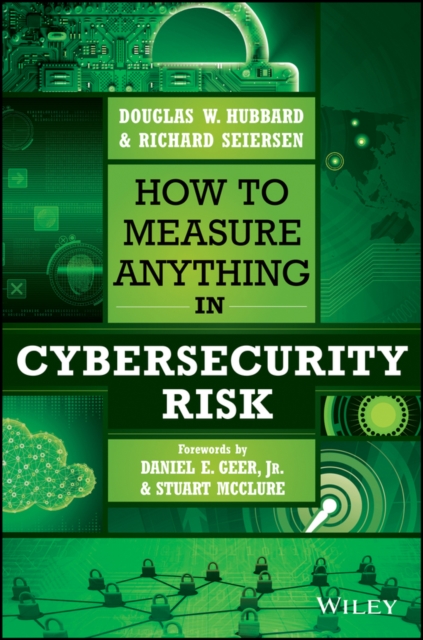
How to Measure Anything in Cybersecurity Risk
A ground shaking exposé on the failure of popular cyber risk management methods How to Measure Anything in Cybersecurity Risk exposes the shortcomings of current \"risk management\" practices, and offers a series of improvement techniques that help you fill the holes and ramp up security. In his bestselling book How to Measure Anything, author Douglas W. Hubbard opened the business world's eyes to the critical need for better measurement. This book expands upon that premise and draws from The Failure of Risk Management to sound the alarm in the cybersecurity realm. Some of the field's premier risk management approaches actually create more risk than they mitigate, and questionable methods have been duplicated across industries and embedded in the products accepted as gospel. This book sheds light on these blatant risks, and provides alternate techniques that can help improve your current situation. You'll also learn which approaches are too risky to save, and are actually more damaging than a total lack of any security. Dangerous risk management methods abound; there is no industry more critically in need of solutions than cybersecurity. This book provides solutions where they exist, and advises when to change tracks entirely. Discover the shortcomings of cybersecurity's \"best practices\" Learn which risk management approaches actually create risk Improve your current practices with practical alterations Learn which methods are beyond saving, and worse than doing nothing Insightful and enlightening, this book will inspire a closer examination of your company's own risk management practices in the context of cybersecurity. The end goal is airtight data protection, so finding cracks in the vault is a positive thing-as long as you get there before the bad guys do. How to Measure Anything in Cybersecurity Risk is your guide to more robust protection through better quantitative processes, approaches, and techniques.
eBook


Wars of Disruption and Resilience
Increasingly, the power of a large, complex, wired nation like the United States rests on its ability to disrupt would-be cyber attacks and to be resilient against a successful attack or recurring campaign. Addressing the concerns of both theorists and those on the national security front lines, Chris C. Demchak presents a unified strategy for survival in an interconnected, ever-messier, more surprising cybered world and examines the institutional adaptations required of our defense, intelligence, energy, and other critical sectors for national security. Demchak introduces a strategy of \"security resilience\" against surprise attacks for a cybered world that is divided between modern, digitally vulnerable city-states and more dysfunctional global regions. Its key concepts build on theories of international relations, complexity in social-technical systems, and organizational-institutional adaptation. Demchak tests the strategy for reasonableness in history's few examples of states disrupting rather than conquering and being resilient to attacks, including ancient Athens and Sparta, several British colonial wars, and two American limited wars. She applies the strategy to modern political, social, and technical challenges and presents three kinds of institutional adaptation that predicate the success of the security resilience strategy in response. Finally, Demchak discusses implications for the future including new forms of cyber aggression like the Stuxnet worm, the rise of the cyber-command concept, and the competition between the U.S. and China as global cyber leaders. Wars of Disruption and Resilience offers a blueprint for a national cyber-power strategy that is long in time horizon, flexible in target and scale, and practical enough to maintain the security of a digitized nation facing violent cybered conflict.
eBook

Cyber blockades
This is the first book to examine cyber blockades, which are large-scale attacks on infrastructure or systems that prevent a state from accessing cyberspace, thus preventing the transmission (ingress/egress) of data. The attack can take place through digital, physical, and/or electromagnetic means, and it can be conducted by another state or a sub-state group. The purpose of this book is to understand how cyber blockades can shut down or otherwise render cyberspace useless for an entire country, and Russell also seeks to understand the implications of cyber blockades for international relations. A cyber blockade can be either a legitimate or illegitimate tool depending on the circumstances. What is certain is that the state on the receiving end faces a serious threat to its political, military, economic, and social stability. The book includes two in-depth case studies of cyber blockades, Estonia in 2007 and Georgia in 2008, both of which suffered cyber attacks from Russia. Russell compares cyber blockades with those in other domains (sea, land, air, and space) and offers recommendations for policymakers and for further academic study.
Book
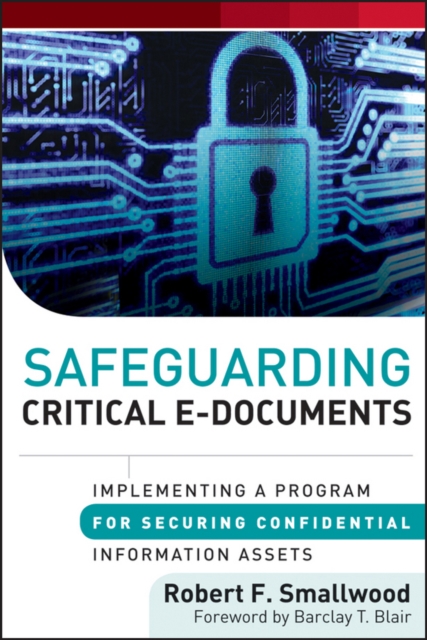
Safeguarding critical E-documents
Practical, step-by-step guidance for corporations, universities and government agencies to protect and secure confidential documents and business records Managers and public officials are looking for technology and information governance solutions to \"information leakage\" in an understandable, concise format. Safeguarding Critical E-Documents provides a road map for corporations, governments, financial services firms, hospitals, law firms, universities and other organizations to safeguard their internal electronic documents and private communications. Provides practical, step-by-step guidance on protecting sensitive and confidential documents-even if they leave the organization electronically or on portable devices Presents a blueprint for corporations, governments, financial services firms, hospitals, law firms, universities and other organizations to safeguard internal electronic documents and private communications Offers a concise format for securing your organizations from information leakage In light of the recent WikiLeaks revelations, governments and businesses have heightened awareness of the vulnerability of confidential internal documents and communications. Timely and relevant, Safeguarding Critical E-Documents shows how to keep internal documents from getting into the wrong hands and weakening your competitive position, or possible damaging your organization's reputation and leading to costly investigations.
eBook

Business continuity in a cyber world : surviving cyberattackes
\"Until recently, if it has been considered at all in the context of business continuity, cyber security may have been thought of in terms of disaster recovery and little else. Recent events have shown that cyberattacks are now an everyday occurrence, and it is becoming clear that the impact of these can have devastating effects on organizations whether large or small, public or private sector. Cybersecurity is one aspect of information security, since the impacts or consequences of a cyberattack will inevitably damage one or more of the three pillars of information security: the confidentiality, integrity or availability of an organization's information assets. The main difference between information security and cyber security is that while information security deals with all types of information assets, cyber security deals purely with those which are accessible by means of interconnected electronic net- works, including the Internet. Many responsible organizations now have robust information security, business continuity and disaster recovery programs in place, and it is not the intention of this book to re-write those, but to inform organizations about the kind of precautions they should take to stave off successful cyberattacks and how they should deal with them when they arise in order to protect the day-to-day businesses.\"--Publisher website.
Book

Cyberspace and Cybersecurity
Providing comprehensive coverage of cyberspace and cybersecurity, this textbook not only focuses on technologies but also explores human factors and organizational perspectives and emphasizes why asset identification should be the cornerstone of any information security strategy. Topics include addressing vulnerabilities, building a secure enterprise, blocking intrusions, ethical and legal issues, and business continuity. Updates include topics such as cyber risks in mobile telephony, steganography, cybersecurity as an added value, ransomware defense, review of recent cyber laws, new types of cybercrime, plus new chapters on digital currencies and encryption key management.
Vulnerabilities in Information Systems
Vulnerabilities in the Organization
Risk in Information System Infrastructure
Secure Information Systems
Cybersecurity and the CIO
Building a Secure Organization
Cyberspace Intrusions
Cyberspace Defence
Cyberspace and the Law
Cyber Warfare and Homeland Security
Digital Currencies
Dr. George K. Kostopoulos is a faculty member at the University of Maryland University College, where he serves and teaches as a faculty mentor in the master’s degree programs in cybersecurity and information assurance. Dr. Kostopoulos has an extensive international academic career, having taught in seventeen universities around the world, including Boston University, Texas A&M International University, Florida Atlantic University, the University of Heidelberg (Germany), and the American University of Sharjah (UAE). He is the author of numerous scholarly papers and two other books, \"Digital Engineering\" and \"Greece and the European Economic Community.\" Dr. Kostopoulos received his master’s and PhD degrees in electrical and computer engineering from the Arizona State University, and a master’s in economics from California State Polytechnic University. He is the founder and editor-in-chief of the Journal of Cybersecurity and Information Assurance and a reviewer of numerous scientific conferences.
eBook

Cyberspace in peace and war
\"Cyberspace in Peace and War presents a comprehensive understanding of cybersecurity, cyberwar, and cyber terrorism. From basic concepts to advanced principles, Libicki examines the sources and consequences of system compromises, addresses how cybersecurity policies can strengthen countries defenses--leaving them less susceptible to cyberattack, and explores cybersecurity in the context of military operations, highlighting unique aspects of the digital battleground and strategic uses of cyberwar. He provides the technical and geopolitical foundations of cyberwar necessary to understand the policies, operations, and strategies required for safeguarding an increasingly online infrastructure.\"--Provided by publisher.
Book
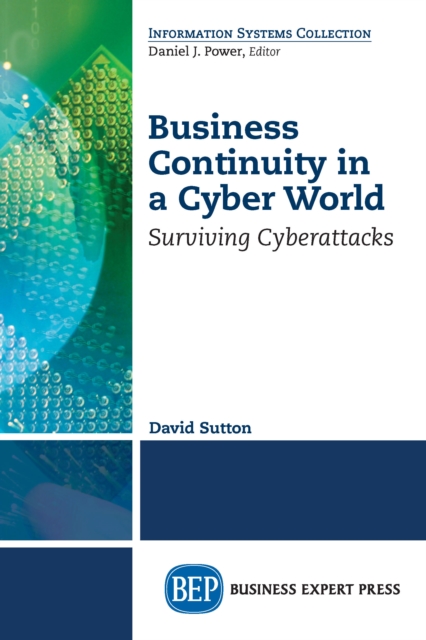
Business continuity in a cyber world
Until recently, if it has been considered at all in the context of business continuity, cybersecurity may have been thought of in terms of disaster recovery and little else. Recent events have shown that cyberattacks are now an everyday occurrence, and it is becoming clear that the impact of these can have devastating effects on organizations whether large and small, and whether in the public or the private sector. Cybersecurity is one aspect of information security, since the impacts or consequences of a cyberattack will inevitably damage one or more of the three pillars of information security: the confidentiality, integrity, or availability of an organization's information assets. The main difference between information security and cybersecurity is that while information security deals with all types of information assets, cybersecurity deals purely with those that are accessible by means of interconnected electronic networks, including the Internet. Many responsible organizations now have robust information security, business continuity, and disaster recovery programs in place, and it is not the intention of this book to rewrite those, but to inform organizations about the kind of precautions they should take to stave off successful cyberattacks and how they should deal with them when they arise in order to protect their day-to-day business.
eBook