
Catalogue Search | MBRL


Are you sure you want to remove the book from the shelf?

{{itemTitle}}
1,055
result(s) for
"Cyprus Foreign relations."
Sort by:


The United States and the Making of Modern Greece
Focusing on one of the most dramatic and controversial periods in modern Greek history and in the history of the Cold War, James Edward Miller provides the first study to employ a wide range of international archives--American, Greek, English, and French--together with foreign language publications to shed light on the role the United States played in Greece between the termination of its civil war in 1949 and Turkey's 1974 invasion of Cyprus. Miller demonstrates how U.S. officials sought, over a period of twenty-five years, to cultivate Greece as a strategic Cold War ally in order to check the spread of Soviet influence. The United States supported Greece's government through large-scale military aid, major investment of capital, and intermittent efforts to reform the political system. Miller examines the ways in which American and Greek officials cooperated in--and struggled over--the political future and the modernization of the country. Throughout, he evaluates the actions of the key figures involved, from George Papandreou and his son Andreas, to King Constantine, and from John Foster Dulles and Dwight D. Eisenhower to Richard Nixon and Henry Kissinger. Miller's engaging study offers a nuanced and well-balanced assessment of events that still influence Mediterranean politics today.
eBook
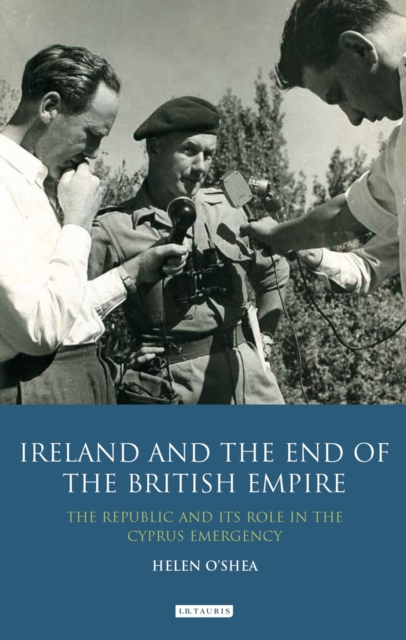
Ireland and the End of the British Empire
In 1949, Ireland left the Commonwealth and the British Empire began its long fragmentation. The relationship between the new Republic of Ireland and Britain was a complex one however, and the traditional assumption that the Republic would universally support self-determination overseas and object to 'imperialism' does not hold up to historical scrutiny. In reality, for economic and geopolitical reasons, the Republic of Ireland played an important role in supporting the Empire- demonstrated clearly in Ireland's active involvement in the Cyprus Emergency of the 1950s. As Helen O'Shea reveals, while the IRA formed immediate links with EOKA and the Cypriot rebels, the Irish government and the Irish Church supported the British line- which was to retain Cyprus as the Middle-Eastern base of the British Empire following the loss of Egypt. Ireland and the End of the British Empire challenges the received historiography of the period and constitutes a valuable addition to our understanding of Ireland and the British Empire.
eBook


Cyprus under British Colonial Rule
This is a unique book that combines a political narrative with poetry to examine the role of culture and the fusion of religion and politics during the struggle against colonialism.The context is Britain's geopolitical interests in the Middle East.
eBook

Cyprus under British colonial rule : culture, politics, and the movement toward union with Greece, 1878-1954
This study examines British rule in Cyprus from 1878 to 1954. The author analyzes the cultural and religious dimensions of Cypriot responses to British rule and the ways in which Greek Orthodox culture was a primary conduit for resistance to the colonial system.
Book

Legal Aspects of the Cyprus Problem
The book is an ideal choice for practitioners and researchers because it combines first hand information on the most recent developments on Cyprus with legal evaluations from an international official trained in international and European law.
eBook


Great Power Politics in Cyprus
This volume approaches foreign interventions in Cyprus from two different angles: a vertical angle, which corresponds to a case-by-case historical analysis of foreign interventions which have taken place throughout the modern history of Cyprus, and a horizontal angle, which corresponds to the implementation of systemic models of analysis in approaching foreign interventions in Cyprus. Furthermore, the volume deals with domestic perceptions formed as a result of foreign interventions in Cyprus.
eBook